A bilingual handoff needs the source version beside the translated task
Keep the source version, glossary and unresolved instruction beside a translated task before anyone accepts or distributes it.
A translated handoff can sound courteous and professional while changing what someone has been asked to do. Review can become approval, a tentative date can become a commitment, and an optional request can become an obligation. For an individual coordinating work across languages, the useful AI task is therefore larger than producing fluent target text. The handoff needs a traceable source and a person who can resolve an uncertain instruction.
Mozilla's current Firefox documentation describes on-device translation of supported pages and selected text, with offline use after the required language files are installed. It also provides a route back to the original. Those are product-specific processing and access statements; they do not establish translation fidelity or cover every language, platform, image or application a reader might use. No browser translation was executed for this article. [Firefox translation documentation](https://support.mozilla.org/en-US/kb/website-translation).
Choose the service and the review separately
The European Commission's AI language-tools page, updated on 30 July 2026, describes eTranslation and other task-specific services, with eligibility and access details. Its eTranslation description distinguishes submitted text or documents and selectable output styles. This is an official service description, not proof of access for every reader or certification that its output preserves a particular task. No document was submitted or external account connected here. [Commission language tools](https://commission.europa.eu/resources-partners/etranslation_en).
A local translation feature and an external document service have different data paths. Before choosing either, establish what may be processed, who is allowed to submit it and which materials need another route. A helpful workflow can begin with public or synthetic text. There is no need to discover a privacy boundary by sending a real packet of personal correspondence and investigating afterward.
The WMT24 general-translation findings, published in November 2024, describe an evaluation using professional human annotation of translation outputs across specified language pairs and domains. The authors assess outputs through an error-span protocol. This is meaningful research about those submitted systems and tests, rather than a current universal ranking or a guarantee that any translated instruction will retain its meaning. [Primary translation evaluation](https://aclanthology.org/2024.wmt-1.1/).
Preserve the instruction's moving parts
Identify the source document and version before translating. Mark the passages that contain the action, responsible person, deadline, conditions and unresolved questions. Preserve the surrounding context where a pronoun or exception changes the task. A translation request should state what the text is meant to accomplish, including its intended audience and whether it is a draft awaiting clarification.
Language and regional usage also need a clear description. The IETF language-tag specification distinguishes language, script, region and other subtags; a regional marker can identify relevant linguistic variation. Such a tag helps identify the intended form of text, while saying nothing about whether a particular translation is accurate or who may accept it. A country label is not a substitute for a reviewer's language competence. [Language identifiers](https://www.rfc-editor.org/rfc/rfc5646).
Prepare a short glossary for terms whose meaning matters to the work. Include the source term, intended sense and a place for a reviewer to record the accepted wording. The glossary should remain connected to the particular task. Reusing a familiar phrase from another project can be unhelpful when its meaning depended on different roles, documents or stages of acceptance.
Ask an assistant to flag uncertain passages and alternative interpretations rather than silently choose whichever sounds most natural. Keep that uncertainty visible for the source owner and bilingual reviewer. A useful draft may contain an unresolved term. Removing every visible question can make the handoff look complete while hiding the decision someone still needs to make.
An invented cross-language collaboration
Imagine a fictional volunteer collaboration between Barcelona and Bengaluru preparing a community exhibition. An organiser supplies a draft task in English for a colleague who prefers Spanish. The people, documents and example are invented, and no translation or message has been executed. The source asks the colleague to send a draft for review before it is distributed.
The constructed error changes the meaning into an instruction to distribute an approved copy. These English descriptions identify the difference being studied; they are not presented as authentic Spanish outputs from a named model. The worked conclusion is that the altered version skips an unresolved review stage. Its fluency would not supply the missing acceptance or authority to distribute the material.
A proposed reviewer compares the relevant source span, translated draft and intended task. They ask the organiser whether review is still required and record the answer. A second reader should be able to find that clarification without searching an entire chat history. The accepted handoff retains the specific source version and the clarified role, while the earlier ambiguous draft stays distinguishable.
Now introduce a revised source that changes the intended recipient. The previously accepted translation should not be treated as automatically approved for the new destination. Reopen the affected passages and the distribution decision. The exercise demonstrates a version-dependent review question; it does not report a measured translation error rate, successful international project or product benefit.
Use a second view carefully
A back-translation or another assistant's paraphrase can help a reviewer notice disagreement. It is still another generated representation and may preserve the same misunderstanding. Compare the actual source and intended target meaning with someone qualified to resolve the task's terms. This is a proposed review method, not a claim that a particular combination of tools supplies independent assurance.
Keep the accepted target text separate from explanatory notes. A recipient should be able to identify the actual request, while the author can retain the alternatives considered and the person who settled them. If the wording remains uncertain, send a clarification request through the ordinary authorised route rather than allowing an assistant to transform uncertainty into a stronger commitment.
For an initial personal trial, count the kinds of corrections needed: changed modality, missing condition, inconsistent term, ambiguous owner or a version mismatch. Do not judge only reading smoothness. The review record can reveal which parts of the work need a glossary or a source clarification before a different model or a larger subscription would be relevant.
The final handoff is the accepted text, its source version and the agreed next action. Translation can make cross-language work more accessible, provided the people retain a way to challenge what the draft says. No automatic send, publishing step, legal certification, employment outcome or universal saving follows from the sources or from this unperformed example.
Conceptual diagram and reading guide
The following original diagram explains the article's fictional exercise. It has not been run and adds no observed product result.
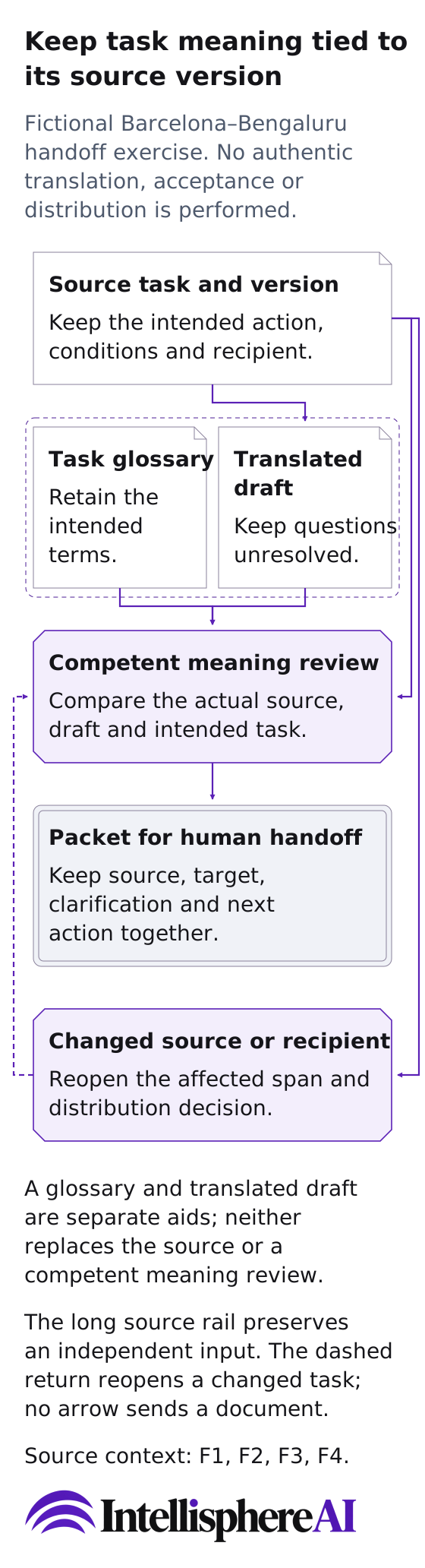
Original conceptual diagram of the fictional, unrun bilingual handoff exercise; no product action, measurement or approval is depicted.
[Open the complete diagram](/assets/personal-evidence-bilingual-version-20261016.svg)
Keep task meaning tied to its source version
Fictional Barcelona–Bengaluru handoff exercise. No authentic translation, acceptance or distribution is performed.
Source task and version
Keep the intended action, conditions and recipient.
Task glossary
Retain the intended terms.
Translated draft
Keep questions unresolved.
Competent meaning review
Compare the actual source, draft and intended task.
Packet for human handoff
Keep source, target, clarification and next action together.
Changed source or recipient
Reopen the affected span and distribution decision.
A glossary and translated draft are separate aids; neither replaces the source or a competent meaning review.
Source task and version to Translated draft: A translation draft remains tied to the exact source version.
Source task and version to Competent meaning review: The original instruction is an independent review input; a fluent draft cannot approve itself.
Task glossary to Competent meaning review: Task terms support a competent reader in settling meaning.
Translated draft to Competent meaning review: Review modality, conditions and who is being asked to do what.
Competent meaning review to Packet for human handoff: Retain the specific clarification without calling the unperformed exercise an approved real handoff.
Source task and version to Changed source or recipient: A new source version or recipient changes the basis of an earlier decision.
Changed source or recipient to Competent meaning review: Reopen affected wording before distribution rather than silently reusing an old acceptance.
The long source rail preserves an independent input. The dashed return reopens a changed task; no arrow sends a document.
No model translation, delivery, official approval or independent assurance from a second model.
The invented error changes send a draft for review into distribute an approved copy. A second generated paraphrase is not independent assurance.
Source context
These references ground the documented distinctions; the pictured routine is original editorial guidance, not a service observation.
- [F1: Firefox translations](https://support.mozilla.org/en-US/kb/website-translation) - [F2: Findings of the WMT24 General Machine Translation Shared Task: The LLM Era Is Here but MT Is Not Solved Yet](https://aclanthology.org/2024.wmt-1.1/) - [F3: AI translation and language tools](https://commission.europa.eu/resources-partners/etranslation_en) - [F4: RFC5646: Tags for Identifying Languages](https://www.rfc-editor.org/rfc/rfc5646)