A claims AI should explain the evidence gap without inventing a decision reason
A fictional property claim connects source versions, missing-information requests, reviewer authority and a practical correction route.
An insurance claim can be delayed by a missing fact, an unclear policy condition or a badly explained request for information. AI may help staff organise that material, but a polished letter does not establish that the claim was examined fairly. The useful investigation is how evidence moves from the claimant's account to a reviewed explanation without losing context or inventing a reason.
Three primary publications were checked on 15 October 2026. They provide supervisory context from international, European and Singapore sources. The workflow below is an original fictional example, not a description of a deployed insurer or a recommendation about the merits of anyone's claim.
The source context is governance, not proof of better outcomes
The [IAIS publication announcement dated 2 July 2025](https://www.iais.org/2025/07/the-iais-publishes-application-paper-on-the-supervision-of-artificial-intelligence/) describes its final application paper and topics including governance, explainability and redress. The official announcement was readable; repeat retrieval of the detailed PDF timed out. No inaccessible provision is quoted or treated as examined here.
[EIOPA's opinion page dated 6 August 2025](https://www.eiopa.europa.eu/publications/opinion-artificial-intelligence-governance-and-risk-management_en) describes a risk-based and proportionate approach addressed to national supervisors. It is not a measured claims-processing experiment. The PDF download failed during this research, so this article relies only on the scope stated in the readable official description.
[MAS's 7 October 2026 announcement](https://www.mas.gov.sg/news/media-releases/2026/mas-sets-out-supervisory-expectations-on-responsible-ai-adoption-by-financial-institutions) describes AI oversight and third-party responsibility, with phased dates in 2027 and 2028. These jurisdictions and stages remain distinct. None establishes that a language model can autonomously decide a claim or that a particular product improves customer outcomes.
The fictional case: a commercial property claim
Imagine a small business in Lyon reporting water damage under an existing policy. The insurer's staff receive the claim form, photographs, a repair estimate and a later note clarifying when the damage was discovered. The proposed assistant helps organise the packet and draft requests for genuinely missing information. A qualified claims reviewer determines what the evidence means.
Start by preserving the claimant's account rather than replacing it with a model summary. Record when each item arrived and who supplied it. Keep uncertain dates as uncertain. If the form and later note differ, the system should show both and ask the reviewer to resolve the discrepancy. Choosing whichever date fits a familiar narrative would conceal a material question.
Identify the operative policy and relevant endorsements separately. A general policy document found online is not necessarily the claimant's agreement. The assistant may retrieve approved passages from the correct version, but it must not infer cover from a generic product description. This workflow extends beyond merely explaining a policy: it connects a particular evidence packet to a reviewed request and decision record.
Missing information is not evidence of misconduct
A blurry photograph can mean the damage is hard to see; it does not prove that the claimant is deceptive. A repair estimate may omit a detail because the contractor has not inspected a concealed area. The assistant should describe the missing evidence without converting uncertainty into an accusation or a finding against the claimant.
Use a structured missing-information list that identifies why the item is relevant and whether another supplied document already answers the question. Staff should be able to remove an unnecessary request. If the system repeatedly asks for the same information, a claimant may face an avoidable burden even though every generated letter sounds courteous.
Separate documentary organisation from decisions about liability, causation or fraud. Each requires its own expertise and authority. A language model's ability to connect words across documents does not establish that it can determine the physical cause of damage from photographs or interpret every policy condition correctly.
Draft an explanation with visible evidence
An internal draft should identify the accepted facts, relevant policy passage, unresolved information and proposed next action. Link every important factual statement to the correct packet item. If the model cannot support a statement, leave it out or mark the question for review. Do not manufacture a coherent explanation to fill a template.
Before any customer communication, show the reviewer the actual wording. A staff member needs authority to revise it, reject it or refer the case. Approval should apply to the exact text and recipient, not an open-ended permission for the assistant to send follow-up requests. The initial version can remain draft-only while the team evaluates its usefulness.
| Step in the fictional claim | Useful assistant contribution | Boundary | | --- | --- | --- | | Receive material | Index documents and arrival dates | Do not rewrite the original account | | Identify a gap | Propose a specific missing item | Missing does not mean dishonest | | Prepare an explanation | Draft from accepted facts and policy version | Do not invent a decision reason | | Respond to disagreement | Assemble the review record | Keep a human correction and escalation route |
Test the customer's burden as well as staff time
Build cases with duplicate documents, late clarifications, incomplete estimates and ambiguous policy references. Ask whether the assistant requests information already present. Compare the proposed letter with a reviewed reference, including its clarity and accuracy. A shorter draft is not better if it omits the reason the customer needs another document.
Include language and accessibility review appropriate to the actual customer group. A technically correct phrase can still be difficult to understand. Test whether a reader can identify what to provide, how to supply it and how to ask a question. These are original evaluation suggestions, not results from an insurer trial conducted here.
Measure time to accepted work, reviewer corrections and unnecessary requests. Record the waiting and rework created for customers, not only the time saved at a staff workstation. Do not infer lower claims costs or universal efficiency from an attractive demonstration. A claims process should not treat lower payment as an automatic measure of AI success.
Preserve a route for correction and appeal
If a claimant challenges an explanation, staff need the original evidence and the accepted review record. Retain versions under the insurer's applicable arrangements so the team can determine whether a model used the wrong document, a person accepted an unsupported statement or new evidence changed the interpretation. These are different reasons for correction.
Provide a clear human contact path when the automated route cannot explain a request. Do not force the customer into an endless conversation with the same assistant whose wording they are disputing. A service interruption should preserve the packet and outstanding questions rather than start a fresh claim or repeatedly demand the same attachments.
Skills and the future of claims work
Claims staff contribute document judgment, policy context and sensitivity to a claimant's circumstances. Engineers can make evidence links, version controls and authority limits visible. Language specialists and accessibility reviewers can identify confusing explanations. These contributions need to affect the process, rather than exist only in a policy statement.
A student can create a fictional claim with a deliberately ambiguous date and two policy versions. Demonstrate a proposed missing-information request, then show a reviewer correcting it because the answer was already supplied. This teaches evidence organisation and respectful communication without handling actual claimant data or making a legal determination.
The workforce question is how routine organisation changes the time available for careful investigation and explanation. New review tasks may accompany any reduction in repetitive drafting. None of the cited supervisory sources establishes a particular headcount change. Managers should evaluate the work and learning opportunities before drawing such conclusions.
What to watch for next
Useful public evidence would describe accepted outcomes, error patterns, customer burden and the ability to correct a decision. Governance publications help frame those questions; they do not substitute for the answers. This is educational analysis of claims-review design, without promoting an insurer, deciding policy coverage or offering insurance or legal advice.
Workflow diagram and readable guide
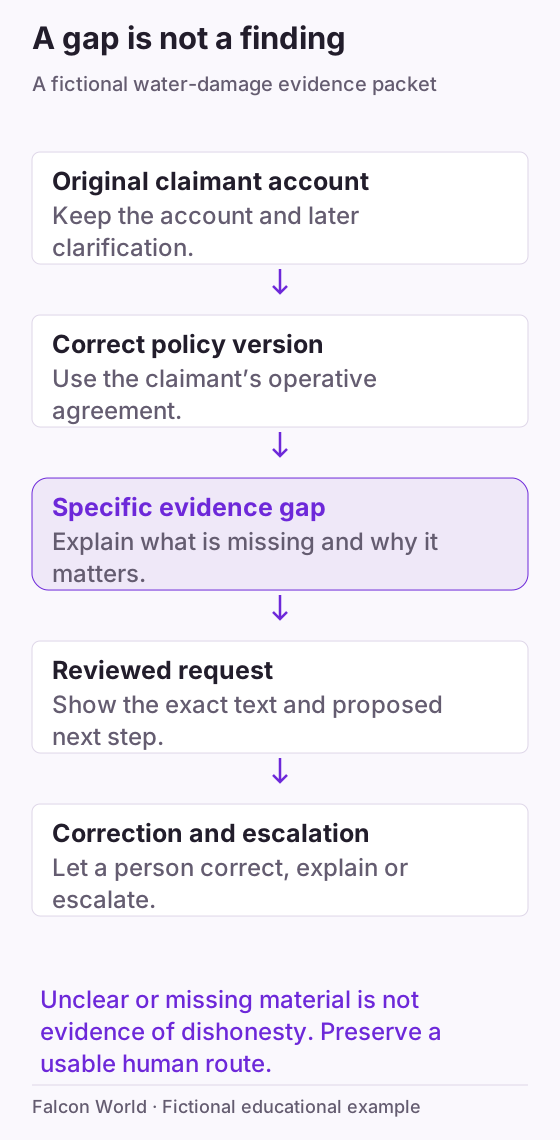
Original diagram of a fictional worked example; not a regulator-issued checklist, compliance certification or actual deployment.
[Open the complete workflow diagram](/assets/financial-workflow-insurance-claims-20261015.svg)
Read the diagram
**A gap is not a finding**
A fictional water-damage evidence packet
1. **Original claimant account.** Keep the account and later clarification.
2. **Correct policy version.** Use the claimant’s operative agreement.
3. **Specific evidence gap.** Explain what is missing and why it matters.
4. **Reviewed request.** Show the exact text and proposed next step.
5. **Correction and escalation.**
**Boundary to retain.** Specific evidence gap Explain what is missing and why it matters. Reviewed request Show the exact text and proposed next step. Correction and escalation Let a person correct, explain or escalate. Unclear or missing material is not evidence of dishonesty. Preserve a usable human route.
*Falcon World · Fictional educational example*