A court transcript and a draft judgment meet different EU AI questions
Current Commission examples and the amended timetable separate technical recording, judicial evaluation and a different ethical framework.
Two systems can process the same hearing while doing very different work. One converts speech into searchable text. Another selects what it considers important, connects it to legal authorities and proposes reasoning for a decision. Calling both court AI conceals the distinction that matters to their intended use.
The European Commission's current implementation material makes that boundary unusually concrete. It sits alongside an amended application timetable and a separate Council of Europe ethical framework. Reading them together requires care: legislation, official explanatory examples and an ethical charter have different roles, and the institutions behind them are not interchangeable.
Start with the specified judicial use
The Commission's [AI Act Service Desk reproduction of Annex III](https://ai-act-service-desk.ec.europa.eu/en/ai-act/annex-3) includes systems intended to assist a judicial authority, or operate on its behalf, with researching and interpreting facts and law and applying law to concrete facts. It also covers similar use in alternative dispute resolution.
This is more specific than a product carrying a legal label. Classification requires attention to the relevant intended purpose, functions and applicable provisions. The annex should not become a claim that every tool used by a lawyer has the same classification, or that a task outside this particular use case is free of other legal responsibilities.
Official examples distinguish recording from evaluation
The [Service Desk's justice-use examples](https://ai-act-service-desk.ec.europa.eu/en/administration-justice-and-democratic-processes) distinguish technical transcription from systems that assist substantive judicial evaluation. They explain that merely placing a transcript in a case file does not, by itself, give it the intended purpose described in point 8(a). Further summarising, selecting arguments or making relevant recommendations can change the assessment.
These are official explanatory examples, checked on 15 October 2026. They are not a court judgment deciding a particular supplier's status. Their value is showing why a team must examine what its combined system does, rather than decide classification from a microphone, a model name or a single isolated component.
The application timetable changed in July 2026
The Commission's [27 July 2026 Omnibus announcement](https://digital-strategy.ec.europa.eu/en/news/ai-omnibus-enters-force), updated on 31 July, reports entry into force that day. The change is Regulation (EU) 2026/1744. Its amended dates for Chapter III, Sections 1, 2 and 3, except Article 6(5), are 2 December 2027 for the Article 6(2)/Annex III category and 2 August 2028 for the Article 6(1)/Annex I category. Separate transitional arrangements require their own check. The earlier package was proposed on 19 November 2025.
As checked on 15 October 2026, this is an enacted amendment described by the Commission, not merely a pending proposal. Entry into force and the future application of particular rules remain separate dates. It would be equally misleading to retain an obsolete timetable or suggest that every AI-related responsibility has been postponed.
An ethical framework comes from a different institution
The [CEPEJ European Ethical Charter overview](https://www.coe.int/en/web/cepej/cepej-european-ethical-charter-on-the-use-of-artificial-intelligence-ai-in-judicial-systems-and-their-environment) records adoption in December 2018. It addresses fundamental rights; non-discrimination; quality/security; transparency, impartiality and fairness; and user control. CEPEJ belongs to the Council of Europe, which is distinct from the European Union.
The charter is an ethical framework, not another application date for the EU AI Act or a certificate for a product. Its relevance here is that a narrow classification question does not exhaust the questions a justice institution should ask about the quality and consequences of a system.
A fictional court-technology workshop
Imagine a fictional team of adult researchers, translators and court-technology staff in Brussels examining an invented hearing. They have a short licensed recording created for training, a reference transcript and a mock dispute with no real parties. No actual evidence is uploaded or decision made.
The team defines three proposed tools before discussing their labels. The first returns words and timestamps. The second extracts the parties' main arguments. The third recommends which argument should prevail and proposes legal reasoning. These are fictional specifications designed to expose changes in function; they are not classifications of real products.
Make the functional change visible
| Fictional version | Proposed output | Question introduced by the change | | --- | --- | --- | | Recording assistant | Transcript and source timestamps | Does the text preserve the recording? | | Argument organiser | Selected claims and summaries | What was omitted or interpreted? | | Decision assistant | Recommended reasoning and outcome | How does it influence the judicial task? | | Combined package | All three outputs in one interface | What does the system do as a whole? |
This original table is a discussion aid, not legal advice or an official classification matrix. A real assessment would need the actual system, the relevant law and appropriate expertise. Labelling a module administrative does not settle the purpose of the combined package.
A human review button does not describe the whole process
In the workshop, each version has a review control. That shared feature does not make their outputs equivalent. Reviewing whether a word was heard correctly involves a different judgment from checking whether an argument was fairly selected or proposed reasoning follows from the record.
The team therefore asks what the reviewer can inspect. A source timestamp can help locate a disputed word. A summary needs a way to examine the material it omitted. A recommendation needs an explanation of its inputs and limitations. These are proposed design questions, not a claim that one interface feature discharges a regulatory obligation.
Review also has practical conditions. If the original record is difficult to reach, the visible approval step may tell little about what was examined. A credible evaluation of an implementation would investigate the actual process and the people using it, rather than count approvals as proof of meaningful oversight.
Preserve uncertainty when the system changes
The fictional team adds automatic argument selection to its transcription prototype. It records the change and revisits its earlier description. That prevents a system evaluated for recording from quietly becoming a system relied upon for interpretation without acknowledging the new function.
An interruption test checks whether the interface marks incomplete processing honestly. The source material and saved draft remain available, while the system explains what has not been produced or reviewed. No status message claims that a legal decision has been completed. This is a local design proposal, not observed behaviour in a deployed court.
What the boundary means for legal work
For developers, the central task is a precise account of purpose, combined functions and changes. For justice professionals, it is understanding what work an output performs before relying on it. For the public, a clear explanation can distinguish help accessing the record from assistance influencing its interpretation.
The sources do not prove that a particular system is fair, accurate or legally compliant. They do not establish a universal checklist for courts or private practices. The useful development is a more specific way to ask the question, attached to a verified current timetable. This is general educational reporting checked on 15 October 2026; individual classification and deployment decisions require appropriate legal and technical assessment.
Evidence diagram and readable guide
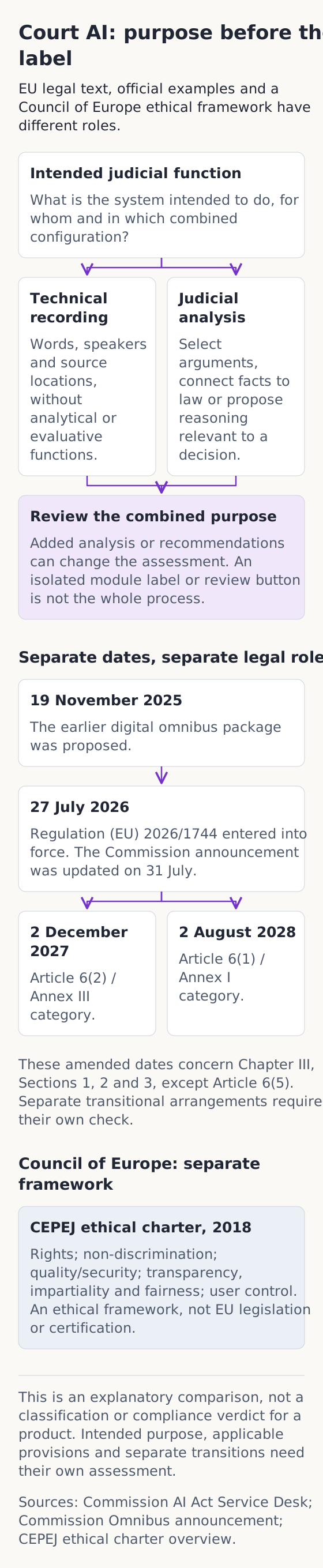
A functional comparison separates technical recording from judicial analysis, alongside precisely qualified EU dates and a separate CEPEJ ethical framework.
[Open the complete evidence diagram](/assets/legal-workflow-eu-justice-boundaries-20261015.svg)
Read the diagram
**Court AI: purpose before the label**
EU legal text, official examples and a Council of Europe ethical framework have different roles.
- **Intended judicial function.** What is the system intended to do, for whom and in which combined configuration?
- **Technical recording.** Words, speakers and source locations, without analytical or evaluative functions.
- **Judicial analysis.** Select arguments, connect facts to law or propose reasoning relevant to a decision.
- **Review the combined purpose.** Added analysis or recommendations can change the assessment. An isolated module label or review button is not the whole process.
Separate dates, separate legal roles
- **19 November 2025.** The earlier digital omnibus package was proposed.
- **27 July 2026.** Regulation (EU) 2026/1744 entered into force. The Commission announcement was updated on 31 July.
- **2 December 2027.** Article 6(2) / Annex III category.
- **2 August 2028.** Article 6(1) / Annex I category.
These amended dates concern Chapter III, Sections 1, 2 and 3, except Article 6(5). Separate transitional arrangements require their own check.
Council of Europe: separate framework
- **CEPEJ ethical charter, 2018.** Rights; non-discrimination; quality/security; transparency, impartiality and fairness; user control. An ethical framework, not EU legislation or certification.
**Reading the evidence.** This is an explanatory comparison, not a classification or compliance verdict for a product. Intended purpose, applicable provisions and separate transitions need their own assessment.
*Sources: Commission AI Act Service Desk; Commission Omnibus announcement; CEPEJ ethical charter overview.*
**Keep the comparisons separate.** Different functions; being used in court does not make their purpose identical. Different high-risk categories and application dates.