A cross-time-zone calendar proposal needs more than a correct-looking hour
Clarify local dates, recurrence and notification before a polished proposal becomes a calendar change.
An assistant can turn a scattered conversation into a tidy event description while leaving the most important question unresolved: when, exactly, are the people expected to meet? A city name, a clock reading and a recurring appointment describe different parts of that answer. The useful personal-productivity task is to prepare an event that someone can inspect before it changes a calendar or reaches another person.
Google's current Gemini help for computers describes creating, finding and editing calendar events through connected calendar apps. It warns that responses can be wrong or outdated. The page distinguishes an event action from its confirmation and notes that some consequences of editing cannot be undone. These are documented capabilities and qualifications, checked on 16 October 2026; no account, calendar or invitation was used for this article. [Gemini calendar help](https://support.google.com/gemini/answer/15305236?co=GENIE.Platform%3DDesktop&hl=en).
Give the proposed event a precise meaning
Google Calendar's developer guide distinguishes timed events from all-day dates, and individual occurrences from recurring series. It describes a calendar's default time zone separately from an event's time zone, using IANA identifiers. Those distinctions explain why copying a plausible display string is insufficient: the application may interpret an omitted field through a calendar default. Reading the guide does not require connecting an application or granting it calendar access. [Calendar concepts](https://developers.google.com/workspace/calendar/api/concepts/events-calendars).
IANA's Time Zone Database represents historical local-time rules and is updated as political decisions change boundaries, offsets and daylight-saving arrangements. An offset copied from an earlier message is therefore a weak substitute for a location-based rule and the intended date. The database is maintained for software implementation; the source does not certify that a particular installed calendar has received every update. [IANA time-zone record](https://www.iana.org/time-zones).
The iCalendar specification makes another distinction: a local date-time without a time-zone reference can be a floating time, intended to retain the same clock reading wherever it is interpreted. A shared meeting usually needs a fixed instant instead. This is a calendar-format distinction, not a claim that every assistant exposes the same controls or that users should hand-edit event files. [iCalendar time semantics](https://www.rfc-editor.org/rfc/rfc5545).
Prepare a small review packet
Before asking for an event, collect the source message, proposed date, duration, named location or time zone, intended calendar and recurrence wording. Keep unresolved fields visibly unresolved. If the message says next Tuesday, record whose current date and location give that phrase meaning. If it mentions a city, establish whether that city identifies the meeting venue, the organiser's local clock or simply the sender's office.
An assistant can help extract that packet and highlight missing information. Give it a preparation task such as identifying ambiguous dates and drafting questions for the organiser. A result that invents a time zone to complete every field should be rejected. The user can settle the uncertainty in ordinary language before any application receives an instruction to create an event.
Then render the proposal in the participants' chosen zones, including their local calendar dates. Keep the original organiser wording beside the rendered interpretation. A person reviewing the packet should be able to explain what changed during conversion. If the intended calendar differs from the account's default, that choice belongs in the review rather than remaining an invisible convenience.
Recurrence needs a separate sentence. Does the meeting keep the organiser's local hour as seasons change, or keep the same instant relative to another location? A single successful conversion cannot answer that policy question. Ask the organiser which convention matters, then inspect a later occurrence as well as the first. The review should preserve the convention, not merely today's displayed offset.
An invented scheduling exchange
Imagine a fictional community-design project with colleagues in London, Bengaluru and São Paulo. A message proposes a short review next Tuesday morning and says that the London participant will organise it. The example is unperformed: no real calendar, availability or time conversion is being reported. Its purpose is to show which information a proposed event still needs.
The assistant's first useful output would identify that morning has no shared meaning across the group. It could draft a clarification asking for the organiser's intended local hour, the actual date, duration and recurrence choice. The packet should say that availability has not been checked. A gap in the supplied conversation is not evidence that everyone has an empty calendar.
After the fictional organiser supplies those fields, a reviewer compares the original wording with the proposed local dates in each location. The worked conclusion is that the first ambiguous message never authorised a particular instant. The clarification supplied new information; the assistant did not recover an answer already hidden in the earlier text. Keep both versions so a later reader can understand that difference.
Now change only the recurrence instruction. A proposal that was adequate for an individual meeting may become incomplete for a series. The group should record the newly chosen convention and review the revised proposal again. Nothing in this exercise demonstrates that a named calendar product converted a date correctly or that a specific regional clock rule was independently tested here.
Separate preparation, creation and notification
The final human decision should identify the calendar and event being changed, the accepted time interpretation and whether any notification can result. Asking an assistant to draft an event description is a different instruction from asking it to create the event. Likewise, an event appearing on one's own calendar is not proof that another person received or accepted an invitation.
After an authorised action in a real workflow, inspect the actual event rather than relying only on conversational confirmation. Compare the date, zone, duration, calendar and recurrence. If an outcome is unclear, reopen the existing event or operation history before creating another. A repeated request can otherwise leave duplicate appointments that look individually reasonable and are difficult to reconcile later.
Sharing the review packet also needs restraint. An assistant does not need an entire private calendar to interpret a supplied event request. Start with the smallest permitted material and keep unrelated appointments out of the draft. Public product documentation describes features; it does not grant access to another person's schedule or settle an employer's rules about connected applications.
For a personal trial, record the questions that required clarification and the corrections needed before acceptance. Counting generated event descriptions would reward speed while ignoring those decisions. A useful outcome is a proposal whose interpretation the participants can explain, with an explicit boundary around everything still unconfirmed. The calendar remains a record of agreed time rather than a polished guess.
Conceptual diagram and reading guide
The following original diagram explains the article's fictional exercise. It has not been run and adds no observed product result.
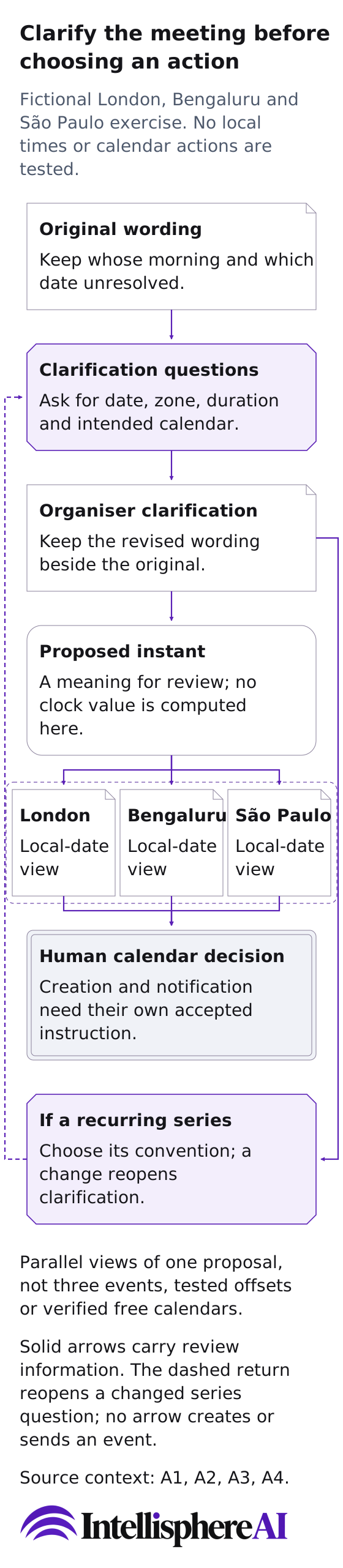
Original conceptual diagram of the fictional, unrun multicity scheduling exercise; no product action, measurement or approval is depicted.
[Open the complete diagram](/assets/personal-evidence-calendar-meaning-20261016.svg)
Clarify the meeting before choosing an action
Fictional London, Bengaluru and São Paulo exercise. No local times or calendar actions are tested.
Original wording
Keep whose morning and which date unresolved.
Clarification questions
Ask for date, zone, duration and intended calendar.
Organiser clarification
Keep the revised wording beside the original.
Proposed instant
A meaning for review; no clock value is computed here.
London
Local-date view
Bengaluru
Local-date view
São Paulo
Local-date view
Human calendar decision
Creation and notification need their own accepted instruction.
If a recurring series
Choose its convention; a change reopens clarification.
Parallel views of one proposal, not three events, tested offsets or verified free calendars.
Original wording to Clarification questions: An ambiguous request supplies questions, not an authorised instant.
Clarification questions to Organiser clarification: The organiser supplies the missing meaning; the assistant does not invent it.
Organiser clarification to Proposed instant: Keep the interpretation connected to the revised source wording.
Proposed instant to London: Show the proposed meaning in London's local date for review, without supplying a real conversion.
Proposed instant to Bengaluru: Show the same proposed meaning in Bengaluru's local date for review.
Proposed instant to São Paulo: Show the same proposed meaning in São Paulo's local date for review.
London to Human calendar decision: One local-date view is an input to the human review, not availability proof.
Bengaluru to Human calendar decision: Retain this participant's local calendar date in the review.
São Paulo to Human calendar decision: Retain this participant's local calendar date in the review.
Organiser clarification to If a recurring series: Only a recurring proposal needs the separate series convention.
If a recurring series to Clarification questions: Changed recurrence meaning requires clarification again, not an automatic repeat action.
Solid arrows carry review information. The dashed return reopens a changed series question; no arrow creates or sends an event.
Conceptual unrun workflow; no real offsets, calendar integration or notification implied.
The original morning request remains ambiguous until the fictional organiser clarifies it. These cards show review roles, not calculated hours.
Source context
These references ground the documented distinctions; the pictured routine is original editorial guidance, not a service observation.
- [A1: Create & manage your calendar events with Gemini Apps](https://support.google.com/gemini/answer/15305236?co=GENIE.Platform%3DDesktop&hl=en) - [A2: Calendars and events](https://developers.google.com/workspace/calendar/api/concepts/events-calendars) - [A3: Time Zones](https://www.iana.org/time-zones) - [A4: RFC5545: Internet Calendaring and Scheduling Core Object Specification (iCalendar)](https://www.rfc-editor.org/rfc/rfc5545)