A defence AI contract should leave behind a usable lesson
A 2026 US audit and public guidance from Singapore, Japan and the UK show why an AI buying decision should preserve evidence that the next team can inspect.
A procurement team can finish an AI pilot with a working demonstration and very little that the next buyer can reuse. The important decisions may be scattered across meeting notes: why a service was preferred to a software product, which information the supplier could provide, and what happened when the test questions changed. Without that history, another team can repeat the same investigation while believing it is starting from an established success.
This is an administrative problem with technical consequences. A contract describes a relationship that continues after the first demonstration. The supplier may change a model, the customer may change its documents, and an evaluator may discover that a previously convenient measure did not represent the intended task. Preserving the reasons for those choices makes future procurement more intelligible. It does not guarantee that a particular contract is lawful, economical or suitable.
An audit asks what the next buyer can learn
The US Government Accountability Office’s [13 April 2026 AI acquisition report](https://www.gao.gov/products/gao-26-107859) reviewed thirteen acquisitions at four federal agencies, including the Department of Defense. It distinguished agency-directed and vendor-driven approaches, contracts and other agreements, and AI supplied as a service or product. The audit found that selected agencies were not systematically collecting lessons learned. Its recommendations were shown as open when checked on 15 October 2026; that status is a later observation, separate from publication.
Singapore’s [DSTA procurement explanation](https://www.dsta.gov.sg/collaborate-with-us/doing-business-with-mindef) describes a different institutional arrangement. MINDEF and the Singapore Armed Forces generally define needs and seek approval; DSTA handles procurement activities including sourcing, evaluation and contracting. This is a public description of responsibilities, not a promise that a specific AI proposal has passed evaluation. Its page does not establish an original publication day, so this article does not assign one.
Japan’s Ministry of Defense publishes an English [guideline for responsible AI application in research and development](https://www.mod.go.jp/atla/soubiseisaku/ai_guideline/ai_guideline_ver.01_eng_202506.pdf), explicitly marked a provisional translation for reference. It distinguishes legal/policy review from technical review and describes continuing confirmation at relevant development milestones. That distinction helps explain why a technically convincing demonstration cannot settle every procurement question. The document’s filename contains a month marker; an exact publication day was not established here and remains unknown.
The UK’s [Defence AI Playbook landing page](https://www.gov.uk/government/publications/defence-artificial-intelligence-ai-playbook), published on 1 February 2024, says its case studies include applications already in use and others under development. Those stages should not be flattened into a list of proven deployments. A useful procurement lesson records what was actually investigated and what remained a proposal, even when both appear in an official publication.
A fictional archive-service purchase
Consider a fictional adult team procuring a reference assistant for a defence-history reading room in Ottawa. It would search approved public manuals and help staff locate passages. No real institution, supplier or procurement is represented. The exercise excludes operational documents, personnel files and decisions about force. Its value lies in examining ordinary buying questions without using sensitive information as a shortcut to realism.
The team begins with a need it can explain: a reader should find the correct edition and supporting passage. It separates that need from a supplier’s preferred interface. A fluent answer is not automatically useful if it cites a withdrawn edition. Conversely, a modest search result may satisfy the task when it leads the reader to a reliable passage. Writing the task clearly gives the procurement record a stable reference point.
Next, the team records the alternatives considered. A maintained index, ordinary search and an AI-assisted service might all be candidates. The record explains why each is included and which burdens it creates. For an ongoing service, the team asks how changes are announced and how earlier test evidence can be revisited. For a product, it asks who maintains the document collection and the associated evaluation. These are questions for the exercise, not universal contract clauses.
Keep the disagreement, not just the decision
Suppose one evaluator prefers the supplier’s polished summaries while another notices that edition identifiers are missing. The lesson should preserve that disagreement and its resolution. A final score without the underlying question would tell a future buyer little. The team could retain a small synthetic example showing why a correct edition matters and how the comparison was changed to reflect it.
The same discipline applies to information the supplier cannot provide. The record should distinguish a missing artifact from an artifact reviewed and found adequate. It should also state whether an explanation came from the supplier or from an independent inspection. Repeating a statement in an acceptance document does not change its evidence type. A later team needs to know which parts it can inspect and which remain assertions.
A worked procurement note might therefore contain the intended task, candidate approach, test boundary, unresolved questions and reason for the next decision. It can attach public reference identities without reproducing a supplier’s confidential material. Sensitive commercial or security information belongs under the appropriate access arrangements. A useful institutional lesson need not be a public dump of every document involved in a purchase.
Treat a changed service as a changed question
Imagine that the fictional supplier later updates its retrieval component. The reading room should be able to identify which earlier evidence is still relevant. A formatting change may require a different review from a change to document selection. The procurement record can define how the team will classify changes and decide what comparison is needed. It should not declare every update harmless or demand an identical review regardless of its effect.
Exit planning is similarly practical. If the service ends, the institution still needs its approved document index, annotations and evaluation history in a usable form. Whether particular material can be retained or transferred depends on actual terms and applicable law. The editorial recommendation is to investigate that dependency before it becomes urgent, with the responsible procurement and legal specialists, rather than treating an export button as proof of sufficient rights.
What a lesson can honestly promise
A good lesson may prevent a future team from misunderstanding an earlier trial. It can show why a comparison changed, which requirement was difficult to express and which unresolved issue affected the decision. Those are useful outcomes without a claim of measured savings. This fictional purchase supplies no price comparison, delivery result or certification.
The GAO audit, DSTA’s institutional description, Japan’s development guideline and the UK playbook are different kinds of primary evidence. Together they support a careful habit: leave the next buyer an account of the investigation, not merely a success label. The contract’s institutional value includes what people can learn after the demonstration has ended.
Evidence diagram and readable guide
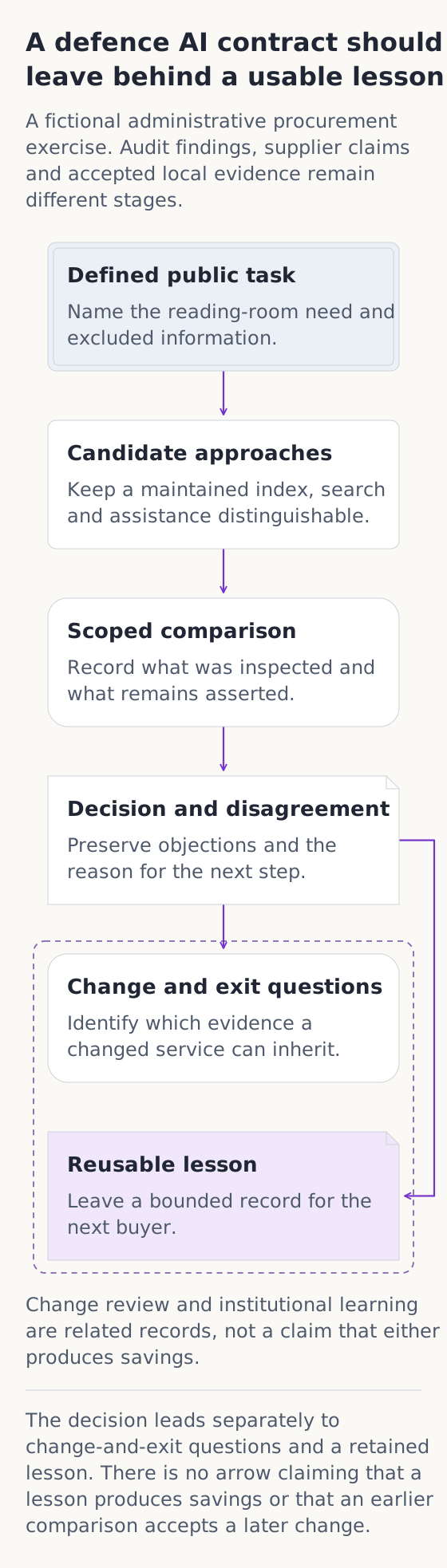
Original explanatory diagram: a fictional public-reference purchase retains its comparison, disagreement and change questions as separate records.
[Open the complete evidence diagram](/assets/defence-workflow-procurement-learning-20261015.svg)
Read the diagram
**A defence AI contract should leave behind a usable lesson**
A fictional administrative procurement exercise. Audit findings, supplier claims and accepted local evidence remain different stages.
- **Defined public task** Name the reading-room need and excluded information.
- **Candidate approaches** Keep a maintained index, search and assistance distinguishable.
- **Scoped comparison** Record what was inspected and what remains asserted.
- **Decision and disagreement** Preserve objections and the reason for the next step.
- **Change and exit questions** Identify which evidence a changed service can inherit.
- **Reusable lesson** Leave a bounded record for the next buyer.
Change review and institutional learning are related records, not a claim that either produces savings.
How the connections work
- The defined public task sets the scope for comparing candidate approaches.
- Candidate approaches are examined in a scoped comparison.
- Comparison evidence informs the decision and preserves disagreement.
- The decision identifies questions about later changes and exit.
- The decision is retained as a bounded lesson for the next buyer.
Relationship key
The decision leads separately to change-and-exit questions and a retained lesson. There is no arrow claiming that a lesson produces savings or that an earlier comparison accepts a later change.