A multilingual transcript is only the first draft of an accessible lesson
Current speech-model documentation, AfriSpeech research and UNESCO guidance explain why language support, accurate transcripts and learning access are different achievements.
A lesson can be technically available and still be hard to follow. A learner may encounter an unfamiliar language, an accent the caption system handles poorly or a subject term transcribed as an ordinary word. AI speech recognition offers a concrete way to reduce some of these barriers, but a language menu cannot establish educational access on its own.
Current multilingual transcription systems, African-accent speech research and UNESCO's language-in-education guidance reveal three different parts of the problem. The technology processes sound; evaluation shows which speech it represents; teaching determines whether the resulting material helps someone understand a lesson. These stages need to remain connected without being confused.
What the current transcription documentation says
Google's [Chirp 3 transcription documentation](https://docs.cloud.google.com/speech-to-text/v2/docs/chirp_3-model) describes multilingual speech recognition, automatic language detection and speaker diarisation. The documentation lists language and feature availability separately, with some entries generally available and others in preview. Supported methods do not necessarily have identical language coverage.
Those are provider-documented capabilities, not independent findings about classroom learning. Speech recognition turns audio into text. Speaker diarisation associates speech segments with speakers. Neither automatically provides a faithful translation, a pedagogically appropriate simplification or a complete accessibility service. This article did not call the service or test a recording.
AfriSpeech makes accent coverage tangible
The [AfriSpeech-200 paper](https://aclanthology.org/2023.tacl-1.93/) reports a dataset of 200 hours of Pan-African English speech, with 2,463 speakers and 120 accents across 13 countries. Published in 2023, it addresses clinical and general-domain speech recognition. It is historical research included to clarify an enduring evaluation problem, not a new 2026 classroom trial.
Its accents are not 120 separate languages. Nor is a clinical and general-domain dataset automatically representative of noisy school discussion. The research gives evaluators something more concrete than a claim of support for English: whose English, under which recording and vocabulary conditions, and compared with which reference transcript?
UNESCO frames the language question educationally
[UNESCO's Languages matter guidance](https://www.unesco.org/en/articles/languages-matter-global-guidance-multilingual-education) was published on 29 January 2025; its landing page records an update on 22 July 2026. It presents multilingualism as an educational approach and emphasises learning in languages people understand.
The guidance is not a test of Chirp 3 or AfriSpeech. Its role here is to keep the objective wider than a software feature. A transcript can be accurate in one language while remaining difficult for a learner who is studying through another. Translation quality, subject meaning and access to the underlying lesson require separate attention.
Three evidence stages, three questions
| Stage | Useful question | Evidence still needed | | --- | --- | --- | | Provider documentation | Is this language and feature combination supported? | Actual behaviour on the intended audio | | Speech benchmark | Which voices and domains were evaluated? | Classroom and learner relevance | | Educational use | Does the material preserve meaning and support participation? | Learner testing and qualified review |
The table does not assign a comparative accuracy score. The sources do not provide a shared classroom benchmark or demonstrate that adding automated captions improves attainment for every learner. That gap is part of the story, not a reason to conceal the technology's narrower capability.
A fictional bilingual lesson-preparation task
Imagine a fictional adult teacher-training group in Nairobi preparing a short public lesson about plant growth. An educator records an invented example in English and prepares a separate reviewed explanation in Kiswahili. This is an illustrative workflow, not a reported local installation or a claim that a specific model supports every desired feature.
The group begins with a reference transcript written by the speaker. It includes several scientific terms and one deliberately ambiguous sentence. Trainees compare a mock automatic transcript with that reference, then inspect whether the mistakes change the lesson's meaning. No child is recorded or asked to open a service account.
Count consequential errors separately
Not every missing word has the same educational consequence. An omitted hesitation may matter little to the concept. A dropped negation or incorrect unit can reverse an explanation. The fictional group therefore records both textual differences and changes that affect the learner's interpretation.
An overall word-error rate can be useful for speech research while remaining insufficient for judging a particular worksheet. The proposed review asks whether important terms, relationships and speaker changes survive. It does not create a new published performance measure or assert a result for the provider.
The team also keeps an unclear segment visibly unresolved. A polished sentence invented to fill a gap would be worse than a clear request for review. If the recording cannot be processed, the interface should preserve the draft and say that transcription is unavailable rather than present an empty transcript as complete.
Translation needs its own reference
The English reference transcript cannot validate the Kiswahili explanation by itself. A qualified reviewer needs to examine whether the subject meaning survives and whether the language is appropriate for the audience. A fluent back-translation can be informative without proving that the original translation is good.
The fictional teacher asks learners to explain the main relationship using the reviewed material. That can reveal whether a term is unfamiliar or the explanation relies on background knowledge they do not share. This is a proposed usability exercise; the cited speech records do not measure its effect.
Language and disability should also not be collapsed into one category. Captions may help some learners while leaving other access needs unresolved. A transcript does not substitute for every form of interpretation, assistive technology or human support. The appropriate arrangement depends on the person and task.
Classroom sound is a different test environment
A clear individual recording differs from a room with several people speaking, movement and overlapping discussion. Evaluators should describe the audio conditions and identify which outputs were reviewed. A model's documented language availability cannot answer whether it can reliably distinguish a quiet question from background conversation in that room.
Recording a class also changes the privacy question. Students can disclose personal information incidentally. Any real school use, especially involving children, needs the institution's approved arrangements and a justified recording boundary. A training exercise can avoid that issue by using public, licensed or deliberately invented audio.
The work is in the handoff
Developers can make uncertainty, language status and review history visible. Teachers can identify terms that matter to the concept. Language specialists and accessibility practitioners can assess meaning and participation in ways a generic benchmark does not capture. None of these roles is made unnecessary by a larger supported-language list.
Students can learn to distinguish transcription, translation and explanation, then inspect a small example of each. The next convincing evidence would connect documented capabilities with independently tested classroom material and learner experience in specified languages. This is educational, non-promotional reporting checked on 15 October 2026, not a recommendation to record children or a claim of universal accessibility compliance.
Evidence diagram and readable guide
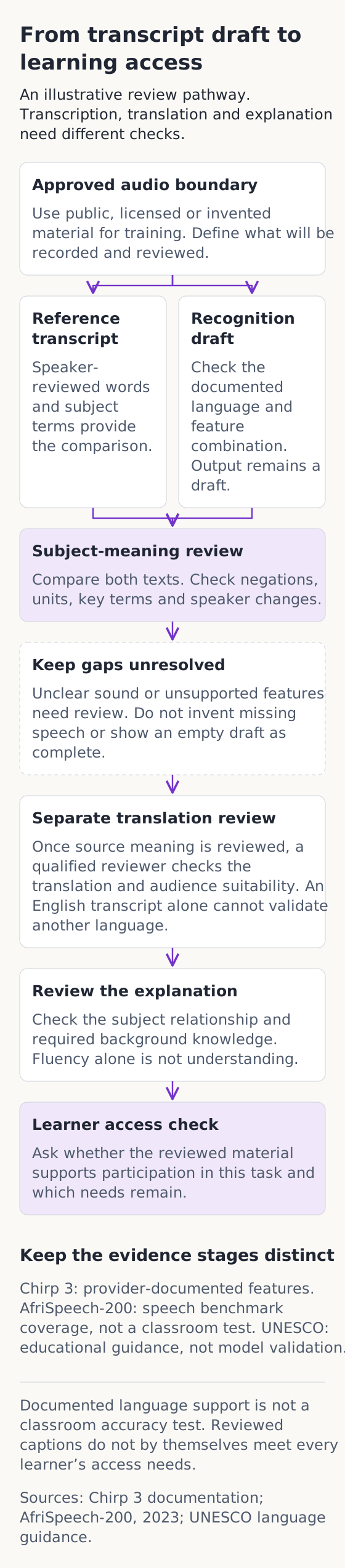
A reviewed audio workflow separates speech recognition, subject meaning, translation and learner access without claiming universal accuracy or accessibility.
[Open the complete evidence diagram](/assets/education-workflow-multilingual-captions-20261015.svg)
Read the diagram
**From transcript draft to learning access**
An illustrative review pathway. Transcription, translation and explanation need different checks.
- **Approved audio boundary.** Use public, licensed or invented material for training. Define what will be recorded and reviewed.
- **Reference transcript.** Speaker-reviewed words and subject terms provide the comparison.
- **Recognition draft.** Check the documented language and feature combination. Output remains a draft.
- **Subject-meaning review.** Compare both texts. Check negations, units, key terms and speaker changes.
- **Keep gaps unresolved.** Unclear sound or unsupported features need review. Do not invent missing speech or show an empty draft as complete.
- **Separate translation review.** Once source meaning is reviewed, a qualified reviewer checks the translation and audience suitability. An English transcript alone cannot validate another language.
- **Review the explanation.** Check the subject relationship and required background knowledge. Fluency alone is not understanding.
- **Learner access check.** Ask whether the reviewed material supports participation in this task and which needs remain.
Keep the evidence stages distinct
Chirp 3: provider-documented features. AfriSpeech-200: speech benchmark coverage, not a classroom test. UNESCO: educational guidance, not model validation.
**Reading the evidence.** Documented language support is not a classroom accuracy test. Reviewed captions do not by themselves meet every learner’s access needs.
*Sources: Chirp 3 documentation; AfriSpeech-200, 2023; UNESCO language guidance.*
**Keep the comparisons separate.** Reference and generated text are compared, not treated as equivalent.