A privacy review should follow an AI conversation through its whole journey
An AI conversation rarely stays inside the chat window. A question can enter a retrieval system, be sent to a model service, appear in an operational log and become part of an evaluation dataset. A privacy notice written only around the visible interface can miss those later uses. The practical star
An AI conversation rarely stays inside the chat window. A question can enter a retrieval system, be sent to a model service, appear in an operational log and become part of an evaluation dataset. A privacy notice written only around the visible interface can miss those later uses. The practical starting point is to trace what happens to the information, who determines each purpose and how a person’s request can reach the relevant records.
Imagine a fictional adult student, Arjun, building an enterprise help assistant with a small team. For a classroom demonstration they use synthetic employee questions and invented personnel documents. The exercise becomes interesting when the team considers a real organisation: a harmless-looking question about leave can reveal health, family or employment circumstances. The team needs a map of processing activities before it decides which documents may be uploaded or which service configuration is acceptable.
Read the date and the instrument together
India’s DPDP Rules 2025 set phased commencement in Rule 1. Rules 1, 2 and 17–21 commence on Gazette publication; Rule 4 follows one year later; Rules 3, 5–16, 22 and 23 follow eighteen months later. The Gazette issue and notification are dated 13 November 2025, while its electronic identifier bears 14 November. This schedule should be read alongside commencement of the Act itself, rather than presented as a claim that every substantive rule already operates. [Government of India, MeitY](https://www.meity.gov.in/static/uploads/2025/11/53450e6e5dc0bfa85ebd78686cadad39.pdf)
The EU GDPR separately addresses processing principles in Article 5, lawfulness in Article 6 and controller–processor arrangements in Article 28. A supplier contract and a processing justification answer different questions. Neither should be assumed to settle the other merely because the service is described as an AI assistant. Territorial scope and the parties’ actual roles still matter. [European Union](https://eur-lex.europa.eu/eli/reg/2016/679/oj/eng)
Singapore’s PDPC issued its consultation response on advisory guidelines for personal data in AI recommendation and decision systems on 1 March 2024. The response belongs to an advisory approach under the PDPA, not a standalone AI act. The existence of an exception discussed in guidance does not establish that every proposed training or deployment use falls within it. [Personal Data Protection Commission Singapore](https://www.pdpc.gov.sg/-/media/files/pdpc/pdf-files/press-room/2024/closing-note-for-public-consultations-on-ag-on-use-of-personal-data-in-ai-systems_1mar2024.pdf)
The UK ICO’s AI governance chapter discusses accountability, DPIAs and controller–processor relationships. Its current banner says the guidance is under review following the Data (Use and Access) Act. That caveat matters: the chapter can inform governance questions, but should not be presented as an unchanged, fully updated account of every UK automated-decision rule. [UK Information Commissioner’s Office](https://ico.org.uk/for-organisations/uk-gdpr-guidance-and-resources/artificial-intelligence/guidance-on-ai-and-data-protection/what-are-the-accountability-and-governance-implications-of-ai/)
These sources do not create a single worldwide privacy workflow. They do show why a review needs explicit dates, jurisdictions and roles. Arjun’s team can reuse its factual data map while allowing the legal assessment to differ. The map is evidence about what the product does; the legal conclusion requires the relevant instrument, the actual circumstances and appropriately qualified review.
Separate the conversation from later uses
The fictional assistant’s map begins with collection. Does the user type a question, attach a document or allow the application to fetch a workplace record? Next comes retrieval: which indexed passages become available, and can the operator verify that the requester is entitled to see them? Then comes generation: what information leaves the organisation, which service receives it and which retention settings have actually been confirmed? Each stage can involve different people and purposes.
Logging deserves its own row. A log needed to diagnose a failure does not automatically need the full question, the whole document or a copy of the generated answer. The team can test whether a safe event reference, limited metadata and a redacted error category are enough for ordinary support. If detailed records are necessary for a particular investigation, access and retention can be considered specifically instead of silently making every conversation a permanent troubleshooting archive.
Evaluation is another distinct use. A corrected answer might be valuable for assessing the assistant, yet the correction could contain personal information copied from a real case. The team should decide how evaluation cases are selected and reviewed. A synthetic case can reproduce a failure pattern without preserving a person’s circumstances. Where real records are proposed, the purpose, permissions and safeguards need their own assessment; calling the dataset “quality improvement” does not answer those questions.
Test the promises users will rely on
Suppose the product tells users that they can remove a document. A practical test follows an invented document identifier through the upload store, retrieval index and any retained evaluation case. The test records which copies disappear, which records remain and why. It should not declare complete deletion merely because the file is absent from the upload list. Conversely, an organisation may need to retain particular records; the user explanation should describe the relevant limit honestly instead of promising an impossible result.
The same discipline applies to access correction. If an employee changes teams, an assistant should not continue retrieving a previously accessible folder just because its index is old. Arjun’s team can create a synthetic permission change and observe the next query. If the system cannot confirm current access, a clear temporary restriction is safer than confidently showing a stale answer. The review should retain the configuration and test time so that later work does not mistake a single successful test for continuing assurance.
For a person using the assistant, recovery needs to be understandable. “We could not check access to this document; try again or contact your administrator” tells the user what to do without exposing internal permission tables. A safe draft can remain available while the service retries an idempotent lookup. A consequential action, such as submitting a request, needs separate confirmation of its outcome before a retry can be offered without risking duplication.
Keep decisions small enough to verify
An illustrative team review can ask which fields are essential, whether retrieval can avoid unnecessary personal information, who controls each later use and which service terms match the deployed configuration. It can ask how a person requests access, correction or deletion, and how that request reaches downstream stores. It should also ask which questions remain unresolved before real information is introduced. These are proposed engineering questions, not a universal statutory checklist.
A useful student exercise is to compare two versions of the data map. One uses public product manuals and synthetic tickets; the other indexes real staff records and retains conversations for evaluation. The student identifies the changed purposes, recipients, access boundaries and user expectations. The answer should explain the differences without inventing a lawful basis or assuming that a consent box cures every problem. Good privacy reasoning starts by making the processing visible.
As of 15 October 2026, the dated primary developments above support a cautious distinction between notified rules, operative provisions and guidance under review. The fictional assistant has not been tested against real personal data, and no service or organisation is certified here. What the example offers is a repeatable way to bring product facts, user explanations and unresolved decisions into the same review before a team makes promises it cannot demonstrate.
Evidence diagram and readable guide
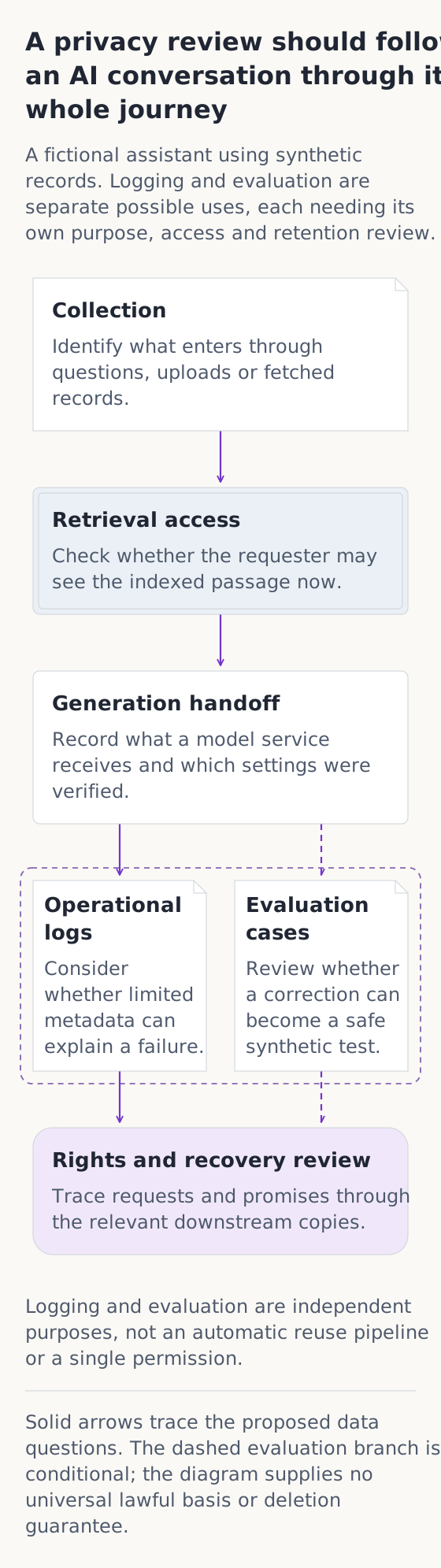
Original explanatory data-journey diagram using a fictional assistant and synthetic documents; not a privacy audit or statutory checklist.
[Open the complete evidence diagram](/assets/policy-workflow-data-governance-20261016.svg)
Read the diagram
**A privacy review should follow an AI conversation through its whole journey**
A fictional assistant using synthetic records. Logging and evaluation are separate possible uses, each needing its own purpose, access and retention review.
- **Collection** Identify what enters through questions, uploads or fetched records.
- **Retrieval access** Check whether the requester may see the indexed passage now.
- **Generation handoff** Record what a model service receives and which settings were verified.
- **Operational logs** Consider whether limited metadata can explain a failure.
- **Evaluation cases** Review whether a correction can become a safe synthetic test.
- **Rights and recovery review** Trace requests and promises through the relevant downstream copies.
Logging and evaluation are independent purposes, not an automatic reuse pipeline or a single permission.
How the connections work
- The collection map identifies the records whose retrieval access must be checked.
- Only the reviewed retrieval boundary supplies context to the proposed generation handoff.
- Operational logging is examined separately; a failure does not automatically justify retaining a complete conversation.
- A corrected answer is only a candidate for evaluation after its purpose and information have been reviewed.
- A person’s request or a deletion promise must account for relevant retained operational records and their limits.
- Evaluation copies are included in the review when they exist; deleting an upload alone does not prove every copy disappeared.
Relationship key
Solid arrows trace the proposed data questions. The dashed evaluation branch is conditional; the diagram supplies no universal lawful basis or deletion guarantee.