A proof checker can verify the wrong translation perfectly
Recent theorem-proving and benchmark research makes a practical distinction between checking a formal proof and checking that it answers the intended question.
Formal mathematical AI has a useful division of labour: a learning system searches for a proof, while a separate checker examines a formal object. A Nature paper published online on 12 November 2025 describes AlphaProof's reinforcement-learning approach to formal reasoning. Its later March 2026 journal issue does not turn the underlying work into a newly performed 2026 Olympiad result. [Research paper](https://www.nature.com/articles/s41586-025-09833-y).
The paper connects proof search with Lean and training on formal mathematical problems. That is a more constrained activity than asking a chatbot to produce convincing-looking prose. A proof accepted for an encoded statement is a substantial achievement, but it does not by itself show that the statement faithfully represents the natural-language question a person intended to ask. [Method and evaluation](https://www.nature.com/articles/s41586-025-09833-y).
The distinction matters for scientific work because a precise answer can still concern the wrong assumptions. A model may solve the proposition placed before it while a missing condition changes the original problem. This gives researchers a practical next task: inspect the translation and the proof separately, rather than letting the apparent certainty of one conceal uncertainty in the other.
What the checker actually checks
Lean's official reference describes elaboration from user-facing syntax into a smaller core theory, followed by kernel checking. The trusted kernel checks that the resulting object follows the rules of that theory. It does not read a researcher's English intention and decide whether the translation captured it. The trusted boundary is narrower and more useful than a claim that software validates arbitrary mathematical prose. [Lean checking pipeline](https://lean-lang.org/doc/reference/latest/Elaboration-and-Compilation/).
For a reader, this suggests a simple annotation method. Beside a claimed success, write the exact statement being checked and the assumptions available to it. In a separate note, explain how that statement relates to the original task. If the relationship is unclear, the appropriate response is to inspect the translation, not to discard the checker or declare the original question solved.
The official reference also distinguishes kernel-checked definitions from the broader compilation and metaprogramming environment. It describes a separate checker that can validate a compiled environment. These distinctions matter when specifying what a reproducibility record should contain. A proposed verification task should state its trusted components and dependencies instead of using the word verified without saying what was checked. [Trusted components](https://lean-lang.org/doc/reference/latest/Elaboration-and-Compilation/).
The AlphaProof paper's evaluations concern specified formal benchmarks and problem settings. Its training and test-time search are not a demonstration that every informal scientific argument can now be automatically checked. A useful research discussion should preserve the represented domain and the resources used, rather than extrapolate a contest-style result into universal mathematical reliability. [Evaluation scope](https://www.nature.com/articles/s41586-025-09833-y).
Benchmark statements deserve review too
The maintainers of miniF2F distinguish an actively developed main branch from a frozen version intended for benchmark reporting. Their repository includes formal statements and informal problem material. Choosing a specific version is consequently part of defining an evaluation; a result should not float between changing files while retaining the same benchmark name. [Benchmark repository](https://github.com/facebookresearch/miniF2F).
A primary preprint submitted on 5 November 2025, by Ospanov, Farnia and Yousefzadeh, examines mismatches between miniF2F's formal and informal statements and proposes a corrected collection. It also finds that a language-model judgement can miss translation errors identified by expert review. These are the authors' reported benchmark findings, not an independently rerun evaluation by this publication. [Benchmark audit](https://arxiv.org/html/2511.03108v1).
The audit's scope is Lean, and its proposed revision should not be confused with a maintainer branch merely because both use a version-like name. A research record needs the actual repository or paper identifier. Otherwise a statement about an improved benchmark can appear to concern a different collection whose files and review history are not the same. [Audit scope](https://arxiv.org/html/2511.03108v1), [maintainer versions](https://github.com/facebookresearch/miniF2F).
This is an immediately useful lesson for experimental design. Before running a new prover, retain the exact statements being tested and identify which ones were changed. A benchmark correction may improve the question being asked without supplying a directly comparable continuation of every earlier score. A careful comparison explains the changed task rather than using a familiar label to hide it.
An invented example where an assumption changes everything
Consider an unperformed classroom exercise. Students are asked to reason about an invented elementary problem involving a number and its reciprocal. The informal question excludes zero, but one deliberately faulty translation omits that exclusion or changes the domain. Another translation silently adds an assumption that makes the conclusion much easier. These are teaching mistakes constructed for discussion, not reported defects in a cited model.
Before proof search, groups compare the intended statement, “for every nonzero real x, x/x = 1,” with a version that assumes x = 1. The latter covers only that special case. This is the worked translation mismatch, not a Lean execution result. The exercise needs neither a fabricated model transcript nor a claim that unrun code was accepted.
Next, a group receives a purported proof of one formal version. Its first question should be which statement the proof concerns, rather than how persuasive the explanation sounds. Even a valid proof would settle only that version. Students then propose a corrected statement and a separate check that it corresponds to the original classroom question.
Finally, students prepare a tiny evaluation plan. They keep statement review distinct from proof checking and report an unresolved translation as unresolved. If they later execute software, they should record the actual result rather than replace it with the expected one. This proposed exercise is about making a scientific workflow legible, not announcing a new mathematical theorem.
What a reusable research record should preserve
The miniF2F repository supplies a useful starting point for examining how benchmark material is organised. It is not a licence to treat every current branch as the exact collection used in an older paper. A prospective project should record the selected version and inspect its notices before reusing any problem statements or solution material. [Original benchmark materials](https://github.com/facebookresearch/miniF2F).
The later benchmark audit makes translation review a substantive research problem. Its reported discrepancies should motivate careful inspection, without implying that all formal mathematics or all previous results are invalid. A learner can study one example deeply: compare the intended problem, the encoded assumptions and the accepted claim, then explain where human judgement enters the chain. [Translation analysis](https://arxiv.org/html/2511.03108v1).
For research teams, useful work includes formalising definitions, maintaining libraries and making dependencies explicit. For teachers, it includes explaining why a mechanically checked argument can be more reliable about its stated proposition while remaining silent about an unstated intention. These roles are complementary. None of the examined sources establishes a particular reduction in employment or removes the need for mathematical expertise.
This publication has not trained a theorem prover, run Lean or independently checked the cited proofs. The practical next step proposed here is a bounded reading and statement-review project before execution. A suitable illustration would use a fictional student worksheet and separate formal-check panel, not fabricate an authentic successful proof session or a new contest result.
The recent research is interesting because learned search can produce objects for a checker with an explicit job. Its usefulness grows when the surrounding translation and version choices are equally explicit. A proof certificate is a powerful answer to a precise question; the scientific responsibility is to ensure that it is the question the researcher meant to ask.
Conceptual diagram and reading companion
Original conceptual illustration and unperformed classroom exercise; no measured data, authentic research interface or reproduced result is shown.
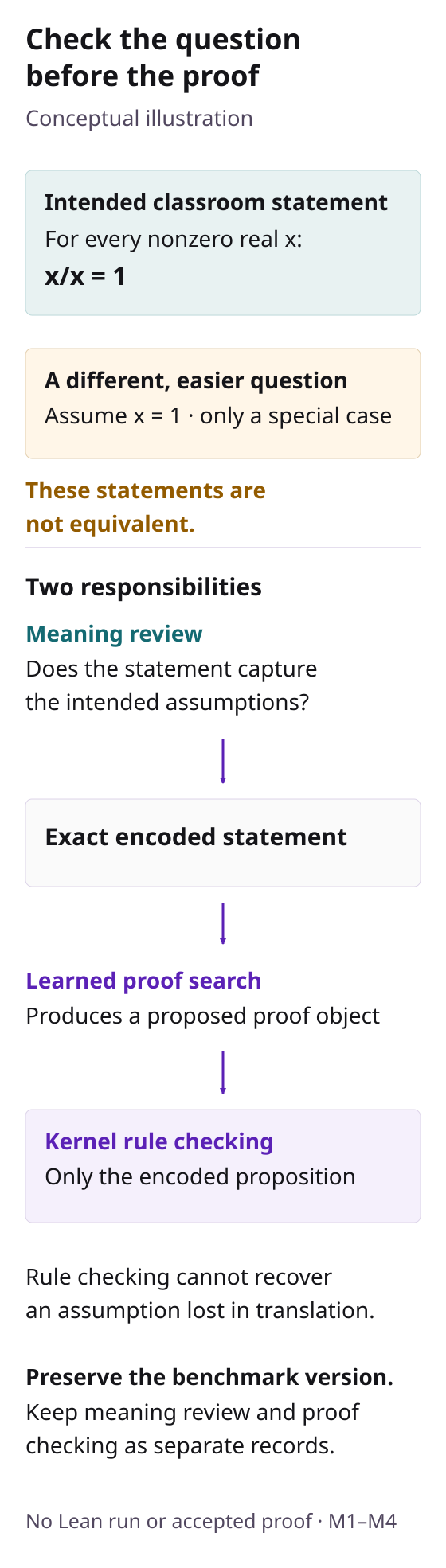
Original conceptual illustration supporting this article. Shapes and teaching examples are explanatory, not measured data, an authentic laboratory interface or an independent reproduction. Read the accompanying source-linked guide.
[Open the complete diagram](/assets/science-formal-statement-review-concept-20261016.svg)
Check the question before the proof
An unperformed elementary statement-review exercise. No Lean session, proof object or acceptance result is created.
Keep the intended classroom question beside the special case
Read the two classroom panels before following the arrows. The first asks about every nonzero real x; the second adds the special assumption x equals one. Retain the original wording, its domain and the exclusion of zero. A solution to the easier special case is not an answer to the first question.
Keep two separate review notes in the hypothetical exercise: which statement the class intended, and which encoded statement a proposed object would address. The arrows mark handoffs between those responsibilities. They do not say that a proof was produced, checked or accepted here.
If the fictional worksheet changes, reopen the statement review rather than copying an earlier success label. The actual benchmark and software qualifications remain in the unchanged article. This companion supplies no theorem, contest score, model transcript or claim that the publication independently checked the cited work.
Readable figure labels
- Check the question - before the proof - Conceptual illustration - Intended classroom statement - For every nonzero real x: - x/x = 1 - A different, easier question - Assume x = 1 · only a special case - These statements are - not equivalent. - Two responsibilities - Meaning review - Does the statement capture - the intended assumptions? - Exact encoded statement - Learned proof search - Produces a proposed proof object - Kernel rule checking - Only the encoded proposition - Rule checking cannot recover - an assumption lost in translation. - Preserve the benchmark version. - Keep meaning review and proof - checking as separate records. - No Lean run or accepted proof · M1–M4
Source context
For the reported facts, dates and access limitations, read the unchanged article above. These are the same underlying references, not additional experiments. The fictional exercise and diagram do not establish a measured result.
- [M1](https://www.nature.com/articles/s41586-025-09833-y) - [M2](https://lean-lang.org/doc/reference/latest/Elaboration-and-Compilation/) - [M3](https://github.com/facebookresearch/miniF2F) - [M4](https://arxiv.org/html/2511.03108v1)