A public defence AI claim needs a date, a stage and a boundary
A public AI inventory, policy announcement and proposed framework carry different evidence; their populations, dates and limitations should travel with the claim.
Public discussion of defence AI often compresses several events into the word adoption. A ministry publishes a policy. An institution announces a pilot. A supplier describes a collaboration. An audit examines selected activities. Each record can be important without proving the same thing. A useful public account should preserve the stage of the evidence instead of allowing a sequence of announcements to become an assumed record of successful deployment.
This discipline also limits what can be inferred from absence. A public inventory may exclude particular organizations, omit sensitive activities or depend on a reporting period. A blank field does not necessarily mean that no activity exists. Responsible public analysis should explain the boundary without seeking classified information or treating secrecy as permission to invent what lies behind it.
An inventory has a population
The US GAO’s [29 July 2025 report on generative AI at federal agencies](https://www.gao.gov/products/gao-25-107653) makes its review population explicit. It selected twelve agencies that publicly reported generative AI use cases and reviewed inventories submitted by eleven, noting that the Department of Defense was exempt from that inventory requirement. Those figures and the exemption belong to the report’s defined context. Its agency totals should not be presented as a complete count of defence AI applications.
Japan’s Ministry of Defense used a [2 July 2024 press conference](https://www.mod.go.jp/en/article/2024/07/92d48f0d92e0e17facfe2235a5c00a77a0a3aed3.html) to explain its newly formulated AI-use policy and a separate cyber-workforce strategy. The English account is explicitly a provisional translation. It is evidence of the policy announcement and stated intent. It is not a record showing that every described ambition was implemented or that any particular technical capability passed evaluation.
UNIDIR’s [proposed framework of responsible industry behaviour](https://unidir.org/framework-of-responsible-industry-behaviour-for-ai-in-the-military-domain/) describes a programme of work with OHCHR to develop voluntary guidance. Its page says participation in development neither implies endorsement nor entails binding commitments. That qualification should travel with any public description of the initiative. A contributor’s involvement is not a certification or proof of the framework’s completed adoption.
The [AI Policy Portal’s methodology and disclaimer](https://aipolicyportal.org/about-us) provide another useful boundary. The UNIDIR-maintained tool draws mostly on official public sources, describes its selection and verification approach, welcomes corrections and cautions that English translations are informational. A searchable profile can help locate evidence. It does not replace the authentic original document or guarantee that no information is missing or out of date.
A fictional public-information desk
Imagine a fictional adult research group in Tokyo preparing an educational explainer about public AI policy announcements. No real organization, official or confidential document is represented. The group works only with public materials and synthetic practice records. It is not investigating current operations or trying to discover information that an institution has chosen not to publish.
The group starts with a simple evidence ledger. For every proposed sentence, it records the source, the event being described and the time boundary. Publication date, programme period and check date occupy different fields. If a source gives only a year, the group does not invent a day to make the table look complete. Unknown dates remain explicit unknowns.
Next, it assigns an evidence stage in plain language: policy announced, proposal described, trial reported, audited activity or observed result within a stated scope. These are editorial categories, not an official maturity model. Their purpose is to help a reader see what the sentence actually claims. A policy document and an audit can appear in the same explainer while keeping their different roles.
Follow the claim through an update
Suppose a synthetic announcement says that an institution plans a document assistant. A later public note says that a small training trial began. The ledger should preserve both records. Replacing the first row with “deployed” would erase the distinction between intent and the reported trial. A reader should be able to see which fact changed and which earlier uncertainty remains.
The same applies to recommendations. An audit may find a management gap and later mark a recommendation as addressed. That later status does not rewrite the historical finding. It also need not establish that every related service now performs well. The group should describe the specific follow-up status and the date it was checked, rather than turning closure of a recommendation into a broad operational success claim.
Numbers require their own boundary. A count of reported use cases is not necessarily a count of models, contracts or users. A pilot can appear under several activities, and an inventory’s scope can change between years. Before comparing totals, the fictional group asks whether the unit, population and period are comparable. If the sources do not establish comparability, it avoids drawing a trend line that suggests more certainty than the records support.
Make corrections visible without exposing more
A public explainer should allow a correction to be understood. If a translation led to an overstatement, the revised account can identify the supported wording and preserve the reason for the change. It need not reproduce private correspondence or identify a person who raised the issue. Transparency about the editorial decision is different from unrestricted disclosure of every underlying interaction.
The group also distinguishes a dead link from a withdrawn policy. A changed website path may make a reference unavailable without establishing that the policy was revoked. An archived or indexed reference can be described as such, with its limitations. The group should not silently substitute a newer document into an older claim or treat an access failure as evidence that the institution has something to hide.
A better boundary for public accountability
The potential benefit is an account that readers can inspect and challenge. They can see whether a statement concerns an intention, a trial or a scoped result, and whether a number describes a defined reporting population. No reduction in misinformation, improvement in public trust or assessment of a military capability is measured in this fictional exercise.
Public accountability does not require pretending that all information is public. It requires precision about the information that is being used. The GAO scope note, Japan’s dated announcement and UNIDIR’s methodological qualifications offer concrete examples of that precision. A defensible public AI claim carries its date, stage and boundary with it, including when that boundary leaves an important question unanswered.
Evidence diagram and readable guide
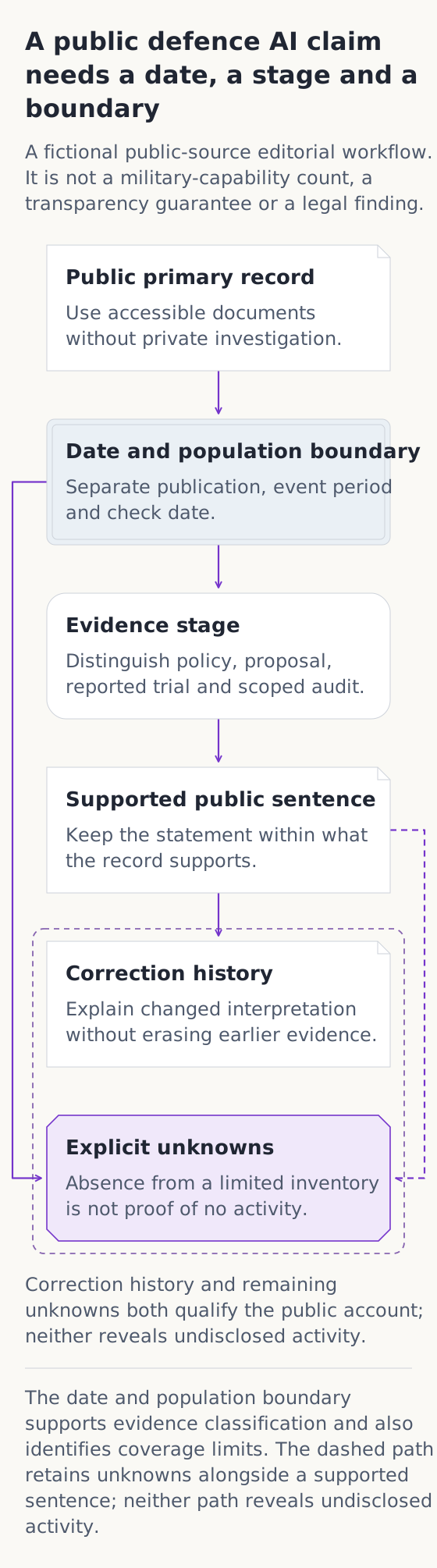
Original explanatory diagram: a fictional public-source account carries its date, population, evidence stage, correction history and unknowns.
[Open the complete evidence diagram](/assets/defence-workflow-public-evidence-ledger-20261015.svg)
Read the diagram
**A public defence AI claim needs a date, a stage and a boundary**
A fictional public-source editorial workflow. It is not a military-capability count, a transparency guarantee or a legal finding.
- **Public primary record** Use accessible documents without private investigation.
- **Date and population boundary** Separate publication, event period and check date.
- **Evidence stage** Distinguish policy, proposal, reported trial and scoped audit.
- **Supported public sentence** Keep the statement within what the record supports.
- **Correction history** Explain changed interpretation without erasing earlier evidence.
- **Explicit unknowns** Absence from a limited inventory is not proof of no activity.
Correction history and remaining unknowns both qualify the public account; neither reveals undisclosed activity.
How the connections work
- The public primary record supplies a date and population boundary.
- That boundary helps identify the evidence stage.
- The evidence stage limits the sentence that can be supported publicly.
- A supported sentence retains a visible correction history.
- The date and population boundary identifies coverage limits.
- The supported public sentence preserves its remaining unknowns.
Relationship key
The date and population boundary supports evidence classification and also identifies coverage limits. The dashed path retains unknowns alongside a supported sentence; neither path reveals undisclosed activity.