A robot’s reasoning model needs a contract with the machine
RynnBrain and Gemini research makes the boundary between interpreting a scene and authorizing a machine action worth inspecting closely.
A factory instruction can sound perfectly clear while leaving the machine with an impossible decision. “Put the damaged item aside” assumes that someone has defined damaged, identified the right item, chosen an allowed destination and decided what happens if the gripper slips. An embodied model may help interpret the scene. The industrial question is how that interpretation becomes a bounded request to a particular machine, with evidence that the request was accepted and completed.
This is a more useful starting point than asking whether a robot has acquired a general intelligence. The interface between understanding and action determines which mistakes remain suggestions and which become movements. It also determines whether an operator can discover that a request was interrupted, refused or only partly carried out. A convincing explanation is valuable, but it cannot serve as a receipt for a physical event.
Three dates, two kinds of output
The Alibaba DAMO Academy [RynnBrain repository](https://github.com/alibaba-damo-academy/RynnBrain) records a 16 July 2026 release of RynnBrain 1.1 checkpoints and a technical report. Its architecture description includes text, pointing sequences, three-dimensional perception and contact signals. These are different output types, requiring different consumers. A suggested contact point does not by itself specify the complete motion, force limits or permitted interaction with a neighbouring machine.
The authors’ [RynnBrain 1.1 paper record](https://arxiv.org/abs/2607.17977) distinguishes its 20 July 2026 submission from a 31 July revision. The abstract describes RynnBrain-VLA, an action space with embodiment-specific masking, and experiments on named robot platforms. That is meaningful research evidence about an implemented connection to action. It is not evidence that a reader’s production line, tooling or product mix has been accepted. The repository release date, paper dates and this article’s 15 October check date should remain separate.
Google DeepMind made a related architectural distinction in its [25 September 2025 Gemini Robotics 1.5 announcement](https://deepmind.google/blog/gemini-robotics-15-brings-ai-agents-into-the-physical-world/). It described an embodied-reasoning model that plans and calls tools, alongside a vision-language-action model that produces robot motor commands. The account also distinguished developer access to Robotics-ER 1.5 from selected-partner access to Robotics 1.5 at that announcement. This is a dated description, not a claim about today’s universal availability or the relative quality of products.
A fictional workshop makes the boundary visible
Consider a fictional adult team assembling irrigation valves near Hangzhou. An engineer, a production operator and a quality technician want help sorting returned housings into review trays. No real company or deployment is represented. The model receives an approved image and proposes “housing with a chipped rim, tray for manual review.” The team’s first useful artifact is a written action contract, not a faster demonstration.
The contract names the housing identifier, the observation time, the camera view and the permitted tray. It distinguishes an uncertain visual observation from a confirmed defect classification. It permits a request to the sorting controller only when the object identity still matches the current station record. If another housing has arrived, the old proposal expires. This prevents an otherwise sensible interpretation from being applied to a later physical situation.
Next, the team chooses what the model cannot decide. It cannot change the conveyor speed, open an enclosure, redefine an acceptable rim or release a reviewed housing for sale. Those decisions belong to other controlled processes. A narrow output vocabulary is useful here: propose a review destination, ask for another view, or decline to decide. A prose paragraph may accompany the proposal, but the controller receives a structured request with a small set of permitted meanings.
The receiving controller checks the request against its own state. An available tray, a known fixture and a valid task are conditions for considering the request, not claims supplied by the model. A rejection should return a reason that the operator can act on, such as an unavailable destination. The interface should not translate every rejection into “try again,” because the underlying condition may require a person to change the work arrangement.
Acceptance is more than a reply
A worked trial should record at least three different events: a proposal was generated, a controller accepted a request, and a sensor or reviewer established the final disposition. Imagine that the controller acknowledges a move, then the station loses communication. Resending the same instruction may move a second housing or repeat an unfinished action. The honest state is unresolved until the station’s task record and physical condition are reconciled.
The team can rehearse that case without assuming a failure rate. It prepares synthetic task records, interrupts the communication path in an authorised test environment, and checks whether the operator sees a preserved pending task. The desired behaviour is a clear hold and a way to inspect the station. This is an editorial test proposal; neither cited model announcement supplies evidence that this particular workshop has passed it.
A comparison should also include mundane alternatives. A fixed rule and a second camera view might resolve the same sorting task with less ambiguity. A model may be useful when descriptions vary or the scene requires contextual interpretation. The trial should count review effort, ambiguous cases and incorrect object associations as well as successful moves. Otherwise a visually impressive demonstration can conceal the work transferred to the technician who corrects its decisions.
Explain uncertainty at the right level
The operator needs to know whether the system is unsure about the housing, waiting for the controller, or unable to confirm completion. Those states require different actions. Asking for another image can help an uncertain observation. It does not settle an unknown movement. Showing the original proposal alongside the current station record can help review, provided the interface does not quietly replace the operator’s notes when fresh data arrives.
The engineering record needs more detail: model and adapter versions, action vocabulary, coordinate convention, observation identity and controller result. Keeping that record separate from the main human message makes the interface easier to use while preserving the information needed to investigate a disagreement. It also allows the team to discover that a changed camera calibration, rather than a changed model, altered the meaning of a point.
What the release evidence can support
The cited work shows that researchers are building richer connections between perception, reasoning and robot actions. The practical opportunity is to turn those connections into interfaces that a plant can inspect and constrain. That could make an experiment easier to understand and adapt. It does not establish reduced scrap, staffing changes, certified safety or reliable operation for an untested task.
For the fictional valve team, progress would be a modest but concrete result: every proposed disposition refers to the correct object; rejected requests remain rejected; interrupted actions remain visible; and an adult operator can recover the task without guessing what happened. A model release begins the investigation. The contract with the machine determines what the investigation can honestly conclude.
Evidence diagram and readable guide
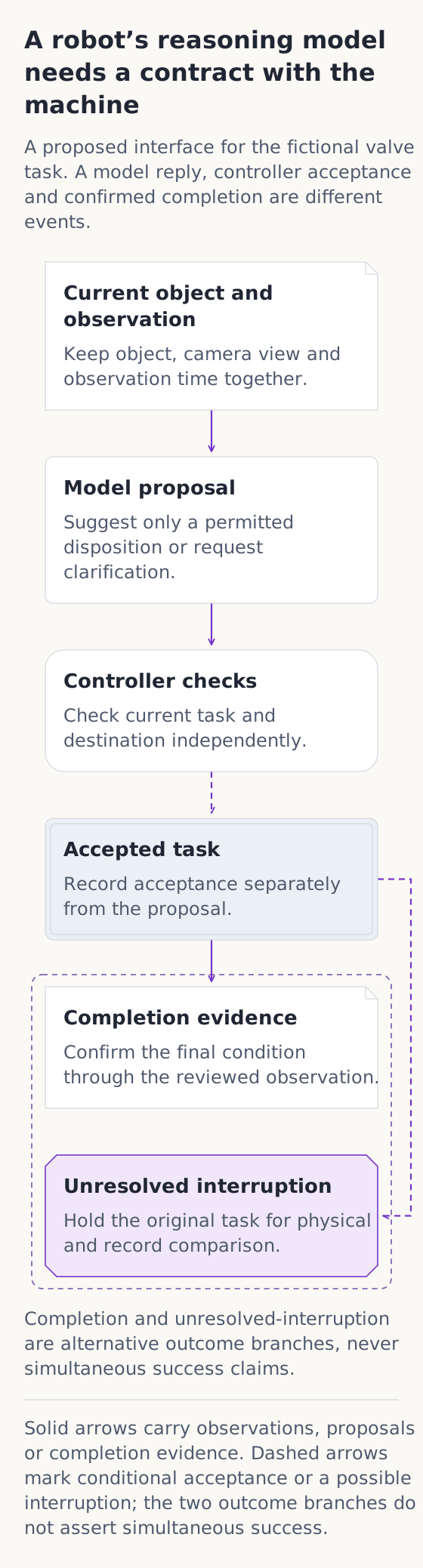
Original explanatory diagram: a model proposal, controller acceptance and completion evidence are distinct events in a fictional task.
[Open the complete evidence diagram](/assets/manufacturing-workflow-action-interface-20261015.svg)
Read the diagram
**A robot’s reasoning model needs a contract with the machine**
A proposed interface for the fictional valve task. A model reply, controller acceptance and confirmed completion are different events.
- **Current object and observation.** Keep object, camera view and observation time together.
- **Model proposal.** Suggest only a permitted disposition or request clarification.
- **Controller checks.** Check current task and destination independently.
- **Accepted task.** Record acceptance separately from the proposal.
- **Completion evidence.** Confirm the final condition through the reviewed observation.
- **Unresolved interruption.** Hold the original task for physical and record comparison.
Completion and unresolved-interruption are alternative outcome branches, never simultaneous success claims.
Solid arrows carry observations, proposals or completion evidence. Dashed arrows mark conditional acceptance or a possible interruption; the two outcome branches do not assert simultaneous success.
How the connections work
- Current object and observation to Model proposal: observation; solid directed link. Proposed conditional or evidence flow; no measured causal relationship.
- Model proposal to Controller checks: proposal; solid directed link. Proposed conditional or evidence flow; no measured causal relationship.
- Controller checks to Accepted task: conditional acceptance; dashed directed link. Proposed conditional or evidence flow; no measured causal relationship.
- Accepted task to Completion evidence: completion evidence; solid directed link. Proposed conditional or evidence flow; no measured causal relationship.
- Accepted task to Unresolved interruption: possible interruption; dashed directed link. Proposed conditional or evidence flow; no measured causal relationship.
Keep the paths separate
Completion and unresolved-interruption are alternative outcome branches, never simultaneous success claims.