A robot training centre is also a test of the human handoff
Hyundai’s 2026 training-centre opening and later production plans make human responsibilities a necessary part of the robotics story.
Teaching a robot to move a part changes more than the movement. Someone selects demonstrations, describes exceptions, checks the destination and decides whether an interrupted task can continue. Those responsibilities can disappear from a presentation focused on the machine. They remain part of the work, whether they belong to a production operator, a trainer, a maintenance technician or an external integration team.
Hyundai Motor Group and Boston Dynamics provide a timely example of why the distinction matters. Their public records describe a training facility that has opened, alongside manufacturing applications planned for later years. That chronology supports a story about preparing work and collecting evidence. It does not support a claim that the planned production transformation, staffing consequences or economic benefits have already occurred.
Opening, training and production are different milestones
Boston Dynamics’ [21 September 2026 announcement](https://bostondynamics.com/news/boston-dynamics-opens-robotics-metaplant-application-center-to-train-humanoid-robots-for-manufacturing-tasks/) says the first phase of the Robotics Metaplant Application Center was operational at Hyundai Motor Group Metaplant America near Savannah, Georgia. It describes Atlas training for activities such as parts logistics and sequencing. The centre is a testbed and training environment; the statement is the participating company’s account, not an independent productivity study.
Hyundai’s [January 2026 strategy announcement](https://www.hyundaimotorgroup.com/en/news/hyundai-motor-group-announces-ai-robotics-strategy--to-lead-human-centered-robotics-era-at-ces-2026), posted 6 January in Korea with a 5 January Seoul/Las Vegas dateline, set out planned Atlas parts-sequencing deployment in 2028 and progression toward component assembly by 2030. These are dated company plans. Reading a later training-centre opening as proof that the 2028 production milestone has already been reached would erase an important boundary between preparation and operation.
The Group’s [30 September 2026 journal account](https://www.hyundaimotorgroup.com/en/story/hyundai-motor-group-bloomberg-atlas-boston-dynamics-rmac) describes its partnership video with Bloomberg and the validation work preceding commercialization. It is promotional institutional reporting, useful for understanding the organization’s stated programme. It is not independent evidence that workers have experienced a particular benefit, that a new role has replaced an old one, or that the programme’s economics have been demonstrated.
The [NIOSH Center for Occupational Robotics Research page](https://www.cdc.gov/niosh/centers/robotics.html), dated 25 November 2024, identifies guidance and training for safe worker interactions with robotics among its objectives. That broader occupational perspective helps frame a practical question: can the people around a new system understand its state and their own responsibilities? The page is a research and guidance account, not an approval of the Hyundai application or the fictional exercise below.
An invented sequencing exercise
Consider an entirely fictional adult team at a Korean automotive-parts training workshop. A trainer demonstrates picking an empty reusable carrier and placing it in the next permitted location. A production operator knows the ordinary sequence, while a quality colleague knows which damaged carriers must be withheld. This example is not a report from Hyundai, Kia or Boston Dynamics, and it asserts no measured result.
Before asking the robot to learn, the team writes down the handoffs. Who confirms that the carrier is empty? Who updates the sequence when an order changes? Who can reject an uncertain placement? Who knows whether a pause occurred before or after the part was released? These questions turn an abstract promise of collaboration into responsibilities that can be practised and observed.
The team makes a simple distinction between teaching a motion and changing the process. A demonstration of the correct pickup does not authorize a new destination. A successful training attempt does not authorize the trainer to release production work. An operator who intervenes should be able to explain the reason without being required to diagnose the model’s internals. The record can describe a blocked carrier or unclear instruction in ordinary production language.
Count the work around the demonstration
For a worked exercise, the team prepares several synthetic orders and clearly marked practice carriers. It includes a missing carrier, a revised sequence and an object deliberately left outside the permitted pickup area. It observes what the system asks people to do, then compares that with the existing manual exercise. The purpose is to discover changes in responsibility, not to stage a contest that guarantees the robot wins.
Useful observations include preparation time, the number of clarifications, interruption handling and the effort required to reconcile a questionable placement. None is a job-loss forecast. A task may become easier while another task becomes more demanding, particularly if diagnosis moves from an experienced operator to a less familiar support team. Recording both makes it harder to confuse reduced motion time with reduced total work.
The participants should review the record together. The trainer may see an issue in demonstration quality; the operator may identify an exception that was never included in the task description; maintenance may identify a fixture problem. Keeping those explanations distinct is valuable. Calling all intervention “human error” would hide whether the system made its own state understandable or asked for a decision that the person had no authority to make.
Train for disagreement and interruption
Training should include moments when the person and machine disagree. In the fictional workshop, the robot proposes a carrier destination that belongs to an earlier practice order. The operator withholds the move and checks the current order. A useful interface preserves the proposal and shows which order it used. Quietly updating the screen to a new order would make it harder to discover why the disagreement arose.
A separate exercise pauses the task after pickup but before placement. The team verifies the physical condition and the task record before deciding what continuation means. This is a proposed training scenario, not a restart procedure for any real robot. Actual operating and safety arrangements require the responsible site specialists. The editorial point is that an interruption changes the human handoff even when the learned motion itself has not changed.
What an honest workforce account would need
A credible account of changed work should identify the observed task, the people involved, the period covered and the comparison used. It should distinguish planned training roles from roles already staffed, and measured workload from expectations. It should include the effort of data preparation, retraining, support and review where those activities are part of delivery. A production target cannot substitute for that evidence.
The September opening is an important reported operational milestone for a training facility. The later manufacturing dates remain plans in the sources checked on 15 October 2026. Between them lies work that deserves its own scrutiny: not just what a robot learns, but whether adults around it can teach, question, interrupt and hand over responsibility with a shared understanding of what happened.
Evidence diagram and readable guide
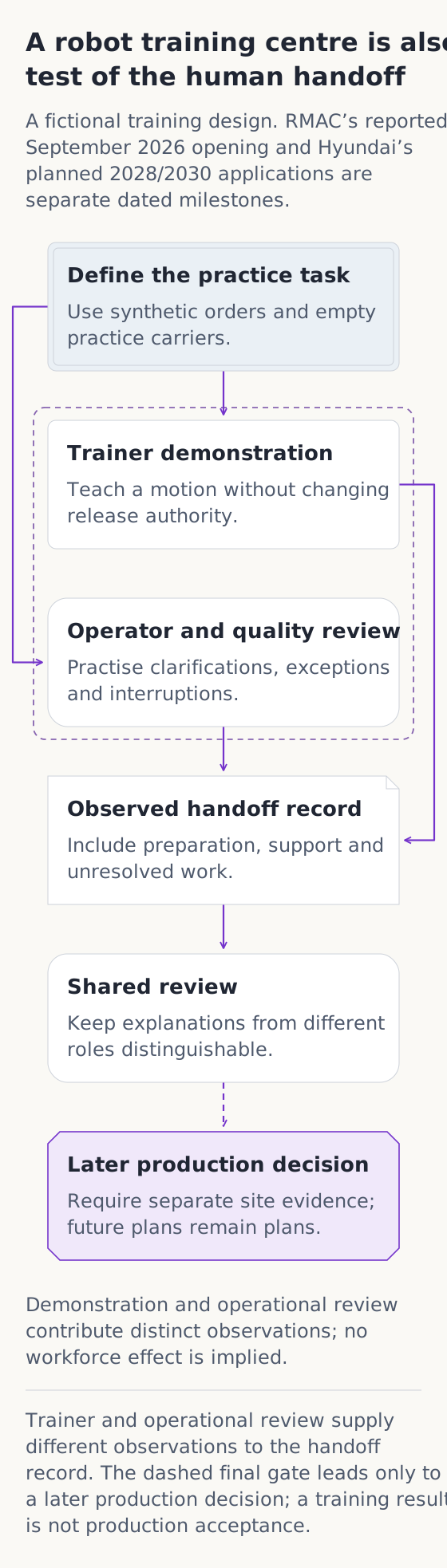
Original explanatory diagram: trainer and operational observations inform a shared handoff before a later production decision.
[Open the complete evidence diagram](/assets/manufacturing-workflow-training-work-handoffs-20261015.svg)
Read the diagram
**A robot training centre is also a test of the human handoff**
A fictional training design. RMAC’s reported September 2026 opening and Hyundai’s planned 2028/2030 applications are separate dated milestones.
- **Define the practice task.** Use synthetic orders and empty practice carriers.
- **Trainer demonstration.** Teach a motion without changing release authority.
- **Operator and quality review.** Practise clarifications, exceptions and interruptions.
- **Observed handoff record.** Include preparation, support and unresolved work.
- **Shared review.** Keep explanations from different roles distinguishable.
- **Later production decision.** Require separate site evidence; future plans remain plans.
Demonstration and operational review contribute distinct observations; no workforce effect is implied.
Trainer and operational review supply different observations to the handoff record. The dashed final gate leads only to a later production decision; a training result is not production acceptance.
How the connections work
- Define the practice task to Trainer demonstration: training scope; solid directed link. Proposed conditional or evidence flow; no measured causal relationship.
- Define the practice task to Operator and quality review: review scope; solid directed link. Proposed conditional or evidence flow; no measured causal relationship.
- Trainer demonstration to Observed handoff record: training observation; solid directed link. Proposed conditional or evidence flow; no measured causal relationship.
- Operator and quality review to Observed handoff record: work observation; solid directed link. Proposed conditional or evidence flow; no measured causal relationship.
- Observed handoff record to Shared review: joint review; solid directed link. Proposed conditional or evidence flow; no measured causal relationship.
- Shared review to Later production decision: future gate; dashed directed link. Proposed conditional or evidence flow; no measured causal relationship.
Keep the paths separate
Demonstration and operational review contribute distinct observations; no workforce effect is implied.