A small adapter is still a new model release
LoRA, PEFT checkpoint formats and Ai2’s research artifacts show why adaptation needs an exact base, permitted examples and a reversible evaluation.
A small file can make a large promise: give a general model a few examples and it will learn the way an organisation works. The promise combines several questions that should be separated. Does the organisation need a different writing format, access to current facts, a new language capability or more reliable behaviour on an already defined task? Those needs do not automatically call for the same intervention.
An adapter can be a useful research tool. It also creates a new artifact whose inputs, dependencies, evaluation and limitations must be understood. A small download is not a small responsibility, particularly when another team will load it into a model that the adapter's author did not test.
What LoRA changes
The original [LoRA paper](https://arxiv.org/abs/2106.09685), first submitted in June 2021, describes freezing pretrained weights and adding trainable low-rank matrices. Its reported efficiency results belong to its experimental models and settings. They do not establish a universal training-memory saving or guarantee that a later adapter will improve a particular task.
For a practical decision, describe what will change and what remains fixed. Name the base model revision, the adapter method and the examples used for adaptation. If a different base is substituted later, that is a new combination requiring its own examination, even when the loader accepts the file.
The checkpoint may not contain the base
The [PEFT checkpoint documentation](https://huggingface.co/docs/peft/main/en/developer_guides/checkpoint) explains that an adapter state dictionary contains adapter parameters rather than the base model. The configuration records information including the base model reference and adapter settings. An adapter file alone is therefore not a complete reproduction package.
The recipient also needs the compatible base, tokenizer, configuration and relevant runtime. A human-readable note saying the adapter works with a model family is too broad when several revisions and instruction templates exist. A missing dependency should be an explicit gap, not something a maintainer is expected to infer from a filename.
A fictional shop defines the actual problem
Imagine a small cooperative in Bandung preparing draft descriptions for a catalogue of handmade products. This is an illustrative scenario, not a reported deployment. The cooperative supplies invented product records containing material, dimensions and care information. Its problem is inconsistent organisation of approved facts, not a lack of imaginative advertising language.
The team first writes an acceptance example by hand. A good description must preserve the supplied measurements, avoid unsupported durability claims and mark missing care information for review. It should not invent a material simply because similar products often use it. Those conditions are decided before any training experiment begins.
Compare an ordinary alternative
The cooperative prepares three proposed approaches: the existing manual process, a fixed instruction with the approved product record supplied, and an adapter trained on permitted examples of the required format. These are experimental alternatives, not claims that adaptation is necessary or that one will win.
The comparison asks what extra work the adapter actually removes. If a clear template already produces acceptable drafts, training may add maintenance without solving a new problem. If the failure concerns missing facts, examples of an attractive writing style do not create an authoritative source for those facts.
Keep changing information outside the claim
Suppose a product's dimensions change. The reviewer should be able to see the current approved record supplied for that item. A fluent old description is not evidence that the new measurements have been used. The exercise should include a changed-record case precisely because a familiar sentence can conceal stale information.
This is a proposed workflow requirement, not a measured property of LoRA. The team can investigate whether supplying the current record explicitly makes corrections easier to inspect. It should retain the source record with the evaluated draft rather than treating the model's prose as a second, equally authoritative product database.
Training data needs its own permission and history
Examples should have a documented source and an allowed purpose. Removing a person's name from a document does not by itself establish permission to train on it. For this fictional exercise, the cooperative writes synthetic product records and example descriptions itself, then retains which examples went into training and which were held back.
The review also follows upstream model lineage. The [DeepSeek-R1 repository](https://github.com/deepseek-ai/DeepSeek-R1) explicitly identifies base-model ancestry for its distilled checkpoints. That is a reminder to retain derivation history; using generated examples or adding an adapter does not erase the underlying artifact's provenance or applicable terms.
Openness can make a research question answerable
[Ai2's OLMo 2 project page](https://allenai.org/olmo2) describes accessible training data, code, recipes, evaluations and intermediate checkpoints. This is a concrete institutional example of a release designed for studying a training process. It is not a claim that reproducing that process is inexpensive or that every model with downloadable weights provides equivalent material.
A student project can use such documentation to ask a narrower question: which part of the adaptation process can we actually reproduce with our available resources? The answer may be a small controlled experiment rather than a reconstruction of pretraining. Reporting that boundary is more informative than calling both activities model training without qualification.
Hold back cases that can prove you wrong
The cooperative separates training examples from evaluation examples before tuning. Its held-back set includes ordinary descriptions, missing fields, changed dimensions and requests for unsupported claims. It also retains some examples on which the unadapted baseline already works, so improvement on one format does not hide a regression elsewhere.
Reviewers compare complete drafts against the supplied facts. They record factual fidelity separately from style and count unavailable or incomplete outputs honestly. A preferred tone cannot compensate for a changed measurement. Repeated training attempts and the rule used to select one adapter belong in the record; only publishing the best-looking sample would conceal the selection process.
Release the evidence with the adapter
The [model-card guidance](https://huggingface.co/docs/hub/en/model-cards) calls for intended uses, limitations and training/evaluation information. For the fictional adapter, a useful card names its exact dependencies, describes the limited catalogue task and identifies the synthetic data and held-back cases. It makes clear that no actual sales or customer outcome has been measured.
The handoff also needs a route back to the accepted baseline. Before merging or replacing artifacts, retain the original files and the evaluation that justified the change. A successful load is a compatibility observation; it is not evidence that the new combination preserved the previous task behaviour.
The cooperative may ultimately keep the template, accept the adapter for a narrow format or abandon the prototype. The valuable result is an explainable decision with retained evidence. This is educational analysis checked on 15 October 2026, not an endorsement or a training-performance claim. No model was trained, merged, served or evaluated for this article.
Evidence diagram and readable guide
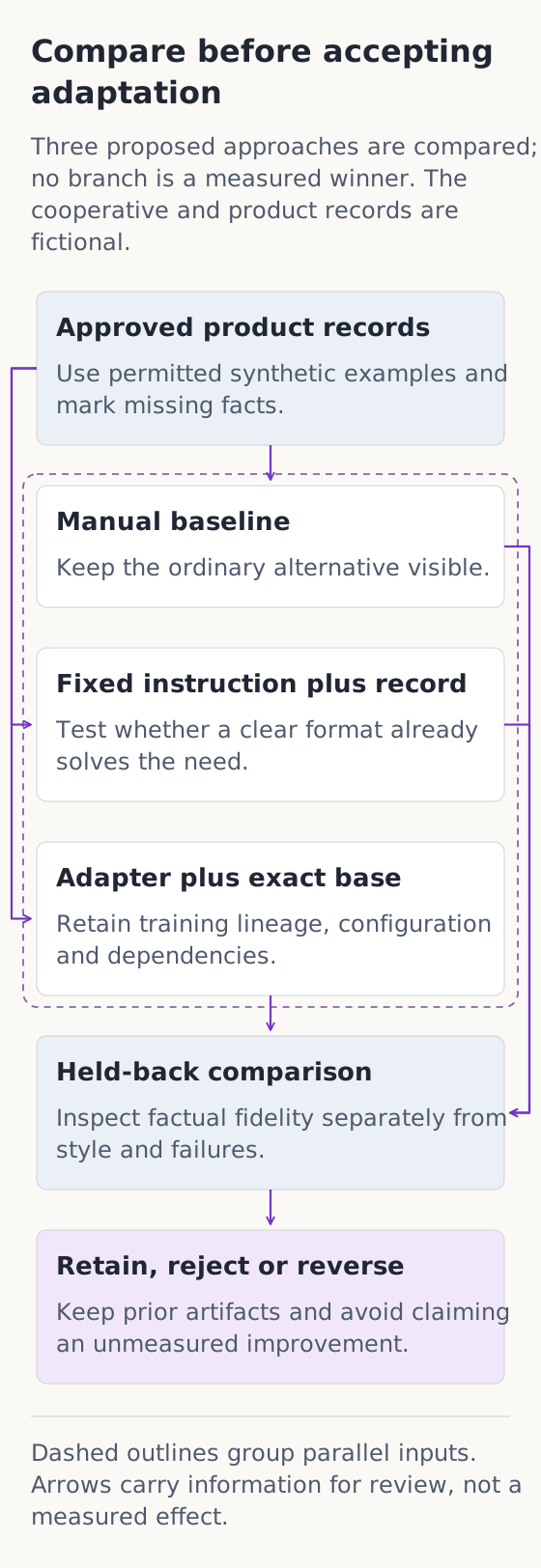
Original explanatory diagram: three proposed approaches share a held-back comparison, with no predetermined winner.
[Open the complete evidence diagram](/assets/open-source-workflow-adapter-release-20261015.svg)
Read the diagram
**Compare before accepting adaptation**
Three proposed approaches are compared; no branch is a measured winner. The cooperative and product records are fictional.
- **Approved product records.** Use permitted synthetic examples and mark missing facts.
- **Manual baseline.** Keep the ordinary alternative visible.
- **Fixed instruction plus record.** Test whether a clear format already solves the need.
- **Adapter plus exact base.** Retain training lineage, configuration and dependencies.
- **Held-back comparison.** Inspect factual fidelity separately from style and failures.
- **Retain, reject or reverse.** Keep prior artifacts and avoid claiming an unmeasured improvement.
Dashed outlines group parallel inputs. Arrows carry information for review, not a measured effect.