A small model fits only when the whole workload fits
Qwen3.5-0.8B and current inference documentation make the useful experiment a complete workload, including cache, context and failure behaviour.
The interesting small-model question is no longer whether a laptop can display a convincing answer. It is whether the same device can complete the intended work, at the intended context length, while remaining usable for the person doing that work. A downloaded weight file is one part of that experiment. It is not the experiment's memory budget or its quality result.
The distinction matters to colleges, small businesses and community organisations that already own computers. A smaller artifact may make local testing possible without making every local workflow reliable. The sensible purchase decision may be to change the task, shorten the input or keep a manual alternative, rather than buy hardware around an untested demonstration.
A concrete current starting point
The official [llama.cpp repository](https://github.com/ggml-org/llama.cpp) currently illustrates its quick start with Qwen3.5-0.8B and documents quantization and several hardware backends. The [specific Qwen model card](https://huggingface.co/Qwen/Qwen3.5-0.8B) describes prototyping and task-specific research or development among its intended uses. Neither document establishes acceptable performance on an arbitrary reader's computer.
That card also warns that this checkpoint can enter thinking loops with the described thinking-mode settings. This is a useful published limitation, not a reason to assume every related release behaves identically. A trial should distinguish a completed answer, a truncated answer and a generation that did not terminate normally.
Weight arithmetic is a lower-bound illustration
Consider an invented model containing exactly two billion stored scalar weights. At four bits per weight, the raw arithmetic is eight billion bits, or one billion bytes. This is an illustrative calculation using decimal units, not the size of a named downloadable file or a claim that a one-gigabyte device can run it.
Real files include additional structures and may use mixed precision. A running system needs more than stored weight values. Treat such arithmetic as a way to expose assumptions, then measure the chosen artifact and actual workload. Do not label an estimate as observed peak memory.
Context has its own footprint
The [Transformers cache documentation](https://huggingface.co/docs/transformers/main/kv_cache) explains that key-value caches can consume substantial memory during long-context generation. It describes offloading and quantized caches as trade-offs, including possible throughput or latency costs. Weight quantization therefore does not automatically settle the cache strategy.
A useful test record distinguishes prompt length, generated length and concurrent requests. If a model worked with one short paragraph, that result says little about several long documents opened together. A run that silently truncates the document is answering a different question, even if it returns fluent text.
A fictional workshop tests a repair-note assistant
Imagine an adult technical-training workshop in Recife preparing a local assistant that reorganises invented equipment-maintenance notes. This is a fictional exercise. It does not diagnose equipment faults or authorise repairs. The task is limited to grouping observations and marking which requested fields were absent from the supplied note.
The instructors prepare a short note, a longer note with repeated sections and an incomplete note containing conflicting dates. Each has a reviewed expected result. Their first experiment asks whether the proposed assistant preserves the difference between a technician's observation and a suggested explanation.
They keep names, customer addresses and real equipment identifiers out of the exercise. This lets trainees investigate memory and response behaviour before any approved service handles operational material. An offline location does not by itself justify using confidential records in a classroom test.
Change one resource decision at a time
The team chooses one checkpoint and first records an approved reference configuration. It then compares a named quantized version with that reference while keeping the task, prompt and output allowance fixed. If the runtime must change, the change is recorded as an additional variable rather than hidden inside the word quantization.
Next they increase input length without changing the intended answer. They record whether the complete source was accepted, how long the first useful response took and whether the final structured fields remained correct. A failure to fit and a wrong answer are separate observations; neither should disappear from the report.
Hardware support is specific
The older [Mistral Small 3.1 24B Instruct card](https://huggingface.co/mistralai/Mistral-Small-3.1-24B-Instruct-2503) is another named artifact with its own configuration and deployment instructions. Its existence does not make a Qwen example's settings transferable. This article makes no cross-model speed comparison and no assertion that a specific memory capacity is sufficient for either model.
For the workshop, the hardware sheet records processor, available memory, accelerator, operating system, runtime version and relevant backend. It also records what else was running. A computer used for teaching may have a browser and accessibility tools open; an otherwise empty benchmark session can conceal that practical constraint.
Measure useful completion
The instructors define success before looking at generated prose. All supplied observations must survive the reorganisation, absent fields must remain absent, and contradictions must be flagged for review. A short, incomplete answer should not receive a speed advantage merely because it omitted the difficult part of the task.
They retain timings separately for loading the model, processing an input and completing the response. Repeated runs distinguish a cold start from a warmed session. An attractive average is insufficient if occasional long delays make the classroom exercise unusable; the individual observations belong in the retained record.
Quantization needs task evidence
A lower-precision candidate may look indistinguishable on a casual greeting while behaving differently on dates, identifiers or a required output structure. The workshop's comparison should therefore inspect the fields people actually rely on. It should also include an unsupported request for which the right result is a clear limitation.
There is no invented accuracy percentage in this exercise. The proposed evaluation shows what to measure, not what the model scored. If the team later reports a measured improvement, it should identify the sample, reference configuration, reviewer criteria and any cases excluded from the comparison.
The unavailable path is part of the interface
Suppose a long input exceeds the tested capacity. A useful assistant should explain that the note needs shortening or division while preserving the text already entered. It should not show a low-level memory exception or present the first half of the note as a complete analysis.
The instructor can then ask whether splitting the note changes the educational objective. If relationships across the entire document matter, splitting is not an equivalent workaround. A manual review or a different authorised service may remain the more honest route for that case.
Decide around the work, not the download
The workshop can now decide which combination of artifact, precision, context and device supports its narrow exercise. It may accept one configuration, reject another or conclude that the prototype is useful only for demonstration. None of those outcomes establishes superiority across countries, languages or tasks.
This educational comparison is not a hardware recommendation or a model endorsement. Documentation was checked on 15 October 2026; the fictional examples contain no measured benchmark results. No model, runtime, device or provider was executed for this reporting.
Evidence diagram and readable guide
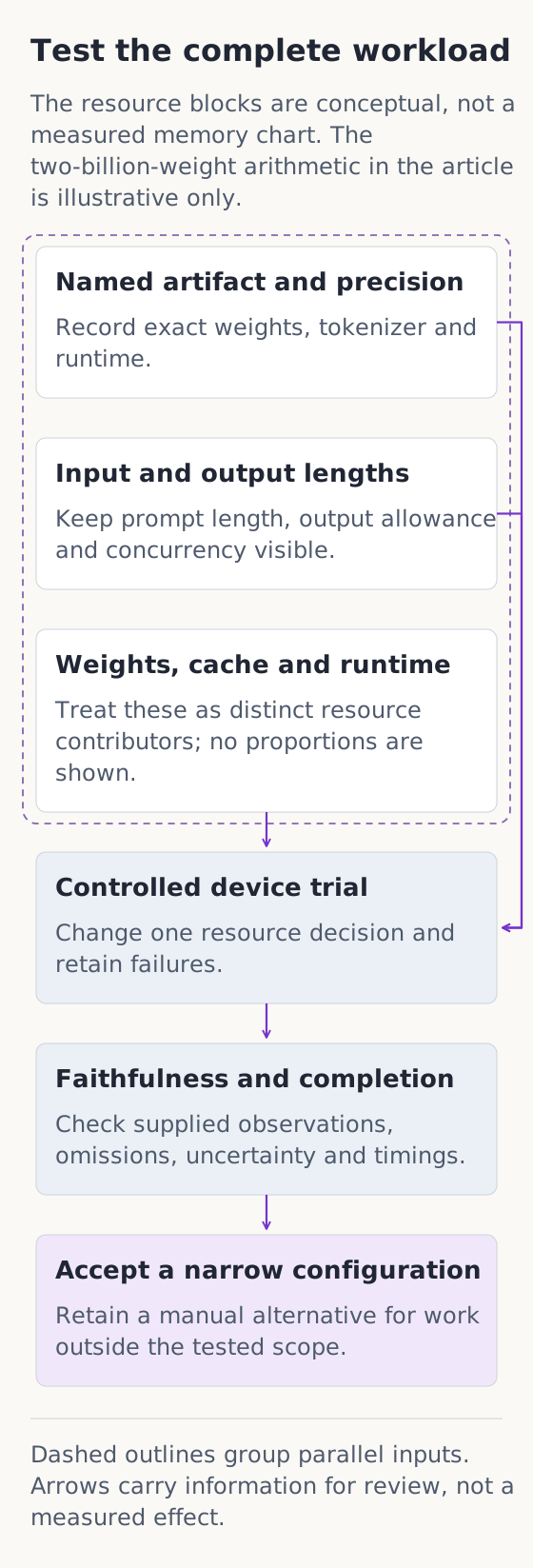
Original explanatory diagram: resource assumptions lead to a controlled task comparison, without measured memory proportions.
[Open the complete evidence diagram](/assets/open-source-workflow-small-model-memory-20261015.svg)
Read the diagram
**Test the complete workload**
The resource blocks are conceptual, not a measured memory chart. The two-billion-weight arithmetic in the article is illustrative only.
- **Named artifact and precision.** Record exact weights, tokenizer and runtime.
- **Input and output lengths.** Keep prompt length, output allowance and concurrency visible.
- **Weights, cache and runtime.** Treat these as distinct resource contributors; no proportions are shown.
- **Controlled device trial.** Change one resource decision and retain failures.
- **Faithfulness and completion.** Check supplied observations, omissions, uncertainty and timings.
- **Accept a narrow configuration.** Retain a manual alternative for work outside the tested scope.
Dashed outlines group parallel inputs. Arrows carry information for review, not a measured effect.