AI crop measurements need a route back to the breeding plot
CIMMYT and IRRI research and training make the plot-to-measurement chain as important as the model producing a trait estimate.
A photograph can become a useful breeding measurement only if researchers know what it represents. The crop, plot, growth stage, environment and measurement method all matter. A model may count a visible feature convincingly while the record beside it refers to the wrong plot. The difficult work is preserving the relationship between an image, an estimated trait and the breeding question that made the measurement worth collecting.
CIMMYT’s September 2025 account of AI-enabled phenotyping describes a pipeline from georeferenced smartphone images through curation, annotation, model training and validation to breeding use. It reports institutional development with partners, including work on African dryland crops. The pipeline is informative; its aspirations for speed and accessibility should not be mistaken for independently reproduced benefits in every breeding programme. [CIMMYT’s phenotyping account](https://www.cimmyt.org/blogs/driving-a-new-era-in-breeding-ai-powered-phenotyping-at-cimmyt/).
A recent workshop highlights the full workflow
In October 2026, CIMMYT reported a three-day Hyderabad workshop introducing Indian wheat and maize breeders to AI-driven breeding and data management. Its account places AI within experimental design, field collection, analysis and breeding decisions. A training event shows an organized effort to build capability, not proof that attendance improved workplace outcomes or that breeders have become replaceable. [The October workshop report](https://www.cimmyt.org/news/equipping-todays-breeders-to-lead-tomorrows-crop-research-and-development/).
IRRI’s July 2026 account describes research combining drone imaging and physiological measurements across more than 300 indica rice varieties and three growing seasons. That is a stated research population and a measurement strategy. It is not a new variety release or a guarantee that a favourable image-derived trait will deliver higher yield in another environment. Imaging itself should not automatically be relabelled AI. [IRRI’s research account](https://ricetoday.irri.org/drone-imaging-accelerates-photosynthesis-research-for-higher-yielding-rice/).
The underlying agronomic method still matters. IRRI’s phenotyping resource page separates protocols for stress screening, soil-moisture monitoring and root studies. This landing-page organization supplies context, rather than evidence that a particular model passed validation. Readers need the relevant qualified research procedure for actual experiments; the linked protocols are not reproduced here. [IRRI’s protocol resources](https://rbi.irri.org/resources-and-tools/phenotyping-protocols).
Follow one fictional record through the process
Imagine a fictional adult breeding team at a training station near Hyderabad, using synthetic plot identities and staged sample images. The team is considering an image-assisted count of a visible plant feature. It is not diagnosing a disease, releasing a variety or making a recommendation to farmers. The exercise asks a narrower question: can another researcher understand how a proposed trait value came to exist?
The first record contains a plot identifier, an invented collection date, the crop stage and the intended trait definition. An image is linked to that record rather than renamed with a loose description such as good plot. The team keeps the original image unchanged and records any derived crop, rotation or resizing separately. A later measurement should not obscure what the camera actually captured.
The trait definition is written before model outputs are inspected. If two people interpret the feature differently, that disagreement is resolved or retained as uncertainty in the reference record. An annotation is not correct simply because it was produced by a person. The evaluator needs to know who checked it, which rule they applied and whether the example remained ambiguous.
Compare estimates with independent observations
The fictional team sets aside records that were not used to tune the model or revise the annotation rules. It includes images with shadows, partial views and ordinary background clutter. It then compares the estimated feature with the agreed reference measurement. These are proposed test conditions, not an account of a named model’s performance. Their purpose is to show which mistakes a clean demonstration might hide.
Keep error descriptions meaningful to the breeding task. A model that merges two overlapping features makes a different mistake from one linked to the wrong plot. A count may be close while the wrong plant is being measured. Recording only an average score can hide these distinctions and leave the breeder unable to decide whether the estimate is suitable for the intended analysis.
The team also checks that closely related images have not been spread casually across development and evaluation sets. Several views of one plot can be useful, but they should not create a misleading impression of independent examples. Document the grouping rule, the environments examined and the model version. When the rule changes, describe which earlier comparisons remain meaningful.
Keep a trait estimate separate from a breeding decision
Suppose the synthetic exercise produces a convincing count for one collection. The next question is how the count relates to the intended trait and experimental design. It may help organize observations or identify records needing inspection. It does not automatically establish a genetic advantage, a stable response across environments or a variety that farmers should adopt. Those are additional research questions with their own evidence.
The handoff to an analyst should therefore include the trait definition, reference method, missing records and relevant evaluation limits. An estimated value can be marked as an estimate without making the dataset unusable. An unsupported value should not be converted into zero simply because the analysis expects a number. Missingness can reveal where the collection procedure needs improvement.
Model changes need a visible comparison. If an updated model revises many values, retain both derived versions and explain which analysis used which edition. Do not silently replace a result that supported an earlier selection discussion. The original images and plot links provide a way to investigate disagreements without rewriting the history of the experiment.
Build capacity around judgment, not button pressing
A useful training session asks adults to find a mismatched plot, explain an ambiguous annotation and decide when to request another observation. Successfully running a tool is only one part of that capability. A participant who recognizes an unsupported estimate and stops it entering an analysis has demonstrated something important, even if the exercise produces fewer completed records.
The practical opportunity is a more inspectable measurement chain. AI may assist a stage within that chain, while experimental design, reference measurements and breeding interpretation remain visible. This article is educational analysis using a fictional adult workshop and synthetic records. It reports no new field trial, varietal release, measured yield improvement or tool endorsement. Any actual crop research requires the appropriate institutional methods, permissions and local expertise.
Evidence diagram and readable guide
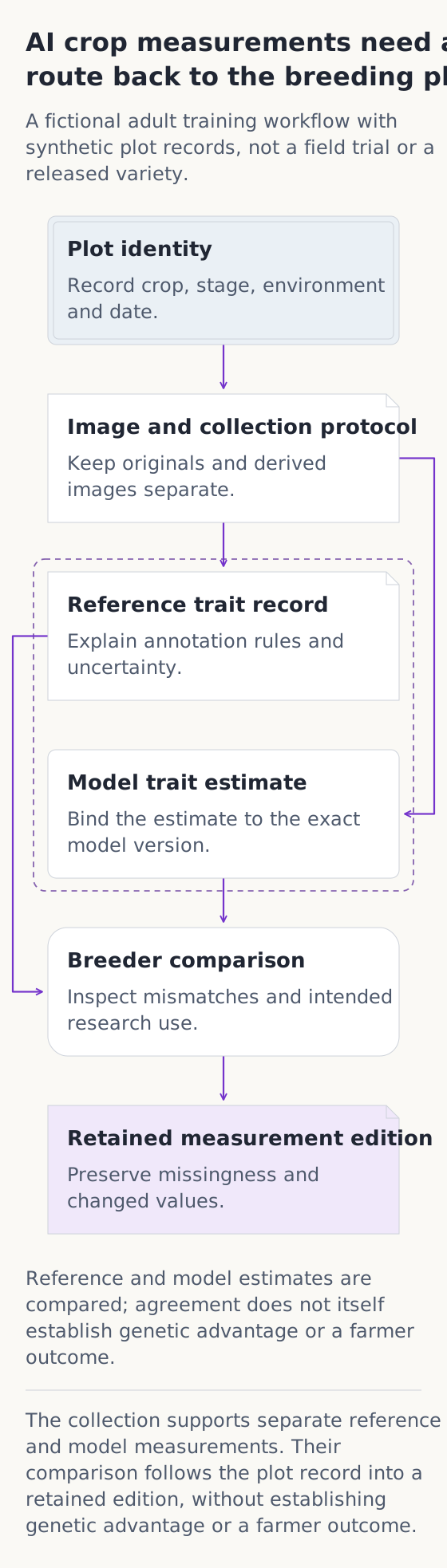
Original explanatory diagram: a fictional adult breeding exercise traces synthetic measurements to a plot, collection protocol and independent comparison; no variety or yield result is shown.
[Open the complete evidence diagram](/assets/agriculture-workflow-breeding-measurements-20261015.svg)
Read the diagram
**AI crop measurements need a route back to the breeding plot**
A fictional adult training workflow with synthetic plot records, not a field trial or a released variety.
- **Plot identity** Record crop, stage, environment and date.
- **Image and collection protocol** Keep originals and derived images separate.
- **Reference trait record** Explain annotation rules and uncertainty.
- **Model trait estimate** Bind the estimate to the exact model version.
- **Breeder comparison** Inspect mismatches and intended research use.
- **Retained measurement edition** Preserve missingness and changed values.
Reference and model estimates are compared; agreement does not itself establish genetic advantage or a farmer outcome.
How the connections work
- Plot identity determines which collection protocol and image belong together.
- The image and protocol support a separately reviewed reference trait.
- The same collection can produce a model estimate with an identified version.
- The reference trait supplies independent context for the breeder comparison.
- The model estimate is compared with that reference rather than treated as its own validation.
- The comparison travels with the retained measurement edition and its unresolved gaps.
Relationship key
The collection supports separate reference and model measurements. Their comparison follows the plot record into a retained edition, without establishing genetic advantage or a farmer outcome.