AI exposed a take-home assessment gap. Universities are redesigning evidence of learning
A historical examination experiment and Australian reform records shift attention from a polished document to evidence of the skill a student can demonstrate.
A polished submission can demonstrate that a good document exists without demonstrating who can explain the ideas inside it. Generative AI has made that familiar assessment problem harder to ignore. A university experiment in England tested the vulnerability directly; separate Australian reform work illustrates approaches to demonstrating learning.
The story extends beyond deciding whether a student may use a tool. It concerns what evidence a course needs to support a judgment about learning. Detection, supervised demonstration and guided human–AI work can answer different questions. Treating them as interchangeable can make an assessment look secure while leaving its educational purpose unclear.
Reading tested an actual examinations process
The [Scarfe and colleagues PLOS ONE study](https://journals.plos.org/plosone/article?id=10.1371/journal.pone.0305354), published on 26 June 2024, inserted entirely AI-written submissions into the marking process for five undergraduate psychology modules at the University of Reading. Markers were not told which submissions were part of the study. The researchers reported that 94% of the inserted submissions went undetected. Here, detected meant flagged for poor academic practice or misconduct; the marker did not have to name AI.
That finding concerns this defined historical experiment. It is not a measurement of current cheating prevalence or the failure rate of every detection product. The researchers' submissions were experimental material, not proof that a particular real student had committed misconduct. This article does not reproduce a method for evading assessment controls.
The result exposes an evidence gap
The experiment makes a narrow but important point: ordinary marking of a finished answer did not reliably identify its origin in that setting. A high mark can assess the answer's quality without establishing the student's independent capability. Conversely, a suspicion about style does not itself establish misconduct.
Those are different questions requiring different evidence. Assessment design asks how a student can demonstrate a specified skill. An integrity process asks whether a rule was broken and must follow the institution's proper procedures. A redesign should not quietly turn uncertainty in one area into an unsupported conclusion in the other.
Sydney made the distinction visible to students
The [University of Sydney's 29 August 2025 account](https://www.sydney.edu.au/study/student-life/student-news/2025/08/29/exploring-the-future-of-learning-with-ai.html) describes its secure and open assessment lanes. Secure activities prohibit or control AI use; open activities allow it under educators' guidance with acknowledgement. The account includes examples such as orals and practicals in the secure lane and essays or collaborative tasks in the open lane.
This is evidence of an institutional approach, not an experiment showing that it eliminates cheating or improves grades. Local assessment instructions and accessibility arrangements still determine how an activity operates. The same approach should not be presented as a rule automatically applying to every Australian or overseas institution.
TEQSA's reform resource concerns implementation
[TEQSA's resource published on 24 September 2025](https://www.teqsa.gov.au/guides-resources/resources/corporate-publications/enacting-assessment-reform-time-artificial-intelligence) describes examples of assessment reform in practice. Its public overview connects learning assurance with responsible and ethical use of generative AI.
The readable overview is the source used here; this article does not attribute detailed provisions to the downloadable report, which was unavailable during the author's retrieval. Guidance and institutional practice can inform design questions, but neither supplies a measured effect equivalent to the Reading experiment. The evidence stages should remain explicit.
Match the evidence to the intended skill
| Intended judgment | Possible activity | What needs checking | | --- | --- | --- | | Explain a concept independently | A bounded supervised explanation | Appropriate access and a clear rubric | | Evaluate generated material | Critique a supplied AI draft | Quality of reasoning, not mere disagreement | | Develop a substantial project | Draft, revision and discussion | Which decisions the student can explain | | Investigate suspected misconduct | The institution's formal process | Evidence and procedural fairness |
This is an original illustrative design table, not a TEQSA requirement or a universal assessment standard. Each row describes a different purpose. A programme may need several forms of evidence rather than a single supposedly AI-proof task.
A fictional environmental-studies assignment
Imagine a fictional university course in Wellington asking adult students to compare two proposals for a local green space. The teacher supplies public, licensed background material and an invented AI-generated briefing containing a plausible unsupported claim. This is an illustrative assignment, not an implemented programme at a named university.
The open component asks students to evaluate the briefing and explain their revisions. A separate bounded discussion asks each student to defend one decision and consider a counterargument. The course defines the purpose and permitted assistance for each component before work begins. It collects no private information from a real community consultation.
A discussion should test reasoning, not performance confidence
A student who speaks quickly is not necessarily demonstrating a better understanding than a student who needs time. The fictional teacher therefore uses a published rubric tied to the concept, provides an appropriate preparation boundary and considers the institution's accessibility arrangements. An oral component is a design choice with its own limitations.
The follow-up question should reveal a decision the student can explain, rather than rely on surprise or intimidation. For example, the teacher might ask what evidence would change the student's conclusion. The aim is assurance of learning, not a theatrical attempt to catch someone out.
If the discussion reveals uncertainty, the teacher distinguishes a gap in understanding from an allegation about authorship. The cited records do not justify treating an awkward explanation as proof of misconduct. Any real concern follows the appropriate formal process rather than an improvised accusation.
Process records can help without becoming surveillance
A draft and a short account of revisions can make decisions easier to discuss. They cannot conclusively prove authorship, and collecting every keystroke would create additional questions about privacy and proportionality. The fictional assignment asks only for material that serves a defined educational purpose.
For students under 18 entering a programme, institutions need appropriate safeguarding and information arrangements. No child data is required to test the assignment design with fictional work. This article does not offer universal legal-compliance advice or suggest that an assessment platform's settings settle those responsibilities.
Developers can preserve versions and label feedback clearly. They should avoid presenting a generated-origin probability as a definitive misconduct verdict. If an upload or comparison fails, preserve the student's submission and state what remains unverified rather than imply that the work was accepted or rejected successfully.
Redesign creates work that should be recognised
Mapping an assessment to its intended skill takes subject expertise. Teachers need time to prepare rubrics, calibrate judgments and support learners through a changed format. Students need examples showing what a good explanation or critique looks like. These tasks do not disappear when an institution announces a new assessment framework.
The next useful research will evaluate whether redesigned programmes provide defensible evidence of learning while remaining feasible and accessible. Neither the historical infiltration test nor the reform records establish guaranteed grades, universal integrity or job reductions. This is educational, non-promotional reporting checked on 15 October 2026. The central shift is from inspecting a document's apparent origin to designing evidence that supports the learning judgment being made.
Evidence diagram and readable guide
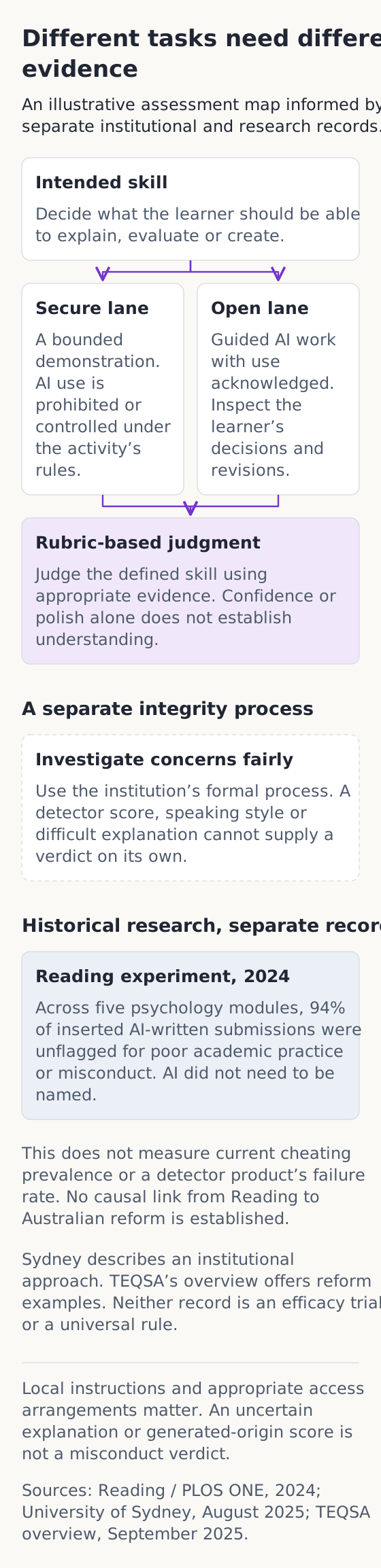
Parallel secure and open assessment lanes lead to rubric-based learning judgments; the integrity process and historical Reading experiment remain separate.
[Open the complete evidence diagram](/assets/education-workflow-assessment-evidence-20261015.svg)
Read the diagram
**Different tasks need different evidence**
An illustrative assessment map informed by separate institutional and research records.
- **Intended skill.** Decide what the learner should be able to explain, evaluate or create.
- **Secure lane.** A bounded demonstration. AI use is prohibited or controlled under the activity’s rules.
- **Open lane.** Guided AI work with use acknowledged. Inspect the learner’s decisions and revisions.
- **Rubric-based judgment.** Judge the defined skill using appropriate evidence. Confidence or polish alone does not establish understanding.
A separate integrity process
- **Investigate concerns fairly.** Use the institution’s formal process. A detector score, speaking style or difficult explanation cannot supply a verdict on its own.
Historical research, separate record
- **Reading experiment, 2024.** Across five psychology modules, 94% of inserted AI-written submissions were unflagged for poor academic practice or misconduct. AI did not need to be named.
This does not measure current cheating prevalence or a detector product’s failure rate. No causal link from Reading to Australian reform is established.
Sydney describes an institutional approach. TEQSA’s overview offers reform examples. Neither record is an efficacy trial or a universal rule.
**Reading the evidence.** Local instructions and appropriate access arrangements matter. An uncertain explanation or generated-origin score is not a misconduct verdict.
*Sources: Reading / PLOS ONE, 2024; University of Sydney, August 2025; TEQSA overview, September 2025.*
**Keep the comparisons separate.** Complementary forms of learning evidence, not sequential mandatory tasks.