AI market surveillance needs better questions, not simply fewer alerts
Nasdaq's 2026 surveillance updates make calibration a real product story, while client wins and quieter dashboards remain different from proven detection.
An alert is an invitation to investigate a pattern. It is not a finding that a trader broke a rule. That distinction becomes more important when AI enters surveillance: the technology may help organise activity or propose a different setting, while the people receiving the alert still need to understand the market, the data and the reason for reviewing it. A quieter dashboard is not automatically a better one.
Nasdaq’s 23 April 2026 business update provides a named example of this development. It identified the recently announced Calibration Copilot and a planned GenAI extension to its surveillance platform, alongside demand related to crypto surveillance. The update establishes a reported product milestone and a plan at that date. It does not disclose the complete detection method, demonstrate a reduction in market abuse or establish that the planned extension had already been delivered. [Nasdaq’s first-quarter update](https://ir.nasdaq.com/node/110321).
The company’s 23 July release adds a different kind of evidence: it reported a first Tier 1 client win for Calibration Copilot early in the third quarter. The wording matters. A client win is a commercial milestone, and the event is labelled early third quarter even though it appears in a second-quarter results release. Neither the quarter in the headline nor the presence of a customer establishes a completed deployment or measured detection performance. [Nasdaq’s second-quarter update](https://ir.nasdaq.com/news-releases/news-release-details/nasdaq-reports-second-quarter-2026-results-15-billion-net).
What calibration changes
In an educational surveillance exercise, calibration means examining how a chosen setting changes the cases brought to a reviewer’s attention. A setting might be appropriate for one activity pattern and unhelpful for another. The point is not to guess how Nasdaq’s undisclosed implementation works. It is to understand why an assistant that proposes changes must also support an intelligible comparison.
Suppose an offline demonstration produces fewer alerts after a change. Several explanations remain possible. Repeated records might have been removed correctly; a useful signal might have disappeared; a missing input might make the result look clean; or the setting might simply be less sensitive to the cases the exercise intended to find. The alert count alone cannot choose between these explanations.
There is also a difference between detecting a possible pattern and explaining it. An assistant may summarise a sequence of messages accurately but attach an unsupported interpretation. A reviewer may agree that a case deserves attention without knowing whether it indicates abuse. Good presentation leaves that uncertainty visible rather than converting a machine-generated label into an accusation about a person.
ESMA’s May 2024 announcement on AI in investment services identifies risks including data quality, opaque decisions, overreliance and privacy or security concerns. It places its expectations in the relevant MiFID II investment-services context. This is useful background for asking who can explain an AI-assisted decision, but it is not a universal legal classification of crypto activity or a compliance verdict on any particular platform. [ESMA’s statement announcement](https://www.esma.europa.eu/press-news/esma-news/esma-provides-guidance-firms-using-artificial-intelligence-investment-services).
FINRA’s 2026-edition oversight report gives another relevant vocabulary. Its GenAI section discusses observed use categories and risks involving autonomous agents, their authority, auditability and sensitive information. The edition’s cover is dated December 2025; it is not a new 2026 effectiveness experiment. The member-firm context also matters when interpreting its discussion, rather than treating it as a rulebook for every digital-asset service worldwide. [FINRA’s primary report, GenAI section](https://www.finra.org/sites/default/files/2025-12/2026-annual-regulatory-oversight-report.pdf).
A fictional alert-review workshop
A fictional adult training group in Frankfurt receives a synthetic record of activity on an imaginary digital-asset venue. There are no real customers, accounts or executable orders. The facilitator supplies a small set of cases with written explanations: some need further review, some contain duplicate messages, and one lacks part of its input feed. The exercise concerns the quality of review, not how to manipulate a market or avoid detection.
The group first studies the cases without an assistant. Each learner describes the available evidence and the question still unanswered. This establishes a useful comparison for later work: whether the tool helps them reach the appropriate next question. It does not assume that one label contains the entire truth about a complicated event.
Next, an assistant presents proposed summaries and a possible change to the demonstration’s settings. Learners keep the original output alongside the proposal. They inspect which cases move, why a case remains open and whether the missing feed is acknowledged. A proposal that quietly treats unavailable activity as absent activity should fail this exercise, even if its summary reads smoothly.
The facilitator then introduces a disagreement. One learner thinks the duplicate messages explain an alert; another wants to confirm that the remaining sequence is complete. The assistant should help them locate the relevant synthetic records, not settle the disagreement through confident wording. A useful result can be a well-specified request for another observation.
Finally, the group records a decision about the demonstration setting and its limits. A change is not presented as approved for a real venue. The record includes the cases considered, the original setting, the proposal and the reason for accepting or declining it within the exercise. Learners can later revisit whether a different input would have changed their conclusion.
Evidence a buyer or reviewer can actually use
A meaningful evaluation would compare more than the number of alerts. It would inspect cases newly surfaced, cases no longer surfaced, explanatory quality and the work needed to resolve disagreements. The people doing the review need a chance to identify important context that the prepared case labels missed. Otherwise the evaluation can reward agreement with an incomplete answer sheet.
Operational constraints are part of the result. An alert delivered after a relevant review window may be less useful than an earlier, less polished summary. A system that works with one data feed may behave differently when a venue adds another source or changes message formatting. Those are questions for a scoped evaluation; they are not shortcomings this article has observed in the named products.
The potential benefit is a more manageable route through complicated evidence. AI may help assemble context, identify inconsistent inputs and make a proposed adjustment easier to inspect. The potential failure is misplaced confidence: a team may accept a clean-looking result without noticing what the assistant has omitted. Both possibilities deserve attention before a business case is reduced to fewer hours or fewer alerts.
The developments reported by Nasdaq show that AI-assisted surveillance is a concrete product and commercial direction. They do not remove the distinction between a proposal, an alert, a reviewed case and a substantiated conclusion. Learning to keep those stages separate is useful preparation for working with such tools, and a better measure of understanding than learning to trust a dashboard that happens to be quiet.
Evidence diagram and readable guide
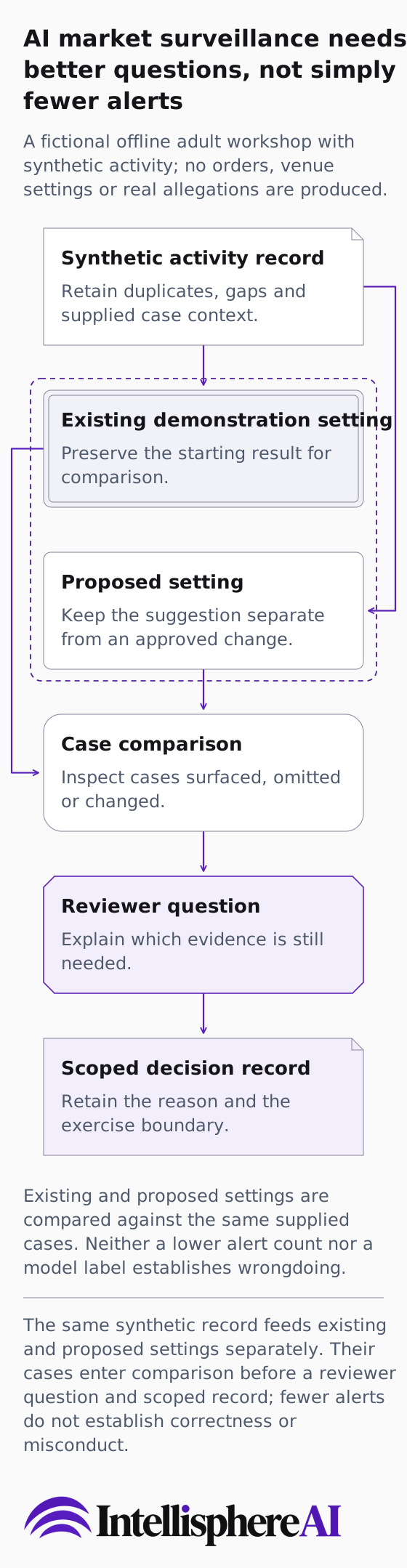
Original explanatory diagram: a fictional offline workshop compares existing and proposed settings against synthetic cases; no real venue setting, allegation or detection result is shown.
[Open the complete evidence diagram](/assets/crypto-evidence-surveillance-calibration-20261016.svg)
Read the diagram
**AI market surveillance needs better questions, not simply fewer alerts**
A fictional offline adult workshop with synthetic activity; no orders, venue settings or real allegations are produced.
- **Synthetic activity record** Retain duplicates, gaps and supplied case context.
- **Existing demonstration setting** Preserve the starting result for comparison.
- **Proposed setting** Keep the suggestion separate from an approved change.
- **Case comparison** Inspect cases surfaced, omitted or changed.
- **Reviewer question** Explain which evidence is still needed.
- **Scoped decision record** Retain the reason and the exercise boundary.
Existing and proposed settings are compared against the same supplied cases. Neither a lower alert count nor a model label establishes wrongdoing.
How the connections work
- The synthetic record provides the cases examined under the existing setting.
- The same supplied record also constrains the proposed demonstration setting.
- The starting cases enter comparison without being discarded by the proposal.
- The proposed cases supply a separate comparison input, not evidence of correctness.
- Case comparison identifies an unanswered question rather than declaring misconduct.
- The reviewer question travels with a limited decision record and its reasons.
Relationship key
The same synthetic record feeds existing and proposed settings separately. Their cases enter comparison before a reviewer question and scoped record; fewer alerts do not establish correctness or misconduct.