AI saved teachers planning time in one trial. What happened to the rest of the work?
English trial minutes, Karnataka’s curated lesson plans and TALIS self-reports reveal different parts of teachers’ changing work—and different limits.
Twenty-five minutes can be useful in a teacher's week. It can also become misleading when a result for one planning task is described as a reduction in the whole job. Research in England, implementation work in Karnataka and international survey evidence offer three different ways to examine what AI changes about teaching work.
The concrete development is assistance with preparing and adapting material. The difficult question is whether that assistance removes work, shifts it into review or creates capacity for something else. A measured task result, a teacher's reported experience and a national adoption figure are all informative, but they should never share an unexplained denominator.
The English trial measured a defined planning task
The [Education Endowment Foundation trial](https://educationendowmentfoundation.org.uk/projects-and-evaluation/projects/choices-in-edtech-using-generative-ai-chatgpt-for-ks3-science-lesson-preparation-2024-teacher-choices-trial) involved 259 teachers from 68 English secondary schools. It concerned preparation for Year 7 and Year 8 science. Its evaluation report was uploaded on 12 December 2024, so this is historical experimental evidence rather than a new 2026 trial.
The ChatGPT group recorded an average 56.2 minutes per week on the relevant lesson and resource planning, compared with 81.5 minutes in the comparison group. The difference was 25.3 minutes, or 31% of that measured task. It was not a 31% reduction in every participating teacher's total working week. The intervention included a guide, with five weeks to become familiar with it and ChatGPT before planning time was recorded in weeks six to ten.
Resource review was separate from student learning
The evaluators used an expert panel that did not know which resources involved ChatGPT. The EEF summary reports that quality did not appear to be affected in that review. This is different from demonstrating an improvement in pupils' attainment or proving that every generated explanation was correct.
An [NFER implementation poster](https://www.nfer.ac.uk/media/hgsfgupc/nfer-classroom-poster-chatgpt-for-lesson-planning-and-preparation.pdf) describes selective use for questions, activities, adaptation and clearer explanations. It comes from the same evaluation programme, not a second trial. The poster does not display an exact publication date, so no invented date is assigned to it here.
Karnataka shows the work around a lesson plan
The [first Shiksha copilot preprint](https://arxiv.org/html/2507.00456v1), submitted on 1 July 2025, studies an AI-assisted lesson-planning system in government schools in Karnataka, India. Its mixed-methods research involved 1,043 teachers and 23 curators. English and Kannada plans were co-created through a curation process, then further adapted by teachers. The archive also records a March 2026 revision; this account stays bound to the fixed first version.
The study examines reported experiences and practices in a real implementation context. It is not a randomised estimate comparable with the English planning-time result. Its account of documentation needs, staffing constraints and local-language adaptation helps reveal tasks that a simple generation-time measurement would miss.
International adoption is a survey result
The [OECD's Results from TALIS 2024](https://www.oecd.org/en/publications/results-from-talis-2024_90df6235-en/full-report/teaching-for-today-s-world_eefb146b.html), published in 2025, shows that around one in three lower-secondary teachers reported using AI in their work in the previous year, on average across OECD education systems. Among AI users, 64% reported using it to generate lesson plans or activities.
That second percentage concerns users of AI, not all teachers. TALIS reflects self-reports about the survey period; it is not an October 2026 usage census or an experiment showing productivity gains. The report also shows considerable variation between education systems. An average should not become an assumption about a particular school.
Keep three kinds of claim apart
| Evidence | Unit | Appropriate interpretation | | --- | --- | --- | | English randomised trial | Time on specified science preparation | A bounded task effect | | Karnataka mixed-methods study | Teachers, curators and implementation practices | Contextual experience and work organisation | | TALIS 2024 | Teachers' survey responses | Reported adoption and purposes | | Fictional exercise below | A sample activity and its revisions | A way to inspect the work, not an effect estimate |
This original table does not rank countries or compare their teachers' productivity. The studies answer different questions and provide different kinds of confidence.
An illustrative planning session
Imagine a fictional science department in Cardiff preparing a lesson about dissolving. Adult teachers use invented pupil responses and a teacher-owned explanation for a training exercise. This is not a local replication of the EEF trial or a deployment of Shiksha copilot.
An approved assistant proposes a short activity and questions. The teachers review whether the activity actually distinguishes dissolving from melting, whether the instructions fit the available materials and which wrong answer reveals a misconception. They keep the original draft beside the accepted version so the review work remains visible.
Measure accepted material, including the edits
In the fictional session, the first draft arrives quickly but uses an unsuitable example. The teacher spends time replacing it and rewriting the question. A stopwatch ending at generation would omit the work that made the resource usable. The department therefore records preparation, review and adaptation separately.
It also distinguishes an activity accepted with minor edits from one discarded entirely. These are proposed evaluation categories, not findings from the cited studies. They help a team ask whether the assistant is useful for its own tasks without assuming that an attractive draft is classroom-ready.
The exercise can be completed without entering real pupil names, attainment records or sensitive needs. Teachers can describe the instructional requirement in general terms and use invented examples. An assistant does not need a child's identity to propose alternative wording for a science question.
Local language changes more than the wording
The Karnataka study's curation process makes an important issue tangible. Adapting a plan involves examples, subject vocabulary, available materials and assumptions about the classroom. A fluent translation can preserve the words while missing those conditions.
In the fictional exercise, a teacher preparing a Welsh version asks an appropriately qualified colleague to review the subject meaning and learner suitability. This is a proposed task, not evidence that the cited system supports Welsh. Keeping the original and adapted plans connected makes disagreements easier to inspect.
Under-18 implementation also needs the school's approved tool and safeguarding arrangements. A teacher-only preparation exercise is different from providing children direct access to a conversational service. This reporting does not assert that either arrangement automatically meets every jurisdiction's requirements.
Saved time needs an honest destination
A task saving does not tell us what a school does with the capacity. It might support preparation for another class, discussion with colleagues or a less pressured evening. It might also be consumed by new documentation requirements. The cited records do not establish a universal outcome.
Leaders should therefore avoid treating an estimated saving as an immediate staffing reduction. Teachers still select objectives, recognise misconceptions, adapt resources and respond to learners. A new tool can change the composition of that work without reducing every part of it. Staff should have opportunities to describe costs that a narrow metric misses.
What to watch next
Stronger evidence would follow sustained use, accepted resource quality, total review effort and classroom outcomes separately. It would explain which teachers and subjects were included and which activities remained difficult. A wider language or feature list would not substitute for that evaluation.
Teachers and students can learn to inspect a generated resource against a clear learning objective; developers can preserve drafts and explain incomplete operations safely. No guaranteed grade gain, verified job loss or universal productivity rate is claimed here. This is educational, non-promotional reporting checked on 15 October 2026, with the measured task kept attached to its actual evidence.
Evidence diagram and readable guide
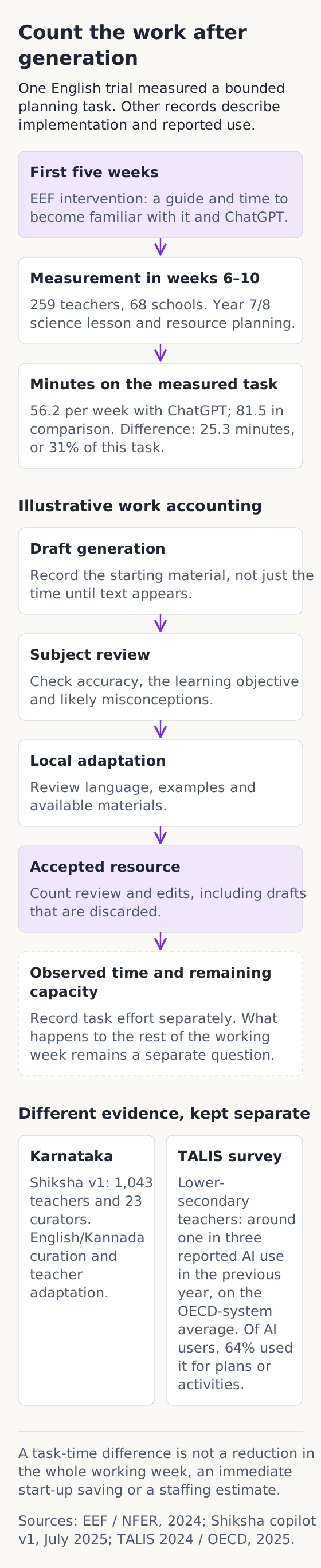
The planning diagram separates EEF familiarisation and measurement windows, a proposed resource-review workflow, whole-workload uncertainty and independent Karnataka/TALIS records.
[Open the complete evidence diagram](/assets/education-workflow-teacher-planning-20261015.svg)
Read the diagram
**Count the work after generation**
One English trial measured a bounded planning task. Other records describe implementation and reported use.
- **First five weeks.** EEF intervention: a guide and time to become familiar with it and ChatGPT.
- **Measurement in weeks 6–10.** 259 teachers, 68 schools. Year 7/8 science lesson and resource planning.
- **Minutes on the measured task.** 56.2 per week with ChatGPT; 81.5 in comparison. Difference: 25.3 minutes, or 31% of this task.
Illustrative work accounting
- **Draft generation.** Record the starting material, not just the time until text appears.
- **Subject review.** Check accuracy, the learning objective and likely misconceptions.
- **Local adaptation.** Review language, examples and available materials.
- **Accepted resource.** Count review and edits, including drafts that are discarded.
- **Observed time and remaining capacity.** Record task effort separately. What happens to the rest of the working week remains a separate question.
Different evidence, kept separate
- **Karnataka.** Shiksha v1: 1,043 teachers and 23 curators. English/Kannada curation and teacher adaptation.
- **TALIS survey.** Lower-secondary teachers: around one in three reported AI use in the previous year, on the OECD-system average. Of AI users, 64% used it for plans or activities.
**Reading the evidence.** A task-time difference is not a reduction in the whole working week, an immediate start-up saving or a staffing estimate.
*Sources: EEF / NFER, 2024; Shiksha copilot v1, July 2025; TALIS 2024 / OECD, 2025.*
**Keep the comparisons separate.** No shared productivity estimate; observational implementation and survey evidence answer different questions.