AI training should rehearse a confident answer that deserves rejection
Recent Singapore and Indian educational accounts support asking what adults can demonstrate after a course, including when they should reject a fluent answer.
An introductory AI course can teach people how to obtain a useful response while spending little time on the response they should decline to use. That imbalance matters in public security and defence administration. Staff may encounter a polished draft, a convenient summary or a suggested explanation without knowing how much support lies behind it. Training needs to make disagreement ordinary, not an embarrassing interruption of the demonstration.
This is a question about learning practice, distinct from deciding who owns an AI service or how many technical posts an institution needs. An adult can understand the organization chart and still struggle to challenge a plausible answer under time pressure. A carefully bounded classroom exercise can reveal that difficulty without using sensitive records, operational scenarios or real decisions about people.
Read programme announcements as programme evidence
Singapore’s Ministry of Home Affairs published a [30 September 2026 Home Team Academy training speech](https://www.mha.gov.sg/media-room/newsroom/home-team-academy-hta-home-team-training-excellence-trax-awards-ceremony-2026/). It describes communities of practice, an AI learning sprint, pilots for trainers and a training roadmap. Those are institutional accounts of initiatives and trials. They do not establish a controlled learning effect, and the Home Team context should not be relabelled as an armed-forces deployment.
India’s [28 March 2022 parliamentary reply on defence AI](https://www.pib.gov.in/Pressreleaseshare.aspx?PRID=1810442&lang=2®=48) distinguishes recommendations from a 2018 task force, organizations created in 2019 and later capacity-building activity. It reports that officers at different levels had been nominated to AI courses. This is a dated official description. It is not evidence that all personnel completed training, that a course changed behaviour or that its details remained unchanged in 2026.
A [25 June 2026 PIB account](https://www.pib.gov.in/Pressreleaseshare.aspx?PRID=2277724&lang=2®=48) describes a minister’s address to senior officers and course participants at India’s National Defence College on technology and national security. It shows that AI was part of that public educational discussion. A speech about strategic importance, however, is a different kind of evidence from an assessment of what participants learned or how they later used a tool.
These sources support a practical distinction between making training available, participating in it and demonstrating a usable skill. Each stage deserves an accurate description. An attendance record cannot automatically support a claim about judgment, just as an institution’s enthusiasm for AI cannot establish that every proposed use is appropriate. This article’s own classroom scenario remains fictional and supplies no measured training outcome.
A fictional adult learning session
Imagine a fictional adult public-administration training group in Bengaluru. Participants are practising how to review generated explanations of an invented classroom-equipment policy. All documents, names and records are synthetic. There is no operational content, personnel assessment or real procurement decision. The instructor wants participants to learn when a response is adequately supported, when it needs correction and when the available material cannot settle the question.
The session begins with two equally polished answers. One accurately reflects the supplied practice policy; the other adds an exception that the document never states. Participants compare the source with the answer and explain their decision. The task is not to identify an AI writing style. Both answers could have been written by a person. The relevant skill is recognizing the difference between a supported statement and a plausible addition.
The instructor then introduces a missing document. A question refers to an earlier edition that the exercise does not provide. A responsible participant can say that the evidence is incomplete. The exercise should not reward guessing the intended answer merely to keep the activity moving. Recognizing the need for another source is a useful learning result, even when it produces less impressive prose than a confident response.
Practise the correction, not only the criticism
Rejecting a draft is only part of the work. Participants should practise explaining what is wrong in ordinary language and preserving the supported parts. A correction might say that the available policy establishes the ordinary process but does not establish the claimed exception. That is more useful than a blanket statement that the system is unreliable. It directs the next person to the specific gap without concealing uncertainty.
A worked exercise can also include a disagreement between two adults. One thinks the wording permits an exception; another reads it more narrowly. The instructor asks which part of the synthetic source supports each interpretation and records the unresolved question if necessary. The purpose is not to replace expert policy interpretation with a classroom vote. It is to stop the generated answer from becoming the unquestioned authority in the discussion.
The interface matters too. A source link hidden below a long answer may be overlooked. A warning displayed after a participant has already copied the text may arrive too late to affect the task. The class can observe these behaviours without attributing them solely to individual carelessness. The learning environment, time allowed and information presentation all influence what the exercise can establish.
Observe a skill before claiming a benefit
An assessment should make its expectations visible before the exercise. For example, the participant should identify an unsupported statement, locate the relevant source and communicate a justified hold or correction. Merely producing a longer critique is not necessarily better. A concise explanation that distinguishes known facts from missing evidence may be more useful than a technically elaborate answer that obscures the next action.
The instructor should distinguish immediate practice from later retention and workplace transfer. A participant can succeed while the source is open and struggle later with a different document. A follow-up comparison can investigate that difference, but an initial session cannot supply the result in advance. Similarly, a favourable opinion survey is evidence about participants’ views, not automatically evidence that their reviewing skill improved.
The group can also record the work the exercise requires from trainers. Preparing synthetic cases, checking references and discussing disputed answers takes time. Those activities should not disappear from a claim that AI makes training easier. Potential benefits such as more varied practice or clearer feedback are reasons to investigate. This fictional session measures neither workload reduction nor improved public-security outcomes.
Keep the training claim narrow
The official records describe serious institutional attention to AI learning, from historical capacity building to current trainer pilots. They do not justify treating exposure to a tool as proof of sound judgment. The useful question for a new course is what an adult can demonstrate, with which evidence and under which conditions.
A training programme becomes more informative when it includes an answer that deserves rejection and gives people a constructive way to reject it. That does not make every future decision safe or correct. It does give the institution a more honest account of the skill it is trying to teach.
Evidence diagram and readable guide
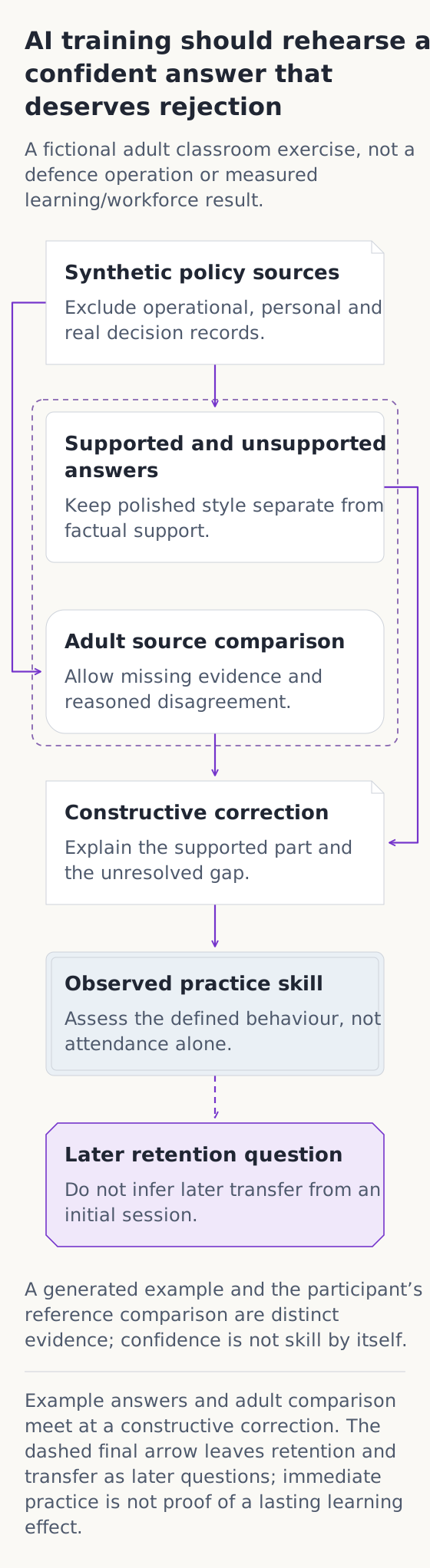
Original explanatory diagram: a fictional adult learning exercise separates supported correction, observed practice and later retention questions.
[Open the complete evidence diagram](/assets/defence-workflow-training-judgment-20261015.svg)
Read the diagram
**AI training should rehearse a confident answer that deserves rejection**
A fictional adult classroom exercise, not a defence operation or measured learning/workforce result.
- **Synthetic policy sources** Exclude operational, personal and real decision records.
- **Supported and unsupported answers** Keep polished style separate from factual support.
- **Adult source comparison** Allow missing evidence and reasoned disagreement.
- **Constructive correction** Explain the supported part and the unresolved gap.
- **Observed practice skill** Assess the defined behaviour, not attendance alone.
- **Later retention question** Do not infer later transfer from an initial session.
A generated example and the participant’s reference comparison are distinct evidence; confidence is not skill by itself.
How the connections work
- Synthetic policy sources are used to prepare supported and unsupported examples.
- The same sources remain available for the adult comparison.
- The example answers are considered in a constructive correction.
- The adult source comparison supplies the separate reference for that correction.
- The correction provides an opportunity to observe the defined practice skill.
- Observed immediate practice leaves later retention and transfer as separate questions.
Relationship key
Example answers and adult comparison meet at a constructive correction. The dashed final arrow leaves retention and transfer as later questions; immediate practice is not proof of a lasting learning effect.