AlphaGenome turns DNA changes into testable questions about gene control
AlphaGenome and Calico’s Borzoi show how sequence models can guide experiments on gene regulation while leaving personal diagnosis and patient benefit unestablished.
A small change in DNA can matter without altering a protein's recipe. It might change when a gene is active, how its RNA is assembled or which regulatory switch a cell uses. Finding the consequential change among many candidates is a difficult research problem. A useful AI system would help scientists choose a better experiment rather than announce a diagnosis from a sequence alone.
That is the opportunity behind AlphaGenome, Google DeepMind's sequence model described in a January 2026 Nature paper. Its importance becomes clearer beside Borzoi, a separate model developed at Calico. Together they show how prediction is moving beyond a list of genes towards the activities that connect sequence with biology. Neither makes experimental confirmation optional.
What AlphaGenome actually predicts
The [AlphaGenome paper](https://www.nature.com/articles/s41586-025-10014-0) describes a model taking one million DNA base pairs and predicting multiple kinds of molecular measurements. These include gene expression, RNA splicing and properties of chromatin, the material in which DNA is packaged. The researchers trained it using human and mouse data and tested predictions against existing experimental measurements.
The scale matters because a regulatory element can sit some distance from the gene it influences. Higher resolution matters because a small sequence change can affect a precise boundary. Those are capabilities for investigating mechanisms. They do not establish that a particular person will develop a disease or benefit from a treatment.
A second programme makes the scientific direction clearer
[Borzoi's Nature Genetics paper](https://www.nature.com/articles/s41588-024-02053-6), published online on 8 January 2025, approaches gene regulation through predicted RNA sequencing coverage. Instead of only estimating a gene's overall activity, it models where measured RNA would occur along a sequence. That can inform investigations of transcription, splicing and the processing of RNA ends.
Calico's [implementation repository](https://github.com/calico/borzoi) specifies 524-kilobase inputs and coverage predictions at 32-base-pair resolution. These dimensions describe a different research design from AlphaGenome. They are not scores on a universal clinical leaderboard. The two programmes also draw on shared public biological resources, so separate authorship should not be confused with entirely independent underlying data.
Why the same DNA change needs several views
Imagine a map with roads, traffic and opening hours on separate layers. A road can exist without being used at a particular time. Similarly, a regulatory sequence can have different consequences across cellular settings. A model prediction becomes more interpretable when the reader can see which measurement and biological context it concerns.
For research planning, the interesting question is often whether several predicted effects tell a coherent story. A candidate change might alter a binding feature and a nearby RNA pattern. Agreement can help prioritise investigation, but correlated predictions can also share the same blind spot. Counting several agreeing outputs as several independent experiments would overstate the evidence.
The evidence ladder is shorter than the clinical journey
| Record | What it establishes | What remains separate | | --- | --- | --- | | AlphaGenome, January 2026 | A multi-output sequence prediction model and reported benchmark evaluations | Individual diagnosis and demonstrated patient benefit | | Borzoi, January 2025 | A different sequence-to-RNA modelling approach | Validation of a particular laboratory hypothesis | | Borzoi research repository | Available implementation instructions and model dimensions | Permission for every intended data use or deployment | | DeepMind research-use statement | Developer's stated intended-use boundary | Independent clinical acceptance |
The [DeepMind release](https://deepmind.google/blog/alphagenome-ai-for-better-understanding-the-genome/) originally appeared on 25 June 2025 and was updated to reference the Nature publication in January 2026. It explicitly says predictions are for research and have not been designed or validated for direct clinical purposes. The release and paper describe the same programme, not two replications.
An illustrative laboratory question
Consider a fictional university group in Bengaluru studying how a regulatory region affects RNA processing in an established experimental cell model. This is an invented educational example, not a report of an Indian deployment. The group has three candidate changes in a public research sequence and capacity to investigate only a small subset.
The team records each candidate's reference sequence, alternative sequence, genome assembly and relevant cellular context. It examines predicted differences and writes a short explanation of the mechanism each experiment could test. A candidate with an interesting score but no interpretable experimental question stays unresolved. The AI ranking guides discussion; it does not become a finding in the laboratory notebook.
Design the experiment before admiring the prediction
In the fictional exercise, a researcher asks what result would contradict the proposed mechanism. That question forces a distinction between a model suggesting altered RNA processing and the laboratory actually measuring such a change. Controls and comparison conditions should be selected by qualified researchers for the experiment, not invented by a general chatbot.
The group also keeps candidates that the model ranked poorly in a separate comparison set. Otherwise, choosing only appealing predictions can hide systematic misses. Its report distinguishes a technically failed measurement from a result that disagrees with the hypothesis. Both are informative, but they answer different questions about the sequence model.
This proposed workflow is editorial analysis. The cited records do not establish that it improves discovery rates in this fictional laboratory. Measuring that would require a defined comparison, enough experiments and transparent accounting of unsuccessful candidates.
What developers can build around the science
A valuable research interface can show reference and alternative predictions side by side, retain the exact model version and link each output to its measurement type. It should make unsupported cell contexts visible. A colourful curve without an explanation of its units is difficult to inspect and easy to overinterpret.
Developers should also distinguish unavailable predictions from predictions of little change. If a service cannot process a sequence, an empty chart must not imply biological normality. Preserve the researcher's draft and explain that the analysis could not be completed. Any retained inputs need an approved data boundary; a public research demonstration is not an appropriate destination for an identifiable personal genome.
Reusing code requires checking its actual licence and the terms attached to weights, datasets and hosted services separately. A repository being readable does not settle all those questions. No model was downloaded or executed for this article.
How students and laboratory workers can learn safely
A student can start with a published, non-identifying sequence example and draw the chain from sequence change to proposed molecular effect to an experiment that might test it. The learning goal is explaining the uncertainty at each step. There is no need to upload a relative's genetic report or infer a personal health risk.
For laboratory workers, the emerging skill is translating predictions into carefully scoped questions and keeping computational and experimental records connected. Biologists supply context that a model output does not contain automatically. Data specialists help preserve sequence identity, provenance and reproducibility. These are changing tasks; the available studies do not support a prediction of a particular number of jobs disappearing.
What would make the next result more convincing
Watch for independent tests on genuinely new experimental settings, clear accounts of where models disagree and prospective evidence that prioritisation improves useful discoveries. A larger benchmark score is informative only alongside the task, comparison and failure cases. Models could become powerful scientific search tools while remaining unsuitable for some biological questions.
This is educational reporting about research methods, not promotion of a service, personal genetic interpretation or medical guidance. Sources were checked on 15 October 2026. The important advance is a richer way to formulate a hypothesis; the scientific work begins when that hypothesis meets a measurement.
Research pathway and readable guide
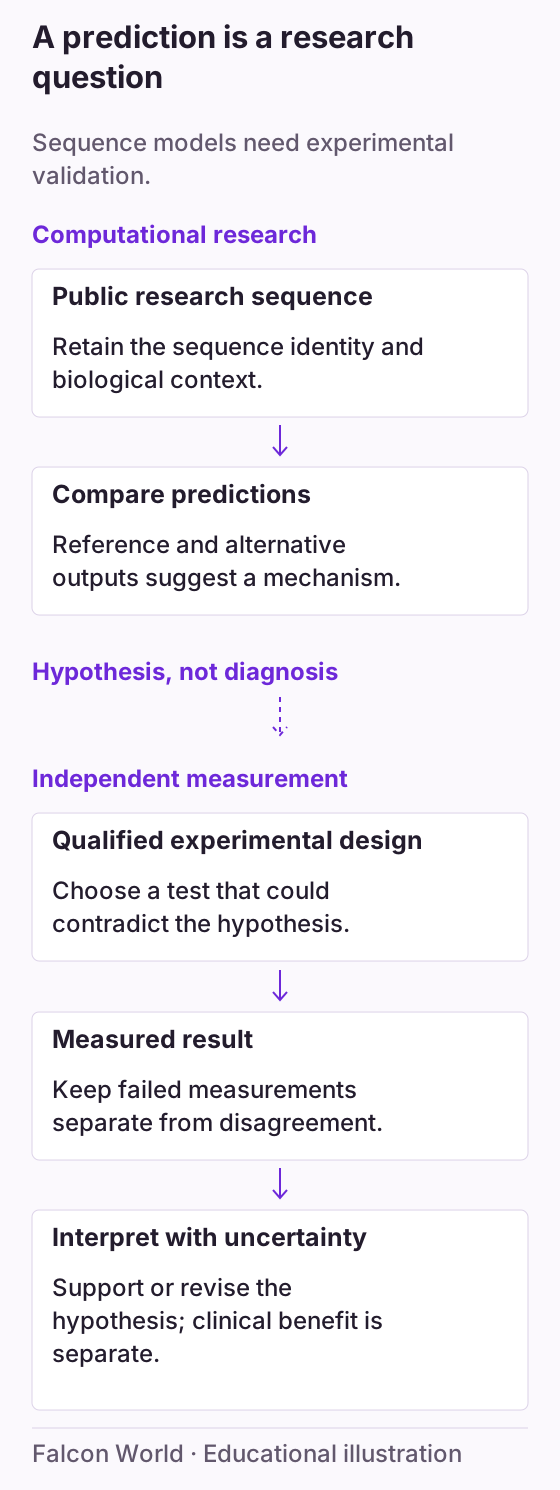
Original educational diagram of research boundaries and a fictional example. Not personal medical advice, a treatment instruction, regulatory approval or an actual clinical deployment.
[Open the complete research diagram](/assets/healthcare-workflow-genomics-20261015.svg)
Read the diagram
**A prediction is a research question**
Sequence models need experimental validation.
**Computational research**
- **Public research sequence.** Retain the sequence identity and biological context.
- **Compare predictions.** Reference and alternative outputs suggest a mechanism.
**Hypothesis, not diagnosis**
**Independent measurement**
- **Qualified experimental design.** Choose a test that could contradict the hypothesis.
- **Measured result.** Keep failed measurements separate from disagreement.
- **Interpret with uncertainty.** Support or revise the hypothesis; clinical benefit is separate.
*Falcon World · Educational illustration*
These pathways describe different research tasks and evidence boundaries. An arrow does not establish that one study caused another or that a research finding leads automatically to clinical benefit.