AMIE's video consultations show progress; real users expose a different test
AMIE’s simulated video consultations, supervised clinical feasibility and Oxford’s public-user experiment answer three different questions about conversational medical AI.
A convincing medical conversation can be technically impressive and still leave a person unsure what to do. Researchers are now testing both sides of that problem: whether AI can interpret a richer consultation and whether people can use its answers effectively. These are related questions with different evidence.
Google's AMIE research programme reported real-time video consultations with patient actors in August 2026. An earlier clinical feasibility study involved people awaiting primary-care appointments. Separately, Oxford-led research with 1,298 UK participants found that strong standalone model performance did not translate into better decisions in its scenario exercise. Together the studies make a more useful story than a universal claim about an AI doctor.
What the August video study demonstrated
The [AMIE video preprint](https://arxiv.org/html/2608.09861v1), submitted on 10 August 2026, describes a system combining rapid dialogue, planning and audiovisual perception. Its randomised examination-style study involved 30 primary-care physicians, 15 patient actors and 100 clinical scenarios, comparing video and text configurations with physicians consulting by video.
The authors report favourable clinical-evaluator ratings on several consultation dimensions. Patient actors preferred some features of AMIE's approach, while physicians were preferred for rapport and partnership. The difference on those dimensions was not statistically significant. These are findings from simulated consultations. They do not establish that autonomous video care improves health outcomes in an unrestricted patient population. The record remains a preprint in the version used here.
The clinical feasibility study had active supervision
The [March 2026 AMIE clinical manuscript](https://arxiv.org/html/2603.08448v1) describes a single-centre, single-arm study at Beth Israel Deaconess Medical Center, conducted from April through November 2025. Adults interacted through text before an urgent primary-care appointment. Human safety supervisors monitored the conversations, and patients still attended their scheduled clinical visit.
Its participation table identifies 98 people completing both the AI interaction and the clinician encounter. The abstract's 100 completed chats refers to a different step. These counts should not be merged. The absence of supervisor-triggered conversation stops under predefined criteria also does not mean every statement was correct or that unsupervised use was tested.
Oxford tested people using general-purpose models
The [Oxford-led Nature Medicine study](https://www.nature.com/articles/s41591-025-04074-y), published on 9 February 2026, randomly assigned 1,298 UK participants to model assistance or a control approach across ten medical scenarios. It tested GPT-4o, Llama 3 and Command R+, not AMIE. Participants using those models did not outperform the control group on the study's condition-identification and disposition tasks.
This was a controlled scenario study rather than a clinical trial of health outcomes. Nevertheless, it examined actual human interaction rather than assuming that a model answering a complete vignette represents a person trying to explain a concern. Its updated publisher page records a correction on 17 April 2026; this article relies on the current displayed study text.
Keep the three questions separate
| Study | Participants and setting | Main interpretation boundary | | --- | --- | --- | | AMIE video, August 2026 | Physicians and patient actors; simulated consultations | Consultation ratings, not real-world clinical benefit | | AMIE clinical manuscript, March 2026 | Supervised adults awaiting an appointment | Feasibility of a supported workflow | | Oxford, February 2026 | UK public participants; ten scenarios | Human–model interaction with different systems |
The Oxford result does not directly disprove the AMIE findings. The systems, participants and tasks differ. The comparison instead exposes the unanswered transition: a system that performs well under a structured evaluation must still work with people who omit details, misunderstand questions or interpret a suggestion differently from its authors.
Why more senses do not remove the interaction problem
Video offers information a text box cannot carry, but it also introduces choices about framing, sound and what a system can actually observe. A person may believe the system has seen something outside the camera view. The system may generate an interpretation despite an unclear signal. These are design questions raised by the modality, not failures independently demonstrated in the AMIE study.
The useful test is whether the interface and conversation make those limits understandable. A plain statement that a view or recording is insufficient is more useful than a confident inference from missing information. The person should be able to correct a misunderstanding without restarting the entire exchange.
A fictional appointment-preparation exercise
Consider a fictional community clinic in Bristol designing an educational prototype that helps people prepare questions for an already scheduled visit. This is not an AMIE deployment or a diagnostic service. Its role is to organise what the person wants to discuss and produce a draft the person can review.
The team tests invented scenarios in which an actor is interrupted, changes an answer or cannot hear a question. The prototype repeats uncertain information for confirmation and keeps unresolved points visible. It does not generate a treatment recommendation or imply that the scheduled appointment has been replaced.
Test comprehension after the conversation
In the fictional exercise, a researcher asks the actor to explain what the draft says, which points remain uncertain and what happens next. A participant liking the conversation is useful feedback, but it does not prove that the information was understood. A fluent summary may conceal a mistaken assumption the actor never noticed.
The team retains the actor's corrections beside the initial draft for evaluation, using invented content rather than private health records. It records whether corrections survive into the final version. This is a proposed learning method, not an outcome measured by the cited studies.
The evaluation also includes a refusal to continue. People should have a clear exit and an alternative route through the existing service. A prototype that works only for confident, uninterrupted users answers a narrower question than a public-facing product would need to answer.
Supervision is part of the system being tested
The AMIE clinical study's monitored conversations are evidence about the combined workflow. Removing a supervisor changes that workflow. A service cannot inherit the same evidence merely by retaining the chatbot's name or producing a similar-looking transcript.
If a future implementation claims efficiency, count the time spent monitoring, debriefing and resolving misunderstandings, as well as the clinician's preparation time. The March manuscript describes infrastructure and onboarding considerations that help explain why real-world studies are valuable. A smooth conversation on a demonstration screen does not reveal those operational demands.
This article does not recommend a tool for assessing symptoms or making care decisions. No patient interaction was conducted and no model was tested by the author. People evaluating services should use qualified clinical oversight and the appropriate research and information-governance process.
What this means for patient-service work
The emerging work includes conversation design, accessibility testing, clinical supervision and careful handoffs into existing care. Reception and patient-support staff understand repeated questions and points of confusion that a benchmark may miss. Their experience can help define tests that reflect a service's actual users.
Students can compare the three study designs and explain what each can and cannot support. A screen-only exercise using fictional dialogue can examine corrections, uncertainty and interrupted sessions without offering medical advice. Developers should learn that preserving a draft and explaining an unavailable service are part of a trustworthy interaction.
Follow the next studies for broader populations, clear supervision requirements and outcomes extending beyond satisfaction or evaluator ratings. These records do not establish a universal replacement for clinicians or a forecast of job losses. This is educational, non-promotional reporting checked on 15 October 2026: progress in clinical conversation is meaningful when people can understand and use it safely.
Research pathway and readable guide
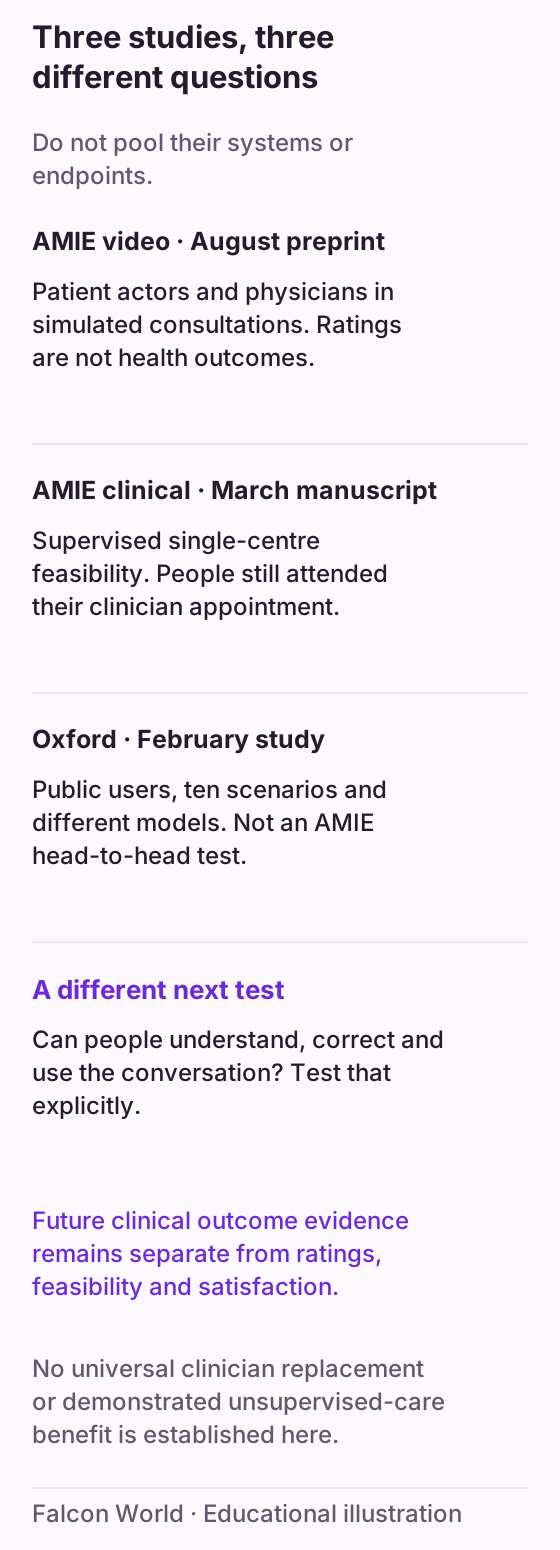
Original educational diagram of research boundaries and a fictional example. Not personal medical advice, a treatment instruction, regulatory approval or an actual clinical deployment.
[Open the complete research diagram](/assets/healthcare-workflow-patient-conversations-20261015.svg)
Read the diagram
**Three studies, three different questions**
Do not pool their systems or endpoints.
- **AMIE video · August preprint.** Patient actors and physicians in simulated consultations. Ratings are not health outcomes.
- **AMIE clinical · March manuscript.** Supervised single-centre feasibility. People still attended their clinician appointment.
- **Oxford · February study.** Public users, ten scenarios and different models. Not an AMIE head-to-head test.
- **A different next test.** Can people understand, correct and use the conversation? Test that explicitly.
**Future clinical outcome evidence remains separate from ratings, feasibility and satisfaction.**
No universal clinician replacement or demonstrated unsupervised-care benefit is established here.
*Falcon World · Educational illustration*
These pathways describe different research tasks and evidence boundaries. An arrow does not establish that one study caused another or that a research finding leads automatically to clinical benefit.