An accounting AI needs an evidence packet before it writes the audit memo
A supplier-contract example shows how source authority, amendments and reviewer decisions turn a fluent summary into traceable preparation.
A finance assistant can find an apparent inconsistency in a contract within seconds. The harder question is whether an accountant can reconstruct how it reached that conclusion, distinguish an expired clause from the operative agreement and explain why the difference matters. Audit preparation is therefore a useful place to examine AI without confusing attractive writing with evidence.
This article examines an original, fictional supplier-contract review workflow. Three primary resources were checked on 15 October 2026. They describe professional learning, historical outreach and current data-governance analysis; none proves that this workflow has been deployed or that auditors can surrender professional responsibility to a model.
What the available evidence actually says
The [PCAOB staff Spotlight from July 2024](https://pcaobus.org/documents/generative-ai-spotlight.pdf) reports limited outreach, mainly involving larger audit firms and several preparers. It describes early administrative and research uses alongside concerns about reliable output and confidential inputs. It is a staff publication, not a Board rule or a representative 2026 adoption census.
The public introduction to [IFAC's AI and accounting resource collection](https://www.ifac.org/knowledge-gateway/discussion/artificial-intelligence-accounting) distinguishes different types of AI and professional questions. Its deeper material requires an account; no restricted pages were accessed here. A resource library provides learning directions, not an evaluation of a particular finance product.
The [FSI analysis published through BIS on 26 March 2026](https://www.bis.org/publications/fsi-insight-73-data-we-trust-emerging-policy-and-supervisory-approaches-ai-data-use-financial-services) examines data quality, privacy and dependencies. Its authors' views are not necessarily the BIS's institutional position. Together these sources make provenance a concrete engineering question rather than a decorative citation at the bottom of a memo.
The fictional case: a supplier agreement with several versions
Imagine a finance team in Toronto preparing evidence for a review of supplier commitments. The archive contains an original service agreement, an amendment, an unsigned draft and an email referring to a possible future change. The team wants help finding passages relevant to an accounting question. It does not ask the assistant to determine the accounting treatment or certify the financial statements.
Start with a document register. Record who supplied each file, whether it is signed, its date, the period it covers and whether it supersedes another document. Keep an original copy and a separate searchable representation. An extracted page is useful only if the reviewer can return to the right original. A file named final does not establish contractual authority.
Then define the question narrowly: which reviewed documents describe termination rights for this supplier relationship during the relevant reporting period? Avoid an instruction such as tell us everything important. A narrow question lets the team examine completeness and disagreement. A broad summary can hide that the model used the unsigned draft because its wording was clearer.
Build an evidence packet before a narrative
The first output should be a structured candidate packet: document identifier, page or section, short relevant passage, date, status and reason it may matter. A reviewer should be able to mark an item relevant, irrelevant or unresolved. Keep a distinct place for missing amendments and conflicting dates. Do not turn unresolved items into a confident conclusion merely to finish the task.
Use a deterministic document register to decide which files the assistant may access. The language model should not give itself access to the payroll folder or a different client's archive because it believes that information would help. If the task requires another document, it can request the authorised person to supply it. This is a proposed boundary for the example, not a claim that a particular vendor enforces it.
The narrative comes later. After the accountant accepts the packet, an assistant may draft a description of the documents reviewed and questions still open. The draft should preserve the distinction between a fact, an interpretation and an item requiring advice. It should never describe model confidence as equivalent to the strength of the underlying evidence.
A review table that makes disagreement visible
| Item in the example | Permitted assistant contribution | Human acceptance question | | --- | --- | --- | | Signed agreement | Locate the relevant section | Is this the operative document for the period? | | Later amendment | Identify the changed language | Does it supersede the clause under review? | | Unsigned draft | Flag its different status | Should it be excluded from the evidence set? | | Informal email | Identify a possible missing record | What additional authoritative evidence is needed? |
These are fictional items, not records from an actual company. Their purpose is to show why a source link alone is insufficient. A system can cite a real file while using it for the wrong period or treating a proposal as an accepted contractual change.
Test the mistakes that ordinary accuracy misses
Prepare evaluation cases before the first demonstration. Include a scanned page with a poor date, an amendment that changes only one provision, two entities with similar names and a missing signature page. Ask the assistant to identify uncertainty. A system that refuses an unsupported conclusion can be more useful than one that fills every box.
Compare the proposed workflow with the team's existing process. Measure time to an accepted packet, reviewer corrections, missing relevant passages and the time needed to reconstruct a disputed answer. Count retrieval and review work, not just generation time. Do not infer a saving from one successful example or assign an arbitrary productivity percentage to the whole finance department.
Run the initial comparison with permitted synthetic or appropriately controlled records. A realistic document is not automatically authorised for an external model service. Confirm the information boundary before testing. If an approved hosted route is used, record the relevant service configuration and retention arrangements; the location of the provider's headquarters does not establish where every request is handled.
Keep changes and failures understandable
A model upgrade can change which passage it chooses. Save the model identifier, retrieval collection version and accepted packet for important reviews. Re-run targeted cases when an agreement changes, extraction software is replaced or a model version changes. A log of successful calls without the document versions cannot explain why an answer differed later.
When extraction fails, show the reviewer which document remains unreadable and offer the original file. When a source disappears, retain the record of the earlier review subject to the organisation's retention rules. Never silently substitute a different document and call the original task complete. Recovery needs to preserve the accepted evidence as well as the user's draft.
What changes for accountants and students
The useful skills include identifying authority, controlling document versions, evaluating retrieval and explaining uncertainty to another professional. These complement accounting knowledge. They do not make the knowledge unnecessary. A junior accountant should practise tracing a finding back to a document before relying on a polished generated memo.
A student can build a miniature archive with three invented supplier agreements and one amendment. Write the expected relevant sections before using an assistant. Record one incorrect selection, the reason it was tempting and how the register prevented it. This teaches auditability without uploading confidential client files or pretending to conduct a regulated audit.
The workforce question is whether the process reduces unproductive searching while maintaining opportunities to learn judgment. If junior staff only approve prewritten conclusions, the team may lose the very experience needed for difficult reviews. Managers should examine learning and correction patterns alongside speed. Neither the cited historical outreach nor this fictional example establishes a particular headcount reduction.
What to follow next
Follow published evaluations that report accepted outcomes, document boundaries and reviewer effort. Ask vendors for task-specific evidence instead of a generic demonstration of fluent summaries. Preserve the earlier dated research when new evidence appears, so readers can understand what changed. This is educational analysis of accounting workflows, not a recommendation of a provider, an audit opinion or financial advice.
Workflow diagram and readable guide
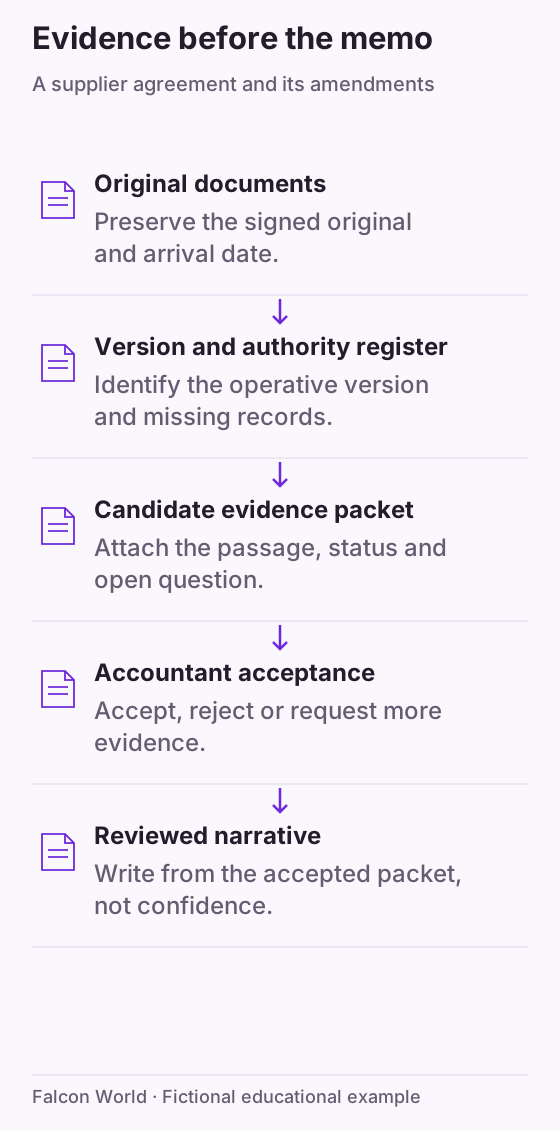
Original diagram of a fictional worked example; not a regulator-issued checklist, compliance certification or actual deployment.
[Open the complete workflow diagram](/assets/financial-workflow-finance-audit-20261015.svg)
Read the diagram
**Evidence before the memo**
A supplier agreement and its amendments
1. **Original documents.** Preserve the signed original and arrival date.
2. **Version and authority register.** Identify the operative version and missing records.
3. **Candidate evidence packet.** Attach the passage, status and open question.
4. **Accountant acceptance.** Accept, reject or request more evidence.
5. **Reviewed narrative.** Write from the accepted packet, not confidence.
*Falcon World · Fictional educational example*