An AI-content label has to survive the journey from generation to publication
A synthetic image can be clearly labelled in the application that created it and become ambiguous after someone downloads, crops and republishes it. An audio clip can carry a spoken disclosure that disappears when a short excerpt is taken. Transparency is therefore a journey through interfaces, file
A synthetic image can be clearly labelled in the application that created it and become ambiguous after someone downloads, crops and republishes it. An audio clip can carry a spoken disclosure that disappears when a short excerpt is taken. Transparency is therefore a journey through interfaces, files and publishing decisions. A team needs to know which actor adds which information, what can be lost during a transformation and what a reader can still understand at the destination.
Consider a fictional adult editor, Leila, preparing a public-interest explainer with synthetic illustrations and a generated narration. Her team uses invented people and records. It wants readers to understand what was generated and what evidence supports the article. The editorial question is not solved by placing a small icon in the original production workspace. It needs a publishing plan that follows the illustration and narration through the formats the audience will actually receive.
Similar goals do not imply identical duties
China’s AI-generated-content labelling measures distinguish explicit and implicit labels and allocate duties to covered generation services, dissemination services, app-distribution platforms and users. The notice was published on 14 March 2025; the measures took effect on 1 September 2025. The actor-specific provisions should not be collapsed into a claim that every person has exactly the same technical obligation. [Cyberspace Administration of China and other departments](https://www.cac.gov.cn/2025-03/14/c_1743654684782215.htm)
The European Commission published Article 50 transparency guidelines on 20 July 2026 and updated the page on 31 July. Its page states that the transparency obligations apply from 2 August 2026. Guidelines provide practical interpretation; the binding obligations, actor categories and exceptions remain matters to assess under the AI Act itself. [European Commission](https://digital-strategy.ec.europa.eu/en/library/guidelines-transparency-obligations-providers-and-deployers-ai-systems)
The Commission describes its Code of Practice on Transparency of AI-generated Content as a voluntary tool supporting compliance with AI Act transparency obligations. A voluntary code and a statutory duty have different status. Participating in a code should not be advertised as automatic legal approval, and choosing another approach does not make the underlying statutory question disappear. [European Commission](https://digital-strategy.ec.europa.eu/en/policies/code-practice-ai-generated-content)
NIST’s July 2024 Generative AI Profile is a companion resource to the voluntary AI Risk Management Framework. It can inform a discussion of generative-AI risks, but it is not a content-labelling law or an authorisation to publish synthetic media. Its release date and voluntary status should remain visible when it is cited in a publishing policy. [US National Institute of Standards and Technology](https://nvlpubs.nist.gov/nistpubs/ai/NIST.AI.600-1.pdf)
For Leila’s team, the useful comparison is between responsibilities along the content journey. The legal and policy review asks which instruments apply to each actor and destination. The editorial review asks whether an ordinary reader can understand the content’s origin and the article’s evidence. A clear reader experience can support good practice without being presented as proof that every legal requirement has been met.
Keep origin information separate from factual verification
A label saying that an image was generated tells the reader something about production. It does not tell them whether the accompanying claim is correct. An illustration of a parliamentary chamber, for example, might be synthetic while the article’s account of a vote requires dated official evidence. The publisher should maintain both records: the media’s provenance and the sources supporting the factual narrative. Combining them under one “verified” badge would make it harder to see which question has actually been checked.
Leila can assign each synthetic asset a production record that explains its intended editorial role. A caption might describe it as an illustration of a fictional public-service workflow rather than a photograph of an actual government deployment. The record can also identify restrictions, such as avoiding real officials, official seals or interfaces that imply an endorsement. These are proposed editorial controls; they do not reproduce a regulator’s prescribed form or claim that a generic caption satisfies every jurisdiction.
The article’s factual review then works independently. It checks whether dates refer to proposal, adoption, application or a later update. If the illustration shows a hypothetical future process, the article should not imply that the process is already operating. This is especially important for policy stories, where a convincing image can accidentally lend reality to a plan that remains only proposed. A source link and a clear caption serve different but complementary purposes.
Test transformations that can remove useful information
The team can build a small synthetic test set: an image with production metadata, an image exported through a common editing step, an audio file with a spoken disclosure and a short excerpt intended for another format. It records which information survives each transformation. The test should observe the actual files and destination interface rather than assume that a label survives because it was present in the master file. A missing field becomes an identified gap, not a successful test.
Visible information also needs review. A caption may be readable on a desktop article and disappear below a cropped mobile preview. A disclosure might depend only on colour, or a screen reader might encounter a filename instead of a meaningful explanation. The team should inspect the ordinary reader journey, including an image that fails to load. A clear fallback can preserve the explanation of the illustration even when the asset itself is unavailable.
Where a publishing workflow crosses organisations, the handoff needs an owner. The originating team can state what it supplied, while the receiving editor confirms how the content will appear. A contract or policy may allocate responsibilities, but the operational check still needs to observe the final result. The team should avoid saying that a downstream publisher retained a disclosure unless it actually inspected the relevant version or obtained appropriate evidence.
Give uncertainty a place in the publication decision
Suppose Leila’s audio excerpt loses its spoken context during editing. The production record should flag that change before publication, and the editor can decide how to restore an appropriate explanation. If the team cannot establish which rule applies to the destination, it can hold that distribution step for specialist review while continuing work on the source article. Uncertainty should affect the relevant action; it should not be hidden inside a broad assurance statement.
An illustrative editorial checklist can ask who generated the content, which parts are synthetic, who will publish it, which transformations occur, what information is carried inside the file and what the audience sees or hears. It can ask who reviews the final version and where the supporting factual sources remain available. Those questions should be adapted to the actual media and jurisdiction instead of treated as a universal legal template.
An adult student can practise by following one invented illustration through three output formats and explaining which provenance information is retained in each. The exercise does not require publishing anything or imitating a real official event. As of 15 October 2026, the official developments above support the stated status distinctions. The proposed journey and tests are editorial methods for making responsibility visible, not certification, a complete interpretation of Chinese or EU law, or a guarantee that a label prevents deception.
Evidence diagram and readable guide
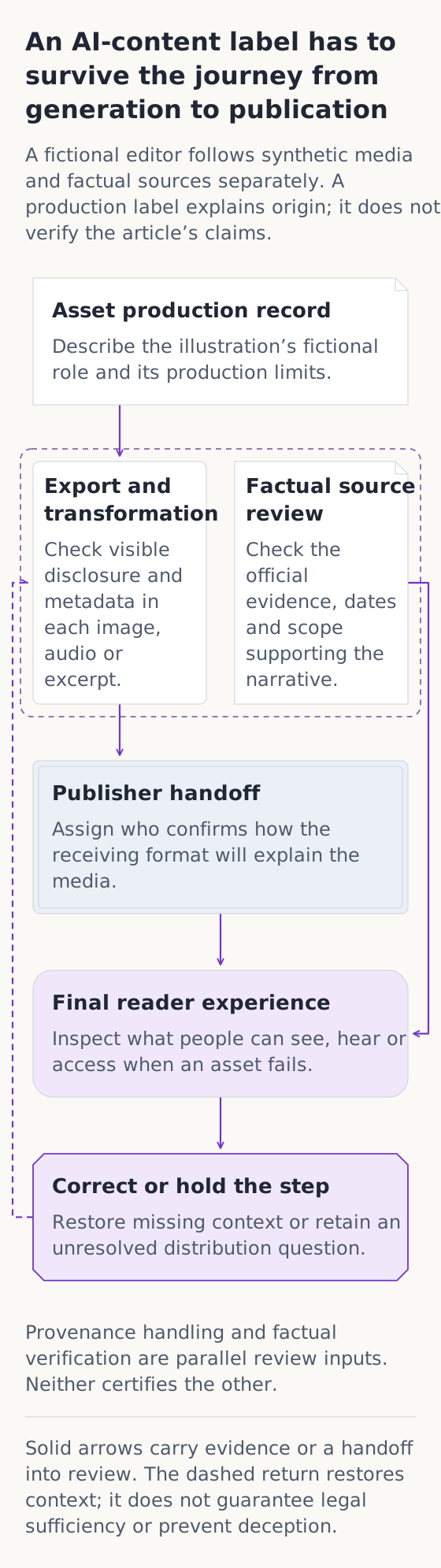
Original explanatory publishing diagram for fictional generated media; not an actual deployment, regulator endorsement or universal labelling rule.
[Open the complete evidence diagram](/assets/policy-workflow-content-transparency-20261016.svg)
Read the diagram
**An AI-content label has to survive the journey from generation to publication**
A fictional editor follows synthetic media and factual sources separately. A production label explains origin; it does not verify the article’s claims.
- **Asset production record** Describe the illustration’s fictional role and its production limits.
- **Export and transformation** Check visible disclosure and metadata in each image, audio or excerpt.
- **Publisher handoff** Assign who confirms how the receiving format will explain the media.
- **Factual source review** Check the official evidence, dates and scope supporting the narrative.
- **Final reader experience** Inspect what people can see, hear or access when an asset fails.
- **Correct or hold the step** Restore missing context or retain an unresolved distribution question.
Provenance handling and factual verification are parallel review inputs. Neither certifies the other.
How the connections work
- The production record supplies origin information whose survival must be observed through transformations.
- The originating team records what it supplied, while the receiving editor checks the destination.
- The handoff is tested against the actual final format, not assumed from a master file.
- Factual verification reaches final editorial review independently of the synthetic-media label.
- A missing explanation or unresolved rule can affect the relevant publication step; a broad assurance is not substituted.
- The editor can revisit an export that lost context, without claiming that adding a generic label satisfies every jurisdiction.
Relationship key
Solid arrows carry evidence or a handoff into review. The dashed return restores context; it does not guarantee legal sufficiency or prevent deception.