An AI copilot helped a brain-controlled arm—but the user's goal remains the hard part
UCLA’s small EEG experiment combines decoded intent with visual context. Independent implanted-control work shows another path, while home usefulness remains to be demonstrated.
Picking up a block looks simple because people supply an enormous amount of context without noticing. They see the object, choose a destination and adjust a hand's movement. A brain–computer interface must turn noisy neural measurements into control while coping with that same environment.
A UCLA research team tested an interesting division of labour: decode a user's signal, then let an AI copilot use task information to help complete a movement. The 2025 work demonstrates an assistive-control approach, not a cure for paralysis. Beside separate implanted-interface research, it also shows why the route from a successful task to useful everyday independence is longer than a demonstration video.
What UCLA built and tested
The [Lee and colleagues paper](https://pmc.ncbi.nlm.nih.gov/articles/PMC12599856/), published in Nature Machine Intelligence on 1 September 2025, describes a non-invasive system using electroencephalography, or EEG, measured from the scalp. Its decoder combines learned signal features with adaptive movement estimation. AI assistance draws on task context, including visual information for robotic manipulation.
The experiments included three participants without motor impairments and one participant with paralysis. Tasks included computer-cursor control and moving blocks with a robotic arm. The participant with paralysis completed the robotic task with the copilot when they could not complete it without that assistance. This is a specific result from a small experimental cohort, not a population-level estimate of restored function.
Shared control changes what performance means
The system is not merely reading a more precise command. It is combining a decoded signal with an estimate of the intended target. If the environment offers a small set of possible destinations, a relatively weak signal can become more useful when combined with contextual information.
That makes the distinction between the person's intention and the machine's inference central. A block moves successfully only if it moves where the person wanted it to go. A fast system confidently choosing the wrong target would fail an important part of assistive control, even if its movement trajectory looked smooth.
The [NIH Common Fund account](https://commonfund.nih.gov/newinnovator/highlights/new-ai-powered-device-help-regain-motor-control), last reviewed on 10 December 2025, explains the four-person early testing and camera-enabled assistance. It is a sponsor's account of the same study. Its discussion of possible use outside the laboratory describes potential, not observed home deployment.
An independent implanted system answers another question
A separate [Nature Medicine paper](https://www.nature.com/articles/s41591-024-03341-8), published on 20 January 2025, demonstrated continuous control of finger groups and a virtual quadcopter game by one participant with paralysis. Its implanted interface and task differ from UCLA's scalp-recorded shared-control approach.
This is a useful comparison of research directions, not a head-to-head competition. An invasive interface has a different signal and intervention boundary. A virtual task also differs from moving a physical arm near household objects. Neither result supports a claim that every person with a similar injury could obtain the same benefit.
Read the experimental stage precisely
| Research record | Demonstrated setting | Still unestablished here | | --- | --- | --- | | UCLA AI copilot | Small laboratory cursor and block-moving experiments | Reliable independent home use | | NIH account | Sponsor summary of the UCLA experiment | A separate replication | | Implanted finger-control study | One participant; continuous virtual control | Broad comparative effectiveness | | Proposed learning exercise below | Fictional screen simulation | Any medical or device acceptance |
The records describe impressive engineering, but the number of successful movements is not the number of independently helped people. Repeated trials teach us about a system's behaviour in a defined setting. They do not erase the small participant denominator.
A fictional design exercise about changing one's mind
Imagine a fictional assistive-technology student team in Rotterdam creating a screen-only simulation. No participant wears a headset and no physical robot moves. A simulated cursor approaches one of three objects. The software predicts a target, but the user changes direction at the last moment.
The team compares interfaces that make the inferred target visible with ones that hide it. It records whether a person can notice, cancel and correct an unwanted selection. This invented exercise is not a replication of the UCLA result. It explores a design question raised by shared autonomy: how assistance can remain understandable and reversible.
A useful assistant must sometimes wait
The fictional simulation includes an ambiguous scene with two nearby objects. Instead of forcing a selection, the interface can ask for a clearer signal or let the person continue manually. The purpose is to observe the trade-off between speed and control, not to set a clinical threshold.
The next case introduces an object the system has not seen before. Does the copilot recognise that its assumptions no longer fit? An experiment using neat blocks can establish a technical capability without answering how a camera handles reflective surfaces, clutter or an obstructed view. These are questions for future evaluation, not failures demonstrated by the cited study.
Everyday usefulness includes setup and fatigue
A future evaluation should measure the time and support required before the first useful action, as well as performance once everything is working. A person may value being able to pause, recover from an error or use a familiar alternative more than a small improvement in laboratory speed.
This is an inference about useful evaluation, not a claim that the studies measured all these outcomes. Longer-term research could examine comfort, reliability across days, assistance from caregivers and whether the chosen tasks matter to users. It should also account for sessions when control is unsuccessful, rather than reporting only the most effective demonstration.
What developers and rehabilitation workers contribute
Engineers need to make the boundary between decoded input and machine assistance inspectable. A record should distinguish what the user signalled, what target the system inferred and what action it performed. When the signal is unavailable, the interface should explain that control is paused rather than quietly continuing on an old assumption.
Rehabilitation and assistive-technology professionals can help choose meaningful activities and identify burdens invisible in a speed metric. People who may use these systems should help define acceptable behaviour. That participation is part of the work, not a ceremonial review after the design is finished.
The workforce implication is multidisciplinary coordination across signal processing, robotics, accessibility and user research. The available studies do not support a forecast of replaced therapists or a numerical reduction in care work. A system that improves one action can still require substantial ongoing support.
Learning without experimenting on people
Students can study the actual published methods and properly licensed code, while keeping early exercises in simulation. A toy model can separate an intended target from an inferred one and expose how often they disagree. It should be clearly described as a teaching tool, not advertised as an assistive medical device.
No brain signals were collected and no device or model was operated for this article. Nothing here is guidance on treating paralysis or building a system for unsupervised use. Any human or clinical research needs its own qualified oversight and appropriate permissions.
The next convincing milestone would connect technical control with sustained, user-valued benefit in a broader and clearly described population. Sources were checked on 15 October 2026. The invention is worth following because it makes contextual assistance concrete while keeping the human goal at the centre of the problem.
Research pathway and readable guide
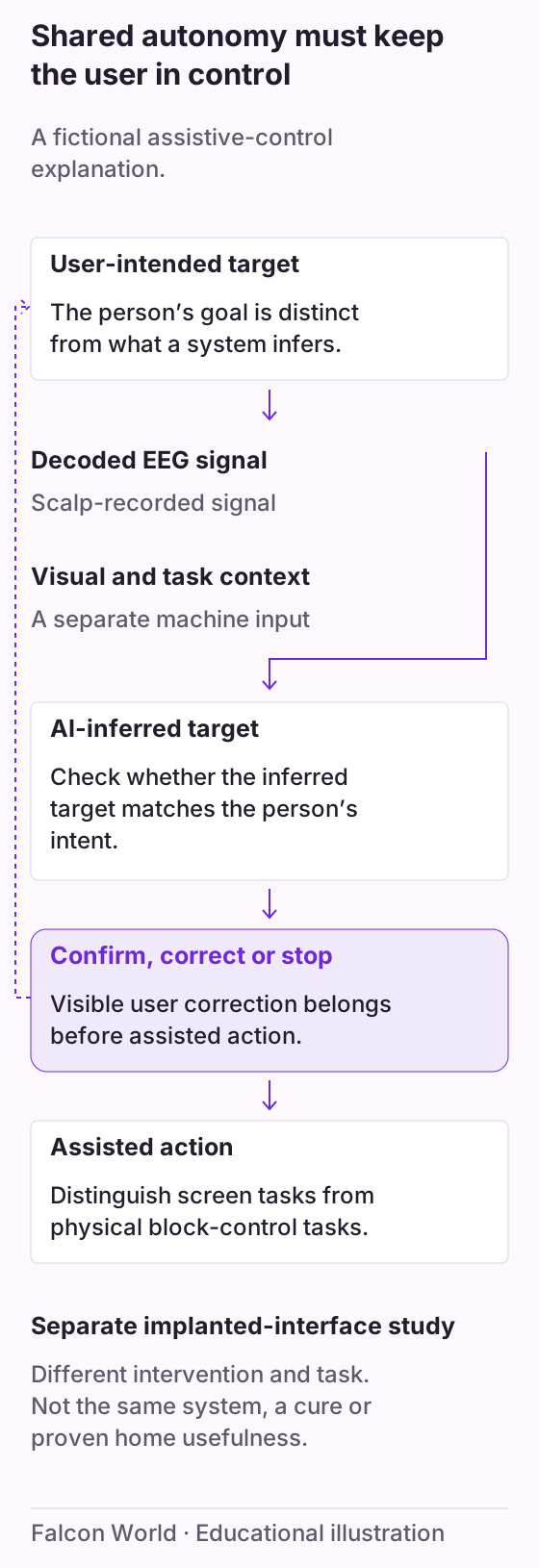
Original educational diagram of research boundaries and a fictional example. Not personal medical advice, a treatment instruction, regulatory approval or an actual clinical deployment.
[Open the complete research diagram](/assets/healthcare-workflow-assistive-bci-20261015.svg)
Read the diagram
**Shared autonomy must keep the user in control**
A fictional assistive-control explanation.
- **User-intended target.** The person’s goal is distinct from what a system infers.
- **Decoded EEG signal.** Scalp-recorded signal
- **Visual and task context.** A separate machine input
- **AI-inferred target.** Check whether the inferred target matches the person’s intent.
- **Confirm, correct or stop.** Visible user correction belongs before assisted action.
- **Assisted action.** Distinguish screen tasks from physical block-control tasks.
- **Separate implanted-interface study.** Different intervention and task. Not the same system, a cure or proven home usefulness.
*Falcon World · Educational illustration*
These pathways describe different research tasks and evidence boundaries. An arrow does not establish that one study caused another or that a research finding leads automatically to clinical benefit.