An AI-driven law firm was authorised. Its debt-work boundaries matter more than the label
Garfields authorisation record and a later SRA discussion make scope, client approval and accountable professional work visible.
The phrase AI-driven law firm suggests that a machine has acquired a lawyer's professional status. The regulatory record tells a more specific story: a firm, a defined service, accountable solicitors and controls around what the system can do. Understanding that structure is more useful than treating authorisation as a general endorsement of legal AI.
Garfield.Law's authorisation in England and Wales offers a concrete example. A later Solicitors Regulation Authority discussion about agentic systems adds a different perspective on workflow and client needs. Neither record is a trial proving that automation improves every debt claim or makes professional responsibility unnecessary.
The announcement and the licence have different dates
The [SRA's announcement of 6 May 2025](https://www.sra.org.uk/garfield-ai) describes Garfield.Law as the first purely AI-based firm it had authorised to provide regulated legal services in England and Wales. It describes an assistant helping businesses recover unpaid debts through the small-claims process up to trial.
The [licensed-body register](https://www.sra.org.uk/solicitors/firm-based-authorisation/abs-register/8010904/) gives licence number 8010904, granted and effective from 14 March 2025. March's licence date and May's public announcement should not be collapsed into one event. The register is an entity record, not a measured report of the service's accuracy, recovery outcomes or users' experience.
The launch description contains important exclusions
The SRA announcement says the system would not propose relevant case law. It also describes client approval before steps, supervision and monitoring, with increased oversight during the initial launch phase. Named regulated solicitors remain accountable for outputs and professional standards.
Those are features of the regulator's described arrangement. They do not establish that any chatbot with an approval button is equivalent, or that every possible legal matter falls within the service. The phrase AI-driven is therefore a starting point for examining the work allocation, not a substitute for that examination.
A 2026 discussion focuses on the process around the tool
The [SRA's 2 July 2026 account of an agentic-AI discussion](https://www.sra.org.uk/news/blogs/adding-client-value/) reports speakers' experiences and advice about client needs and understanding business processes. Garfield's co-founder discussed use outside ordinary business hours. Other contributions emphasised mapping the process before selecting technology.
This is a regulator-hosted discussion, not independent outcome evaluation. A speaker's observation about when people use a service does not establish that their problems were resolved more quickly or successfully. The record is valuable because it directs attention to how a service fits around clients and staff, while leaving those outcomes unmeasured.
Map the decision, not just the document
| Part of a proposed workflow | Question for the team | Boundary to preserve | | --- | --- | --- | | Information intake | What is known, disputed or missing? | Extraction is not a determination of truth | | Draft preparation | Which supplied facts support each statement? | A draft is not automatically ready to send | | Client approval | What action does this approval authorise? | Reviewing text differs from authorising transmission | | Professional oversight | Who handles ambiguity or an exception? | A general quality score does not resolve a case | | Completion status | What was actually saved or sent? | Attempted action is not confirmed delivery |
This original table is an illustrative design aid. It is not a reproduction of Garfield's internal workflow or an SRA-approved operating manual. A regulated service may involve additional requirements that cannot be inferred from public descriptions.
A fictional training file exposes the handoffs
Consider a fictional team of adult legal-operations trainees in Manchester. They use an invented invoice, a mock correspondence chain and a simulated payment record. There is no real creditor, debtor, claim or filing. The task is to identify which facts a drafting system should carry forward and which differences require review.
The first mock record shows a payment after the invoice date. A second contains a disagreement about whether the work was completed. The trainees compare a simple summary with the underlying material. An assistant that treats both records as identical has lost context, even if the resulting letters are grammatically polished.
Approval needs a comprehensible object
The fictional interface offers separate controls for saving a draft and authorising a simulated next step. Before approval, the user sees the relevant document, recipient and unresolved questions. The exercise asks whether a person can understand what is about to happen without needing to interpret an internal system event.
A mock network interruption occurs immediately afterwards. The interface should explain that the outcome has not been confirmed, preserve the draft and avoid encouraging an unexamined repeat action. This is a proposed reliability test; it is not a report of an actual interruption in Garfield or a claim about its delivery architecture.
The distinction matters because a document workflow can affect another person. Treating an uncertain operation as complete can mislead the client; automatically repeating it can produce duplicate communications. The relevant design question is whether the recorded state matches what the user has been told.
Exceptions are part of the service
A workflow may be efficient for familiar cases precisely because it excludes difficult ones. That is not necessarily a defect. The important questions are whether the boundary is visible, whether it is recognised consistently and whether there is a workable route to the appropriate human review.
In the training exercise, trainees invent an exception outside their mock service description. They do not decide the legal merits. They examine whether the system stops without turning uncertainty into an unsupported assertion. This keeps the exercise about service design rather than teaching participants how to pursue a real debt.
Measure review effort alongside generated work
Counting draft documents can conceal how many were discarded, corrected or escalated. A useful evaluation of a particular implementation would distinguish those categories, explain the sample and identify who judged the work. Completion speed and the quality of a legal service are related questions with different evidence requirements.
The public records discussed here do not supply a comparative recovery rate or independently measured staffing saving. A firm considering a similar arrangement would need its own evidence and appropriate professional assessment. The fictional exercise offers inspection categories, not a validated performance instrument or a general legal-compliance checklist.
New responsibilities remain attached to people
The authorisation record illustrates work in specifying scope, reviewing exceptions, supervising outputs and explaining actions to clients. Those tasks can change when software coordinates more of a process. It does not follow that all of them shrink, or that the same balance applies across practice areas and jurisdictions.
For a client, the practical question is less abstract than whether AI can practise law. It is which firm is providing which service, what happens when the matter falls outside its described scope and who remains responsible. For developers, the corresponding work is making those boundaries survive real interactions. This is general educational reporting checked on 15 October 2026, with no recommendation to use a named provider or advice on an individual claim.
Evidence diagram and readable guide
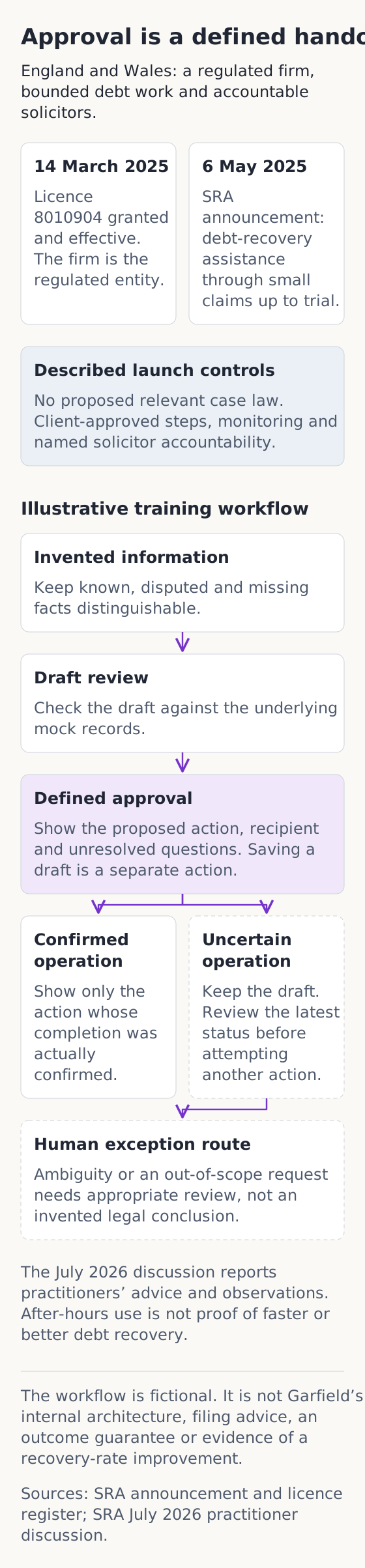
SRA authorisation context sits above an illustrative workflow that distinguishes draft review, approval, confirmed completion and human exception review.
[Open the complete evidence diagram](/assets/legal-workflow-supervised-debt-work-20261015.svg)
Read the diagram
**Approval is a defined handoff**
England and Wales: a regulated firm, bounded debt work and accountable solicitors.
- **14 March 2025.** Licence 8010904 granted and effective. The firm is the regulated entity.
- **6 May 2025.** SRA announcement: debt-recovery assistance through small claims up to trial.
- **Described launch controls.** No proposed relevant case law. Client-approved steps, monitoring and named solicitor accountability.
Illustrative training workflow
- **Invented information.** Keep known, disputed and missing facts distinguishable.
- **Draft review.** Check the draft against the underlying mock records.
- **Defined approval.** Show the proposed action, recipient and unresolved questions. Saving a draft is a separate action.
- **Confirmed operation.** Show only the action whose completion was actually confirmed.
- **Uncertain operation.** Keep the draft. Review the latest status before attempting another action.
- **Human exception route.** Ambiguity or an out-of-scope request needs appropriate review, not an invented legal conclusion.
The July 2026 discussion reports practitioners’ advice and observations. After-hours use is not proof of faster or better debt recovery.
**Reading the evidence.** The workflow is fictional. It is not Garfield’s internal architecture, filing advice, an outcome guarantee or evidence of a recovery-rate improvement.
*Sources: SRA announcement and licence register; SRA July 2026 practitioner discussion.*
**Keep the comparisons separate.** Entity grant/effect and public announcement are separate dates. Different operation states; an attempted action is not confirmed delivery.