An AI load-flexibility promise needs evidence after the test window
A useful data-centre flexibility offer connects workload limits, measurement boundaries and the return to normal operation.
A data centre can reduce demand during a demonstration and still leave important questions unanswered. Was work cancelled or postponed? Did another site take it over? Did a backlog produce a later demand spike? Did the facility protect the services it had promised to keep available? A useful flexibility proposal must describe the work and its recovery, rather than end the evidence at the moment a power trace falls.
This is a practical way to frame a limited evaluation, not an instruction for operating electrical equipment or a report of a real deployment. The example uses fictional workloads and an invented research campus. No live grid connection, customer service or computing facility was controlled for this article.
A forecast and a site capability answer different questions
The IEA's [2025 Energy and AI analysis](https://www.iea.org/reports/energy-and-ai/energy-demand-from-ai) models future data-centre demand through scenarios and explicitly discusses uncertainty. It also describes a facility's servers, storage, networking, cooling and power-support equipment. An annual sector projection is therefore not a certificate that a particular site can defer a particular workload at a particular hour.
That distinction matters even when the public debate is urgent. A developer can improve a model's task efficiency while total activity increases. The IEA's [2026 follow-up](https://www.iea.org/reports/key-questions-on-energy-and-ai/executive-summary) examines changing AI applications, uptake and efficiency together. Neither report tells an individual operator that all inference requests are equally interruptible or that a broad energy trend can replace an actual service commitment.
Name the flexibility being offered
The US Department of Energy advisory working group's [recommendations presented on 30 July 2024](https://www.energy.gov/sites/default/files/2024-08/Powering%20AI%20and%20Data%20Center%20Infrastructure%20Recommendations%20July%202024.pdf) include a proposed flexibility taxonomy. It distinguishes notification time, response speed, available capacity, frequency, duration, ramp behaviour and conditions that limit a response. It also notes that facility ownership and control of AI processing may sit with different parties.
Those categories are more useful than a single label such as flexible. A scheduled batch that can finish later is different from an interactive service with a response-time obligation. A storage asset with an operating limit is different from a software queue. Combining them under one headline can conceal who has authority to act and which constraint ends the offer. The advisory recommendations identify questions for coordination; they do not certify every implementation or establish a universal operating rule.
An illustrative research-campus exercise
Imagine a fictional university campus preparing an offline evaluation of a proposed AI-work scheduler. It has an interactive research help service and a separate batch that produces embeddings for an invented document collection. All records are synthetic. The team wants to learn whether the batch could be postponed during a nominated stress period while preserving useful service and a controlled return to normal.
Before any live experiment, the team writes a workload register. Each entry identifies its owner, deadline, dependency, restart behaviour and reason it may or may not be delayed. The interactive service is excluded from the first proposed response. The batch is eligible only when its deadline and retained state permit it. A model's suggestion does not itself grant permission to change the schedule.
The first exercise uses a replay or simulation with clearly labelled assumptions. It is not an operating commitment to a utility. Record which workload was available to shift, which was already running, what remained queued and what the simulation assumed about power. Do not turn a synthetic schedule into an observed reduction in facility demand.
Agree on what the meter represents
Specify whether the evidence concerns a software scheduling action, computing-equipment demand or the whole facility's demand at an agreed measurement point. These are different observations. A pause message from the scheduler does not establish that a cooling system or another supporting load changed in the same way.
Define a comparison method before the exercise. Explain the proposed baseline, the period being compared and the conditions that might make it inappropriate. Preserve missing measurements rather than replacing them with an attractive smooth curve. If a change in weather, another campus activity or a device fault makes the comparison ambiguous, record the ambiguity.
The DOE's [December 2024 announcement of the Berkeley Lab data-centre energy report](https://www.energy.gov/articles/doe-releases-new-report-evaluating-increase-electricity-demand-data-centers) describes efficiency, flexibility, generation and storage as parts of a wider response. That policy direction is useful context, but it is not site-level evidence for the fictional campus. The same discipline applies to vendor demonstrations: identify the actual measurement boundary and service conditions before transferring a result.
Keep the recovery period inside the evaluation
After the nominated window, the fictional team follows the postponed work until completion or an explicit failure. How much remains queued? Which deadlines became difficult? Did a restart repeat a completed operation? Did normal interactive work encounter a new conflict when delayed batches returned?
These are proposed acceptance questions, not outcomes claimed by the institutional reports. A schedule that protects one interval by creating an unmanageable later interval has changed the problem. Conversely, some deferred work may complete without such a conflict. The test must allow either result to appear rather than define success as any initial reduction.
Keep the intervention history beside the result. If an operator manually cancelled a task, moved it elsewhere or changed an eligibility rule, include that event. A successful recovery supported by a person's intervention is different from unattended recovery. Neither should be hidden by a final green status.
Distinguish grid value from a carbon claim
A response that helps a local capacity constraint does not automatically prove lower total energy use or emissions. Those are additional questions requiring their own system boundary, time period and evidence. Moving work across time or location also changes what must be accounted for; it does not make the work disappear.
An [NREL research account published in 2022](https://www.nlr.gov/news/detail/program/2022/new-nrel-dataset-shows-value-building-flexibility-adds-to-grid) describes modelling the grid-service value and emissions effects of building flexibility under power-system scenarios. It concerns buildings and modelling, not this fictional AI campus. Its relevance is methodological: evaluate the specified system and assumptions instead of transferring a general flexibility benefit to an unmeasured site.
Make the offer understandable to the people relying on it
A useful handover identifies the workload owner, eligibility rule, decision authority, notification path, measurement point, stop condition and recovery evidence. It also states what the test did not establish: extreme-weather behaviour, repeated calls, interaction with other workloads, actual utility acceptance or live service reliability may remain untested.
For developers, the practical skill is to connect scheduling state with observable service outcomes and understandable uncertainty. For energy teams, it is to specify the flexibility needed at the relevant place and time. For readers, it is to ask what happened after the impressive part of the demonstration. An AI flexibility claim becomes more useful when the evidence follows the work all the way through its return, including the inconvenient parts.
Explanatory diagram and accessible reading guide
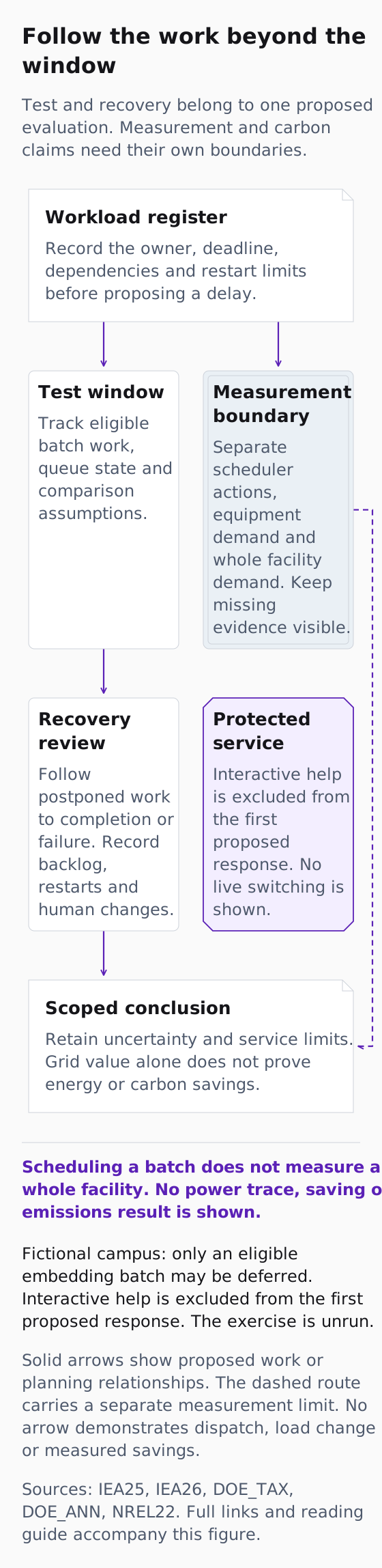
*Original explanatory infographic for An AI load-flexibility promise needs evidence after the test window. Proposed fictional campus exercise; no operated facility, measured load, saving, emissions result or utility acceptance.*
[Open the full-size explanatory diagram](/assets/energy-flexibility-recovery-20261016.svg)
This original diagram explains attributed source context and a fictional learning exercise. The exercise has not been run; the diagram is not an authentic product interface, internal bank architecture or measured operational result.
Follow the work beyond the window
Test and recovery belong to one proposed evaluation. Measurement and carbon claims need their own boundaries.
Workload register
Record the owner, deadline, dependencies and restart limits before proposing a delay.
Test window
Track eligible batch work, queue state and comparison assumptions.
Measurement boundary
Separate scheduler actions, equipment demand and whole facility demand. Keep missing evidence visible.
Recovery review
Follow postponed work to completion or failure. Record backlog, restarts and human changes.
Protected service
Interactive help is excluded from the first proposed response. No live switching is shown.
Scoped conclusion
Retain uncertainty and service limits. Grid value alone does not prove energy or carbon savings.
Scheduling a batch does not measure a whole facility. No power trace, saving or emissions result is shown.
Fictional campus: only an eligible embedding batch may be deferred. Interactive help is excluded from the first proposed response. The exercise is unrun.
Solid arrows show proposed work or planning relationships. The dashed route carries a separate measurement limit. No arrow demonstrates dispatch, load change or measured savings.
Sources: IEA25, IEA26, DOE_TAX, DOE_ANN, NREL22. Full links and reading guide accompany this figure.
Workload register → Test window: Eligibility and authority define the proposed batch test.
Workload register → Measurement boundary: The plan separately names what would be measured.
Test window → Recovery review: The proposed evaluation follows the postponed work after the nominated window.
Recovery review → Scoped conclusion: Recovery observations would qualify any eventual conclusion.
Measurement boundary → Scoped conclusion: The measurement boundary separately limits what the evidence could support.
The arrows describe a proposed evaluation and information boundaries, not measured load changes, dispatch permission or a demonstrated causal effect. Recovery remains inside the work path. The dashed measurement route qualifies the conclusion separately. The protected interactive service has no dispatch edge and is outside the first proposed response. None of these nodes is a utility acceptance, savings measurement or carbon assessment.
The accepted manuscript proposes a replay or simulation using synthetic workloads and an invented campus. Before any live experiment, record ownership, deadlines, restart state and authority. Follow the batch through the test window and recovery while keeping any eventual equipment/facility measurement separate. No grid or computing facility was controlled for this article.
Solid arrows show proposed work or planning relationships. The dashed route carries a separate measurement limit. No arrow demonstrates dispatch, load change or measured savings.
Diagram source references
- [IEA25: Energy demand from AI](https://www.iea.org/reports/energy-and-ai/energy-demand-from-ai) — International Energy Agency.
- [IEA26: Key Questions on Energy and AI: executive summary](https://www.iea.org/reports/key-questions-on-energy-and-ai/executive-summary) — International Energy Agency.
- [DOE_TAX: Recommendations on Powering Artificial Intelligence and Data Center Infrastructure](https://www.energy.gov/sites/default/files/2024-08/Powering%20AI%20and%20Data%20Center%20Infrastructure%20Recommendations%20July%202024.pdf) — US Department of Energy / Secretary of Energy Advisory Board.
- [DOE_ANN: DOE releases new report evaluating electricity demand from data centers](https://www.energy.gov/articles/doe-releases-new-report-evaluating-increase-electricity-demand-data-centers) — US Department of Energy.
- [NREL22: New NREL Dataset Shows Value Building Flexibility Adds to Grid](https://www.nlr.gov/news/detail/program/2022/new-nrel-dataset-shows-value-building-flexibility-adds-to-grid) — NREL institutional archive on current NLR site.