An AI study session should leave evidence of what you can explain alone
Preserve the first attempt, source-backed feedback and later unaided explanation without turning practice into answer substitution.
A satisfying explanation can make a study session feel complete before the learner has tried to explain anything independently. The distinction matters for a student preparing practice work and for an adult learning a skill after work. An assistant can offer a question, a hint or a different explanation, while the learner still needs evidence of what remains when the conversation is closed.
A 2025 PNAS paper reports a field experiment in high-school mathematics in Turkey, comparing different GPT-4-based assistance designs with ordinary resources. The study separates assisted practice from an unaided assessment. It reports that performance with help and learning demonstrated after that help is removed can differ, and that teacher-informed safeguards matter. These are results for the study's particular designs, period and setting, not a conclusion about every current model or every subject. [Guardrails and learning study](https://www.pnas.org/doi/10.1073/pnas.2422633122).
A tutor's design belongs in the result
A separate Scientific Reports paper published on 3 June 2025 describes a randomised comparison of a research-designed AI tutor with active classroom learning in undergraduate physics. Its tutor used pedagogical scaffolding rather than an unrestricted request for answers. The findings concern that intervention and its assessments. They should not become a promise that an ordinary chat window produces the same benefit for adult study, long-term retention or a different discipline. [Structured tutoring trial](https://www.nature.com/articles/s41598-025-97652-6).
The useful comparison is consequently more specific than AI versus no AI. What can the learner ask? What feedback is supplied? Is the answer immediately visible? How is understanding assessed when assistance is absent? Someone choosing a personal learning routine can use those questions without claiming to reproduce either research trial or assuming that a product's tutor label specifies its educational design.
UNESCO's guidance, published in September 2023 with a later updated publisher page, argues for human-centred educational use and attention to privacy, validation and pedagogical purpose. It supplies a policy and design framework, not proof that a particular app improves learning or permission to ignore an institution's assessment rules. The learner's own purpose and the permitted use of assistance should remain explicit. [UNESCO guidance](https://www.unesco.org/en/articles/guidance-generative-ai-education-and-research).
Start with an attempt the assistant did not write
Choose a small question and write an initial response before opening the conversation. Keep it, including uncertainty and incomplete reasoning. That first attempt gives the subsequent discussion something concrete to address. Without it, a fluent model answer can replace both the learner's response and the record of what the learner originally found difficult.
Ask for a hint tied to the attempt, or for a question that exposes a missing assumption. Keep a distinction between feedback about the reasoning and a replacement answer. If the assistant introduces a new fact, locate an appropriate source rather than silently promoting it into the learner's notes. A study conversation can organise a question while still containing factual errors.
A foundational Science study published in 2008 examined repeated study and retrieval in a foreign-language vocabulary task and assessed delayed recall. Its results support taking retrieval seriously in the conditions studied; it was not an AI tutoring trial or a universal prescription for every learning schedule. It offers a reason to include an unaided attempt rather than judging understanding only while an answer remains visible. [Retrieval-practice research](https://pubmed.ncbi.nlm.nih.gov/18276894/).
After the discussion, close or hide the assistance and answer a related question in your own words. Then compare it with the reference and identify the remaining gap. Keep the comparison descriptive: which assumption was missing, which definition was confused and which step could not be explained. A confidence rating or the pleasantness of the conversation should not stand in for that work.
An unperformed adult-learning example
Imagine an adult learner in a fictional Delhi study group preparing to explain a simple chart to colleagues. The exercise and materials are invented and have not been run. A supplied reference card says that the chart records observations and includes no evidence about what caused them. The learner writes an initial description before asking an assistant for feedback.
In the constructed example, a proposed rewrite adds a causal explanation absent from the reference. The learner's task is to locate that unsupported step and return to a description the material can support. The worked conclusion follows from the supplied card: an explanation of cause was never available in this exercise. No real model output, test score or causal research result is being presented.
The group can then discuss what additional information would be needed to evaluate the stronger claim. The assistant may help formulate the question, while the learner remains responsible for distinguishing supplied information from a proposal to investigate. This preserves a useful role for the tool without requiring it to judge its own answer as evidence of learning.
Finally, give the learner a different synthetic chart and ask for an explanation without the chat. Keep the original attempt, feedback and later explanation together. The record can reveal whether the same unsupported inference recurs. This is a proposed comparison, not a claim that the group retained a skill, improved its performance or validated a tutoring product.
Keep practice separate from assessed work
Use material whose permitted use is clear, such as self-authored exercises or authorised practice questions. Follow the relevant course or workplace rules and disclose assistance where required. A workflow for learning should not quietly become a route for submitting generated answers as one's own work. Questions from a live assessment deserve the institution's stated boundary, not an improvised exception from an assistant.
For an adult working outside a course, define the real skill before choosing practice. If the aim is to explain a concept, the review should examine an explanation. If the aim is to carry out a procedure, a conversational answer alone cannot establish competent execution. The personal study record should say which part was attempted and what remains outside the exercise.
Privacy also affects the choice of examples. A person can practise with invented records without uploading colleagues' work, private student material or customer data. Neither a research paper nor a public tutorial grants permission to use those records. This publication has not called a model, recorded a learner, conducted an experiment or used an external educational account.
Return to earlier uncertain items in a later unaided session and keep the actual result. A useful reflection note can be brief: what changed in the reasoning, which source clarified it and what still requires help. The aim is a study routine that makes learning inspectable, while leaving room for a person to say that a topic remains difficult and another form of support is needed.
Conceptual diagram and reading guide
The following original diagram explains the article's fictional exercise. It has not been run and adds no observed product result.
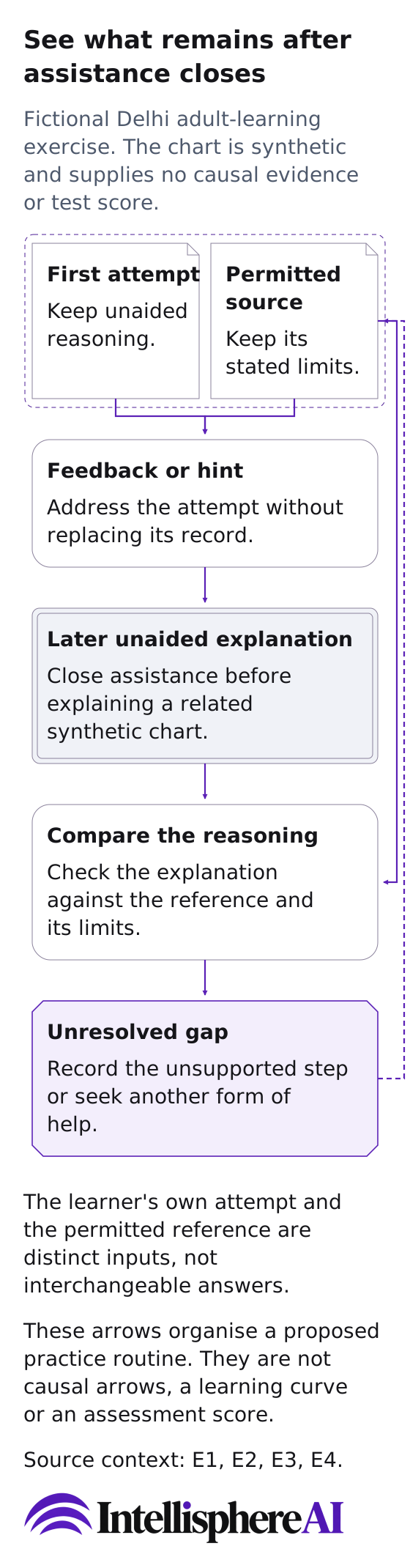
Original conceptual diagram of the fictional, unrun unaided explanation exercise; no product action, measurement or approval is depicted.
[Open the complete diagram](/assets/personal-evidence-unaided-explanation-20261016.svg)
See what remains after assistance closes
Fictional Delhi adult-learning exercise. The chart is synthetic and supplies no causal evidence or test score.
First attempt
Keep unaided reasoning.
Permitted source
Keep its stated limits.
Feedback or hint
Address the attempt without replacing its record.
Later unaided explanation
Close assistance before explaining a related synthetic chart.
Compare the reasoning
Check the explanation against the reference and its limits.
Unresolved gap
Record the unsupported step or seek another form of help.
The learner's own attempt and the permitted reference are distinct inputs, not interchangeable answers.
First attempt to Feedback or hint: The original attempt identifies what the learner found difficult.
Permitted source to Feedback or hint: New factual wording needs a permitted reference rather than the assistant's confidence.
Feedback or hint to Later unaided explanation: A later explanation is produced without the assistance still supplying the answer.
Later unaided explanation to Compare the reasoning: Review what the learner can explain, not how pleasant the chat felt.
Permitted source to Compare the reasoning: The supplied reference independently constrains the explanation; observations do not establish a cause.
Compare the reasoning to Unresolved gap: Keep a remaining uncertainty instead of inventing a grade or retained-skill result.
Unresolved gap to Permitted source: Revisit the source or other support; a later attempt still needs its actual result recorded.
These arrows organise a proposed practice routine. They are not causal arrows, a learning curve or an assessment score.
Proposed practice routine, not a reproduced learning study, measured retention or assessed-work permission.
The constructed rewrite adds a cause absent from the reference. The task is to find that unsupported step, not to claim a tutor improved learning.
Source context
These references ground the documented distinctions; the pictured routine is original editorial guidance, not a service observation.
- [E1: Generative AI without guardrails can harm learning: Evidence from high school mathematics](https://www.pnas.org/doi/10.1073/pnas.2422633122) - [E2: AI tutoring outperforms in-class active learning: an RCT introducing a novel research-based design in an authentic educational setting](https://www.nature.com/articles/s41598-025-97652-6) - [E3: Guidance for generative AI in education and research](https://www.unesco.org/en/articles/guidance-generative-ai-education-and-research) - [E4: The critical importance of retrieval for learning](https://pubmed.ncbi.nlm.nih.gov/18276894/)