An AI weather forecast becomes useful only inside a local decision
AI forecast developments and Indian advisory accounts make issue time, valid period, local observation and the remaining decision worth keeping together.
A forecast and a farm decision have different clocks. A weather service issues information at a particular time, for a particular period and area. A grower has a crop stage, a field observation and a decision that may become difficult to reverse. Agricultural AI becomes more useful when those clocks remain visible together, rather than being compressed into a confident instruction to act today.
ICRISAT’s public iSAT description makes the integration explicit: it combines AI and a rule-based engine with weather, soil, crop and local datasets to produce context-specific advisories. That is an institutional description of an advisory approach, not proof that one message is appropriate for every rainfed field or that its advertised benefits have been independently reproduced. [ICRISAT’s iSAT record](https://issca.icrisat.org/scalable-solutions/intelligent-agricultural-systems-advisory-tool-isat).
Forecast progress does not remove local questions
ECMWF’s current AIFS dataset page records upgrades of its deterministic and ensemble systems to version 2 on 12 May 2026. This is a concrete weather-model development. The page’s publication day is not established, and the upgrade date should not be presented as one. An operational forecast model supplies weather information; it does not establish a planting decision for a particular farm. [ECMWF’s model and version description](https://www.ecmwf.int/en/forecasts/datasets/aifs-machine-learning-data).
India’s IMD Agricultural Meteorology Division provides separate national, state, district and crop-specific advisory resources. That organization of information is a useful reminder to inspect geography and bulletin identity before comparing messages. The directory is a route to information, not itself a valid advisory for the reader’s field. [IMD’s public advisory directory](https://imdagrimet.gov.in/).
In February 2026, India’s PIB reported a Kharif 2025 pilot using probabilistic local monsoon-onset forecasts delivered by SMS. Its account distinguishes wide message dissemination from follow-up surveys in Madhya Pradesh and Bihar. Reported changes in respondents’ decisions do not by themselves establish a causal yield or income effect, or represent every message recipient. [The dated official pilot account](https://www.pib.gov.in/PressReleasePage.aspx?PRID=2227914&lang=2®=48).
Start with the decision that can still change
Imagine a fictional adult farmer group near Anantapur using invented plot records in an extension workshop. The exercise concerns preparation for a coming weather window, not a real instruction to sow. One record describes a field awaiting inspection; another describes a field already prepared. A third deliberately leaves the observation date blank. The same forecast should not erase those differences.
The facilitator first asks what remains open. Is the group deciding when to meet an adviser, whether to inspect field conditions, or whether an existing plan needs review? These are different tasks. A useful advisory should identify the decision it addresses and the information it assumes. If the record is too incomplete, asking a clear question is more responsible than producing a precise-looking recommendation.
For each forecast, retain the issuer, issue time, valid period, geographical coverage and product version. Keep its probability language intact. A forecast for a period is not an observation that rain has already occurred, and an update is not necessarily a correction of an earlier error. Writing those distinctions plainly helps the reader understand what changed without pretending that uncertainty has disappeared.
Keep observation and prediction in separate places
The fictional records have two columns: information reported from the field and information predicted for the future. A damp patch described by an adult participant belongs in the first. A forecast of possible rainfall belongs in the second. An AI summary may bring them together for discussion, but it should not rewrite the forecast as a measured field condition or turn an old observation into a current one.
Next, compare the area named in the bulletin with the area named in the record. If a message refers to a district and the exercise concerns a specific plot, the gap should be visible. The group records which local facts still require an adviser’s judgment. This does not mean a district bulletin is useless; it means that geographical relevance is a question to examine rather than silently assume.
Crop-stage descriptions also need a date and a source. An assistant should not infer that every field of the same crop is at the same stage. For the workshop, participants can correct the synthetic stage and see whether the explanation changes appropriately. The exercise tests the information flow. It does not test a named platform or prove an agronomic effect.
Rehearse an update before it matters
Introduce a second invented bulletin that changes the outlook. Ask the group to show which earlier message it replaces, which decisions remain pending, and who should be informed. A message history is more useful than a screen that quietly overwrites yesterday’s answer. The earlier record explains what information the group had at the time; retaining it need not imply that it remains current.
A late message provides another useful case. If the relevant decision window has passed, the interface should say so and direct the reader to current information. It should not present an expired advisory with a fresh display date that makes it look newly issued. A translation or AI-generated summary needs the original source date and valid period alongside its own preparation time.
Consider a service interruption as well. A cached bulletin can remain readable, but its age and limitations should be explicit. A missing connection should not produce an invented forecast, nor should the absence of a new alert be described as confirmation of favourable conditions. The practical fallback is an identifiable current source or responsible extension contact, rather than an unexplained error.
Measure the handoff before claiming the harvest
For a small evaluation, record whether adults can identify the valid period, explain the probability statement, recognize an expired message and find the correct local follow-up. Record disagreements and clarification requests. These are observations about understanding and service operation. They can inform a later field study, but they are not substitutes for one.
Agricultural outcomes require additional design: what changed, for whom, under which conditions, compared with what alternative, and over which season? Message reach, reported use, forecast skill and crop outcomes answer different questions. Combining them into one success figure obscures where a service helped and where more evidence is needed.
The immediate opportunity is practical. Better AI-supported advisory work can preserve the link between a changing forecast and a farmer’s actual question, while making the remaining local judgment easier to perform. This is an educational, fictional workflow, not a current weather alert, planting recommendation, chemical instruction or endorsement of any service. Readers should use the relevant official advisory and qualified local support for real decisions.
Evidence diagram and readable guide
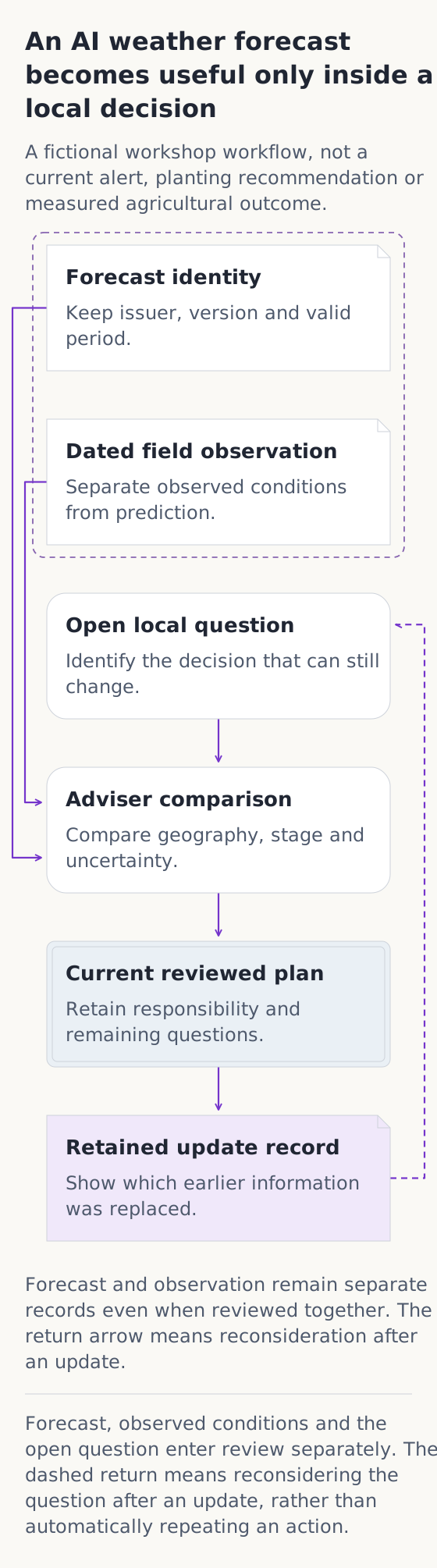
Original explanatory diagram: a fictional workshop keeps forecast identity, field observations and a reviewed local question separate; this is not a current alert or planting instruction.
[Open the complete evidence diagram](/assets/agriculture-workflow-weather-decisions-20261015.svg)
Read the diagram
**An AI weather forecast becomes useful only inside a local decision**
A fictional workshop workflow, not a current alert, planting recommendation or measured agricultural outcome.
- **Forecast identity** Keep issuer, version and valid period.
- **Dated field observation** Separate observed conditions from prediction.
- **Open local question** Identify the decision that can still change.
- **Adviser comparison** Compare geography, stage and uncertainty.
- **Current reviewed plan** Retain responsibility and remaining questions.
- **Retained update record** Show which earlier information was replaced.
Forecast and observation remain separate records even when reviewed together. The return arrow means reconsideration after an update.
How the connections work
- Forecast identity supplies its time and geographical limits to the comparison.
- A dated field observation supplies separate local evidence to that comparison.
- The open question explains which decision the adviser is reviewing.
- The comparison informs a current plan through the responsible local process.
- The plan retains the update and the information available when it was reviewed.
- A changed update can reopen the local question; it is not an automatic instruction to act.
Relationship key
Forecast, observed conditions and the open question enter review separately. The dashed return means reconsidering the question after an update, rather than automatically repeating an action.