An inspection robot should report what it could not observe
India’s Arista showcase and a dated BASF proof of concept show why an inspection round needs explicit records of missed and unusable observations.
A mobile inspection round has two jobs that are easy to confuse. The robot must reach a useful observation position, and the sensing system must obtain evidence that can support a maintenance decision. Completing a route does not establish that every required asset was observed. A missing reading is not a normal reading, and an available image is not necessarily a usable one.
That distinction matters when manufacturers consider AI-assisted inspection. The most informative dashboard may be the one that preserves gaps: a blocked route, an obscured gauge, an uncertain asset identity or a measurement taken under an unsuitable condition. Treating those gaps as first-class results helps a maintenance team decide what still requires attention. This article focuses on coverage and operational handoff, rather than predicting failures from a history or ranking image classifiers.
India’s showcase and an older German proof of concept
A [Press Information Bureau feature dated 20 February 2026](https://static.pib.gov.in/WriteReadData/specificdocs/documents/2026/feb/doc2026220797001.pdf) reported on startups at India’s AI Impact Summit. Its account of RailLabs’ Arista attributes ultrasonic flaw detection, laser track profiling and vision features to co-founder Sumit Anand. This is a government-hosted showcase account of a company’s explanation. It does not supply a controlled detection study, a rail-safety approval or evidence that a manufacturing site has accepted the same equipment.
An older, more site-specific record is ANYbotics’ [25 March 2021 BASF case account](https://www.anybotics.com/news/anymal-case-basf-chemical-plant/). It describes testing at Ludwigshafen, using facility models to prepare routes and viewpoints, followed by on-site gauge, acoustic and thermal inspection activities. The account explicitly discusses a proof of concept and further evaluation. Its vendor-reported experience should not be relabelled as a new 2026 deployment or generalized into a quantified benefit for other plants.
The [ANYbotics overview on Siemens’ developer site](https://developer.siemens.com/anybotics/overview.html) describes mission management, inspection-data transfer and feedback for integration with asset-management or digital-twin systems. Those are described interface capabilities. The page does not prove that a reader’s work-order system has received every reading correctly, or that an interrupted mission has been reconciled. Publication and update dates were not established on that living page.
Boston Dynamics’ [Autowalk documentation](https://dev.bostondynamics.com/docs/concepts/autonomy/autowalk_service.html) offers a concrete design distinction: a target is where the robot should go, while an action is what it should do there; target and action failure behaviours are separately represented. The documentation checked here displayed Spot 5.2.0. It is implementation documentation, not evidence that a particular inspection mission or current installed robot has passed a physical trial.
A fictional plant’s observation contract
Consider a fictional adult maintenance team at a small industrial-gas equipment workshop near Pune. It is exploring a mobile inspection round in an authorised practice area with synthetic labels and non-operating demonstration assets. This is not a RailLabs, BASF, ANYbotics or Boston Dynamics deployment. The team wants a record that makes missed observations visible before any decision about operational use.
It starts with an observation contract for each point. The contract identifies the asset, the required view or measurement, the relevant operating condition and the person who reviews the result. A photograph taken beside the correct machine may still fail the contract if the display is hidden. A temperature value may be irrelevant if the measurement was intended for a different operating state. The contract makes those reasons explicit instead of letting a route-completion tick stand in for them.
The team then separates four states: not visited, visited without usable evidence, usable evidence awaiting review, and reviewed evidence. It can add more detail where needed, but those distinctions already prevent several misleading summaries. The report’s denominator is the agreed set of required observations, not whichever readings happened to arrive. A skipped point remains in the report rather than disappearing from the calculation.
Walk through a blocked route
For a worked exercise, a practice trolley blocks the route to a demonstration gauge. The robot should not improvise access outside the approved trial boundary. The resulting record identifies the missed point and the reason the mission could establish. It might know only that the target was not reached. It should not invent a cause such as an unsafe obstruction unless the system actually observed and classified that condition.
A second exercise reaches the target but deliberately obscures the gauge. The team checks whether the result is recorded as an unreadable observation, not as a normal gauge state. If a model proposes a reading from an ambiguous image, the reviewer should be able to inspect the supporting image and reject the proposal. A neat number without inspectable evidence can create more work than an honest “not established.”
A third exercise interrupts data transfer after an observation. The plant record may be missing while the robot retains a local result. Repeating the entire mission is not automatically the right reconciliation. The team first checks the mission identity, observation identity and retained evidence. The practical requirement is to know which record is missing and which action has already occurred, rather than to make every screen appear complete.
Connect the observation to maintenance
An inspection system can help collect comparable evidence, but an unusual reading is not itself a diagnosis or a work order. The maintenance reviewer needs asset context, the observation conditions and a route to request follow-up. A work-order integration should distinguish a proposed action from an accepted maintenance task. If the receiving system is unavailable, the unresolved proposal should remain visible without creating duplicate work when communication returns.
The team should also account for the burden of preparing routes, checking labels, cleaning sensors and reviewing uncertain observations. Those activities belong to the operating model. Potential benefits such as more regular collection or better traceability are plausible reasons to investigate, but this fictional example provides no measured uptime, labour, cost or safety improvement. The cited showcase and proof of concept cannot supply those missing measurements for it.
Coverage is an evidence claim
A useful final report states which assets were in scope, which observations were usable, which remained unresolved and what human review followed. It preserves route changes and the version of the observation contract. A different route, sensor arrangement or plant condition may require a new comparison; an older successful mission should not silently cover it.
India’s 2026 showcase, the dated Ludwigshafen proof of concept and living integration documentation demonstrate why this is a rich industrial topic. They also show why evidence stages must remain visible. A mobile robot adds value to an inspection programme when it helps people understand the plant, including the parts of the plant that this round did not establish.
Evidence diagram and readable guide
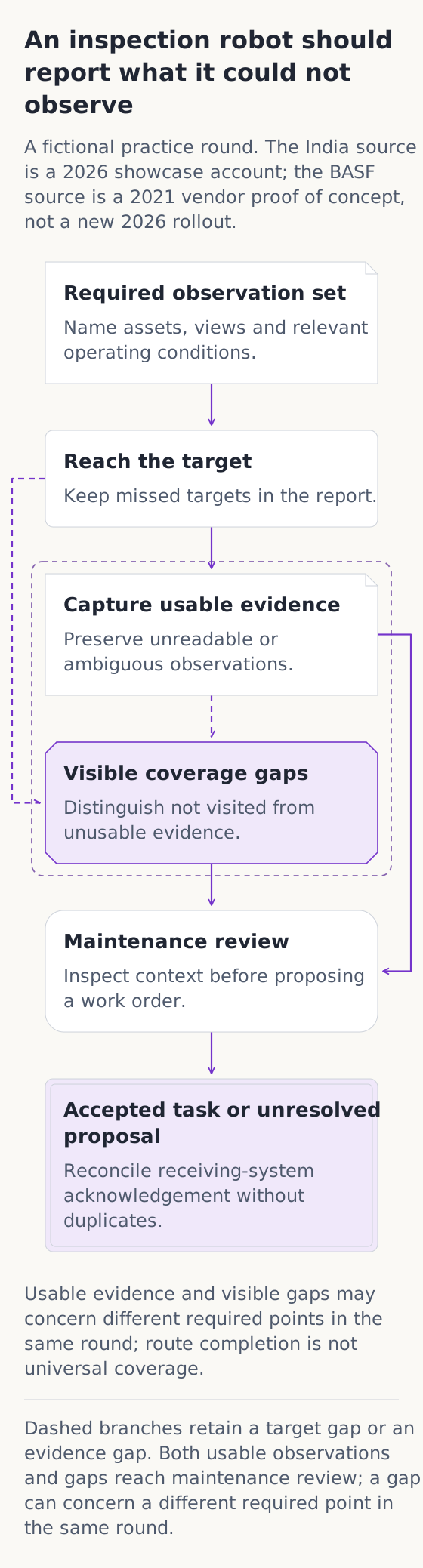
Original explanatory diagram: usable observations and visible gaps remain separate evidence for a fictional maintenance review.
[Open the complete evidence diagram](/assets/manufacturing-workflow-mobile-inspection-coverage-20261015.svg)
Read the diagram
**An inspection robot should report what it could not observe**
A fictional practice round. The India source is a 2026 showcase account; the BASF source is a 2021 vendor proof of concept, not a new 2026 rollout.
- **Required observation set.** Name assets, views and relevant operating conditions.
- **Reach the target.** Keep missed targets in the report.
- **Capture usable evidence.** Preserve unreadable or ambiguous observations.
- **Visible coverage gaps.** Distinguish not visited from unusable evidence.
- **Maintenance review.** Inspect context before proposing a work order.
- **Accepted task or unresolved proposal.** Reconcile receiving-system acknowledgement without duplicates.
Usable evidence and visible gaps may concern different required points in the same round; route completion is not universal coverage.
Dashed branches retain a target gap or an evidence gap. Both usable observations and gaps reach maintenance review; a gap can concern a different required point in the same round.
How the connections work
- Required observation set to Reach the target: mission scope; solid directed link. Proposed conditional or evidence flow; no measured causal relationship.
- Reach the target to Capture usable evidence: observation attempt; solid directed link. Proposed conditional or evidence flow; no measured causal relationship.
- Reach the target to Visible coverage gaps: target gap; dashed directed link. Proposed conditional or evidence flow; no measured causal relationship.
- Capture usable evidence to Visible coverage gaps: evidence gap; dashed directed link. Proposed conditional or evidence flow; no measured causal relationship.
- Capture usable evidence to Maintenance review: usable evidence; solid directed link. Proposed conditional or evidence flow; no measured causal relationship.
- Visible coverage gaps to Maintenance review: follow up need; solid directed link. Proposed conditional or evidence flow; no measured causal relationship.
- Maintenance review to Accepted task or unresolved proposal: work handoff; solid directed link. Proposed conditional or evidence flow; no measured causal relationship.
Keep the paths separate
Usable evidence and visible gaps may concern different required points in the same round; route completion is not universal coverage.