An irrigation AI estimate should not erase the missing sensor reading
US irrigation research illustrates why sensor observations, modelled crop stress, reviewed proposals and water-delivery records should remain separate.
When an irrigation dashboard displays a smooth line, the reader needs to know whether it came from an instrument, a remote-sensing estimate or a model filling a gap. These sources can all be useful, but they do different work. A plausible estimate of crop water status is not a measurement of water delivered, and neither record alone establishes the next irrigation action.
USDA’s Agricultural Research Service describes work in Kimberly, Idaho, combining AI and connected sensors to support vineyard water-status assessment using the Crop Water Stress Index. The discovery page establishes the proposed decision-support approach. It does not supply a universal irrigation schedule or independently verified savings for a different crop, soil or location. [ARS’s vineyard research description](https://scientificdiscoveries.ars.usda.gov/explore-our-discoveries/pacific-west/using-ai-improve-wine-grape-quality).
Different evidence belongs in different places
An ARS FY2023 project report describes a neural-network approach using historical canopy-temperature, weather and management information to predict canopy temperature and crop water stress when sensor data are unavailable. It presents the method as added redundancy for decision support. A predicted replacement should remain identifiable as a prediction; the report does not justify presenting it as a newly observed reading. [The historical ARS project account](https://www.ars.usda.gov/research/project?accnNo=441575&fy=2023).
A USGS record of a 2024 OpenET assessment describes a six-model remote-sensing ensemble compared with observations from 152 in-situ stations across the contiguous United States. That is evidence about a stated estimation system and validation population. Remote-sensing models are not automatically AI, and that comparison does not establish the accuracy of every field-level estimate in another geography. [The OpenET assessment record](https://www.usgs.gov/publications/assessing-accuracy-openet-satellite-based-evapotranspiration-data-support-water).
ARS also lists a western-US AI research project with a stated end date of August 2026 and objectives involving water, nutrients, salinity and pests. Its objectives and study areas show the breadth of the research question. They do not demonstrate that its long-term automation ambitions were completed, or that the project remains active after its recorded period. [The dated project record](https://www.ars.usda.gov/research/project?accnNo=438468).
Reconstruct one proposed decision
Consider a fictional adult vineyard cooperative near the Yakima Valley reviewing synthetic records in a training exercise. No valve, pump or commercial service is connected. The invented record contains a recent instrument reading, a later missing reading, a model estimate and a field-inspection note. The exercise asks whether an adviser can reconstruct the proposed review without confusing those records.
Start with units, timestamps and locations. Two readings that look similar may refer to different observation points or periods. The cooperative labels each item by its source and preserves its original value. An assistant may organize the entries into a readable explanation, but it should not silently convert units, assign an absent location or infer that a measurement remained constant through the missing interval.
The estimated replacement receives its own label, method version and explanation of the information used. The original missing reading remains in the record. That choice allows the group to compare a recommendation made with the estimate against one made without it. If the explanation depends heavily on the replacement, the reviewer can see that dependency rather than mistaking the completed line for uninterrupted observation.
Ask what a disagreement could mean
The facilitator introduces a synthetic conflict: a field note and an instrument-derived estimate appear inconsistent. The first step is to inspect their timing and meaning. A note may describe one part of the block, while an estimate summarizes another area. The exercise does not prescribe which to trust. It asks participants to document the discrepancy and identify the local check needed before treating either as decisive.
Several questions help make the comparison concrete. Was the instrument reporting normally? Does its location still match the record? Was the field note collected before or after the apparent change? Is the model being used within the conditions examined during evaluation? These are information-quality questions. They should not become a pretext for an assistant to invent a cause, such as a broken sensor, without evidence.
The review record can preserve more than one interpretation. It might say that the discrepancy is unresolved and that a designated colleague will check it. A useful system allows that state to remain visible. Forcing every record into a confident recommendation may make a dashboard look complete while weakening the decision it is supposed to support.
Distinguish water status from water accounting
A model’s description of crop stress and a record of water delivered should have separate identities. In the fictional exercise, the delivery log is an invented observation from a different process. It is compared with the proposal after the appropriate review, rather than generated from the proposal itself. Otherwise the same recommendation can be mistaken for evidence that an action happened.
The group also separates the period covered by an estimate from the time of a decision. A historical water-use estimate can support analysis while being unsuitable as an immediate instruction. An AI-generated summary should retain that temporal boundary. A new display date should not make an old estimate appear current, and a refreshed chart should not imply that its underlying observations were refreshed too.
If an eventual integrated service sends commands, an uncertain acknowledgement needs a specific recovery procedure. This article does not provide one for real equipment. In the synthetic exercise, participants simply retain the proposal and compare it with the separate receiving-process record before considering another dispatch. No automatic repetition is treated as safe merely because an interface briefly lost its connection.
Evaluate the claim that was actually made
A proposed estimate can be assessed against relevant held-out observations. A usable explanation can be assessed with adult reviewers. Water savings, crop quality and agricultural outcomes require additional evidence with appropriate comparisons and periods. Counting how many gaps a model filled answers none of those outcome questions by itself.
For farmers and irrigation organizations, the useful lesson is an inspectable chain: observation, estimate, reviewed proposal and separate action record. AI can contribute without concealing which links remain uncertain. This is an educational fictional example, not irrigation scheduling, equipment-control advice, chemical application guidance or a report of measured savings. Real water-management decisions require the applicable local procedures, qualified support and current field information.
Evidence diagram and readable guide
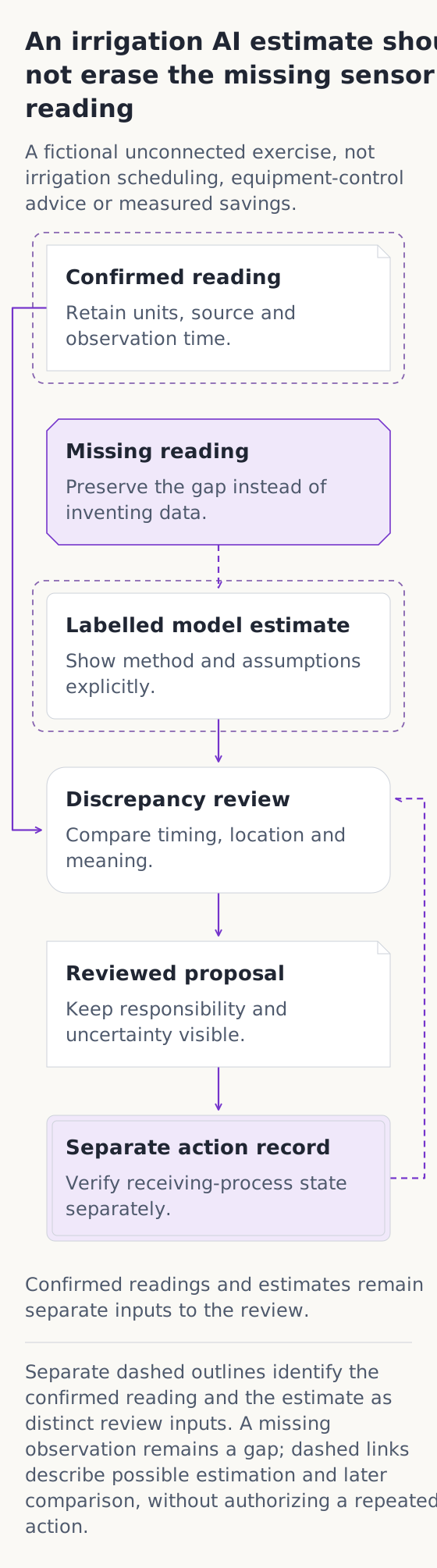
Original explanatory diagram: a fictional unconnected exercise preserves a missing reading and labels estimates before review; this is not irrigation scheduling or a water-saving result.
[Open the complete evidence diagram](/assets/agriculture-workflow-irrigation-evidence-20261015.svg)
Read the diagram
**An irrigation AI estimate should not erase the missing sensor reading**
A fictional unconnected exercise, not irrigation scheduling, equipment-control advice or measured savings.
- **Confirmed reading** Retain units, source and observation time.
- **Missing reading** Preserve the gap instead of inventing data.
- **Labelled model estimate** Show method and assumptions explicitly.
- **Discrepancy review** Compare timing, location and meaning.
- **Reviewed proposal** Keep responsibility and uncertainty visible.
- **Separate action record** Verify receiving-process state separately.
Confirmed readings and estimates remain separate inputs to the review.
How the connections work
- The confirmed reading supplies direct evidence to the discrepancy review.
- A missing reading may motivate a labelled estimate but remains a missing observation.
- The estimate enters review as model output, with its assumptions retained.
- The discrepancy review provides context for a proposal through the responsible process.
- A reviewed proposal requires a separate action record before completion is claimed.
- That separate record can return to the review for comparison without automatically repeating an action.
Relationship key
Separate dashed outlines identify the confirmed reading and the estimate as distinct review inputs. A missing observation remains a gap; dashed links describe possible estimation and later comparison, without authorizing a repeated action.