Banking assistants make exception-handling skills more visible
Financial-sector AI surveys describe adoption and governance, while a careful complaints workflow shows why documentary judgment and decision authority remain different jobs.
Banking work can become more demanding when an assistant makes the ordinary case easier. A service team may spend less time assembling a routine summary and more time resolving disagreements between documents, permissions and customer expectations. That shift changes the skills a bank needs to recognise and teach. It does not establish that every employee becomes a model engineer, or that a faster summary makes a credit decision safe. The useful workforce question is who investigates an exception after the easy administrative steps have been accelerated.
The [Bank of England and Financial Conduct Authority's survey published on 21 November 2024](https://www.bankofengland.co.uk/report/2024/artificial-intelligence-in-uk-financial-services-2024) received 118 responses. Seventy-five per cent of respondents reported using AI, but only 2% of reported use cases involved fully autonomous decision-making. Foundation models accounted for 17% of use cases. These are survey findings about responding UK financial-services firms, not a census of banks worldwide or a measured employment effect. They also show why discussion of AI adoption should not quietly become a discussion only of generative chatbots.
For work design, the distinction between producing information and exercising authority is fundamental. An assistant might arrange a complaint chronology, locate an approved policy or draft a neutral request for missing information. The decision to accept a document, resolve a dispute or change an account can require different authority. A bank should make that boundary visible in the workflow rather than leaving an employee to infer it from fluent text. Otherwise, quicker preparation may simply push ambiguous cases toward workers who have neither time nor permission to resolve them.
Consider an explicitly fictional retail bank in Johannesburg examining a complaint about a fee. Its assistant assembles an invented chronology from a statement, a customer message and two policy versions. The dates do not establish which policy applied when the fee was charged. A customer-service colleague marks that uncertainty instead of inventing an answer; an authorised reviewer checks the effective policy and records the decision. This is a proposed training example, not a real bank deployment, legal conclusion or financial recommendation. Its purpose is to make the handoff between preparation and judgment observable.
The employee's skill is partly documentary. They need to distinguish the date a document was written from the period it covers, trace a claim to its source and recognise that an absence of evidence is not proof that a customer is wrong. These abilities can be assessed with synthetic cases before any customer records enter a pilot. The assessment should include a case where the right response is to request clarification. A system that always completes a convincing narrative can make that professionally appropriate pause look like failure unless the evaluation rewards it.
Employers should also account for the workers behind the apparent speed gain. A frontline summary may depend on policy librarians, data stewards, quality reviewers and colleagues who maintain the exception process. If those contributions disappear from the cost model, a team may save minutes at the front while accumulating unreviewed discrepancies later. A pilot can track unresolved exceptions, repeated customer contact, corrected summaries and review queues. These are proposed management measures; they are not claims that the cited survey demonstrated a particular saving or proved a staffing requirement.
An [OECD employer-and-worker survey report from 27 March 2023](https://www.oecd.org/en/publications/the-impact-of-ai-on-the-workplace-main-findings-from-the-oecd-ai-surveys-of-employers-and-workers_ea0a0fe1-en.html) provides a useful earlier perspective across finance and manufacturing in seven countries. It associates training and worker consultation with better reported outcomes. That association does not prove that a specific consultation programme caused a productivity increase. It does suggest questions for implementation: whether staff can describe changed tasks, practise the new review work and challenge a process that increases pressure without improving service.
Workers can turn those questions into a practical learning plan. A complaints handler might practise comparing policy versions, documenting uncertainty and explaining an escalation. A reviewer might learn to inspect a source trail rather than judging only the readability of a summary. A manager might learn to distinguish a genuine improvement from work transferred to another department. Training should be paid, tied to the actual permitted task and available to people whose roles are changing. It should not become a requirement to fund an unrelated personal AI subscription.
The employment claim requires another layer of evidence. [Anthropic's 5 March 2026 labour-market analysis](https://www.anthropic.com/research/labor-market-impacts) distinguishes observed AI use from theoretical capability and reports no systematic unemployment increase among highly exposed workers in its analysis. It does not establish the absence of future displacement or identify a staffing effect at a particular bank. Vendor usage data, national labour statistics and a bank's internal operating measures answer different questions. Combining them into one confident layoff number would obscure those differences rather than resolve them.
Geography matters in both evidence and practice. The UK survey cannot determine outcomes for the fictional South African bank, or for Indian, Brazilian or European institutions with different customers and operating arrangements. A local trial should include the languages, products and accessibility needs its staff encounter. It should record where a tool cannot support a reliable answer, instead of quietly routing those customers into a slower queue. Company leaders should also examine whether performance targets give workers enough time to serve cases that require additional explanation.
The immediate opportunity is a better supported service role, with less searching and more answerable judgment. The risk is an invisible expansion of responsibility: a worker is expected to approve more material while being assessed as though the task were merely reading. Banks can avoid that mismatch by naming authority boundaries, funding evidence review and retaining a clear path for unresolved cases. Workers can ask how those contributions affect training, progression and workload. A task becomes cheaper to draft before it necessarily becomes cheaper, safer or fairer to decide.
Evidence diagram and readable guide
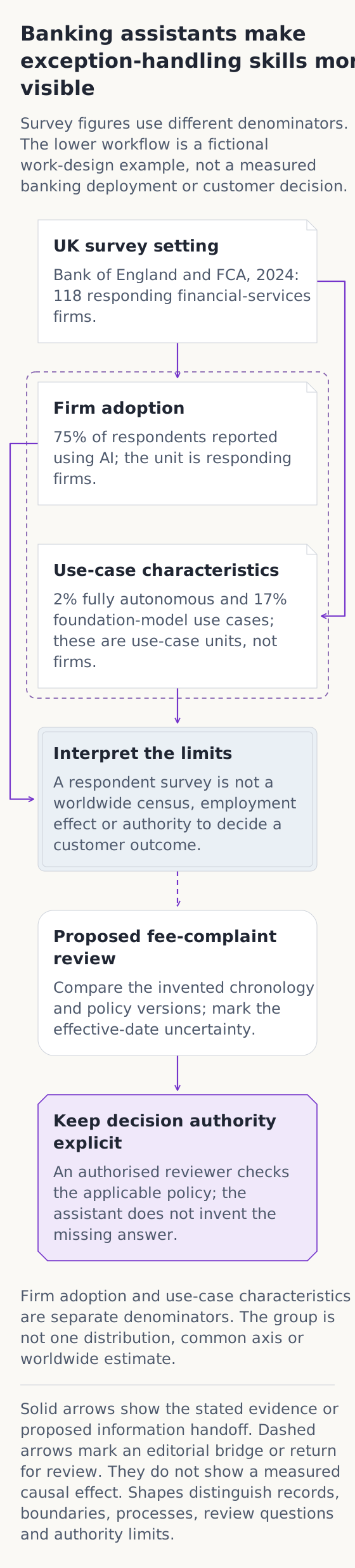
Original explanatory infographic: Survey figures use different denominators. The lower workflow is a fictional work-design example, not a measured banking deployment or customer decision.
[Open the complete evidence diagram](/assets/future-work-workflow-banking-exception-work-20261016.svg)
Read the diagram
**Banking assistants make exception-handling skills more visible**
Survey figures use different denominators. The lower workflow is a fictional work-design example, not a measured banking deployment or customer decision.
- **UK survey setting** Bank of England and FCA, 2024: 118 responding financial-services firms.
- **Firm adoption** 75% of respondents reported using AI; the unit is responding firms.
- **Use-case characteristics** 2% fully autonomous and 17% foundation-model use cases; these are use-case units, not firms.
- **Interpret the limits** A respondent survey is not a worldwide census, employment effect or authority to decide a customer outcome.
- **Proposed fee-complaint review** Compare the invented chronology and policy versions; mark the effective-date uncertainty.
- **Keep decision authority explicit** An authorised reviewer checks the applicable policy; the assistant does not invent the missing answer.
Firm adoption and use-case characteristics are separate denominators. The group is not one distribution, common axis or worldwide estimate.
How the connections work
- The survey setting supports the firm-level adoption observation.
- The survey separately reports characteristics of AI use cases.
- The firm observation reaches the scope check without being converted to a use-case share.
- Use-case observations reach the same scope check while retaining their denominator.
- The scope check frames a proposed fictional complaint exercise, not a causal outcome.
- The unresolved effective-date question is handed to authorised human review.
Relationship key
Solid arrows show the stated evidence or proposed information handoff. Dashed arrows mark an editorial bridge or return for review. They do not show a measured causal effect. Shapes distinguish records, boundaries, processes, review questions and authority limits.
Diagram references
- [Artificial intelligence in UK financial services – 2024](https://www.bankofengland.co.uk/report/2024/artificial-intelligence-in-uk-financial-services-2024)
- [The impact of AI on the workplace: Main findings from the OECD AI surveys of employers and workers](https://www.oecd.org/en/publications/the-impact-of-ai-on-the-workplace-main-findings-from-the-oecd-ai-surveys-of-employers-and-workers_ea0a0fe1-en.html)
- [Labor market impacts of AI: A new measure and early evidence](https://www.anthropic.com/research/labor-market-impacts)