Before AI recommends a spare part, establish what the stock record means
Public research and institutional strategy make an ordinary distinction important: a searchable catalogue is different from confirmed availability or an accepted request.
An inventory entry is a claim about the world, not the world itself. A catalogue may list a component that has been reserved, moved, renamed or recorded in a different unit. An AI assistant can make that catalogue easier to search while leaving those distinctions unresolved. A useful administrative system must therefore distinguish finding a plausible item from establishing that the item is available and appropriate for the request.
This is a non-operational logistics story. It concerns synthetic catalogue records for a fictional training-centre store, not supply routes, readiness calculations or deployment planning. The same ordinary distinction appears in many public institutions: an explanation, a stock observation, an approved request and a confirmed handover are different records. Combining them into one conversational answer can conceal where evidence ends and another process must begin.
Public strategies do not prove a stock-room outcome
UNIDIR’s [Artificial Intelligence Beyond Weapons report page](https://unidir.org/publication/artificial-intelligence-beyond-weapons-application-and-impact-of-ai-in-the-military-domain/) is dated 11 October 2023. It describes research on military AI applications beyond the narrow use-of-force context and discusses strengths and limitations. Its historical date matters: a current website listing does not make the report a new 2026 deployment account. This article uses its broad scope, without reproducing operational examples or treating possibilities as measured results.
NATO’s [30 April 2025 Data Strategy announcement](https://www.nato.int/en/news-and-events/articles/news/2025/04/30/nato-releases-strategy-to-use-data-for-enhancing-collective-defence) distinguishes the public release from agreement by Allies in February 2025. It discusses common standards for collecting, storing and distributing data while Allies retain control. That is a policy direction. It is not evidence that a particular catalogue is accurate, that access has been granted to a supplier or that an AI integration has passed acceptance.
Singapore’s defence minister used a [30 July 2025 innovation speech](https://www.mindef.gov.sg/news-and-events/latest-releases/30jul25-speech/) to discuss faster cycles of capability development alongside more deliberate processes, explicitly raising training and logistics implications. The speech is useful evidence of questions an institution is asking. It is not an independent evaluation of a catalogue assistant, and this article adopts none of its claimed financial or workforce outcomes for the fictional example.
A fictional training-centre store
Consider a fictional adult administrative team in Singapore managing practice equipment for public-sector classrooms. It holds demonstration projectors, reusable cable adapters and non-operating training components. All people and records are invented. The exercise excludes military movements, sensitive stock levels and real supplier information. Its purpose is to examine the meaning of ordinary records before a conversational system is allowed to suggest administrative actions.
The team receives a synthetic request for a replacement power adapter for a classroom projector. Several catalogue entries share similar wording. One describes a loose adapter, another a complete demonstration kit, and another an item retained only as a historical record. The assistant can help locate candidates. It should not silently convert similarity in description into technical compatibility, stock availability or authorization to issue a component.
The first worked step is to inspect the record’s vocabulary. What does available mean? Does the count refer to individual adapters or boxed kits? Does a location describe the current shelf or the place where the item was first received? The team writes those meanings in plain language beside the relevant fields. An elegant search interface cannot repair a definition that different departments use differently.
Separate the catalogue from the transaction
Next, the team distinguishes a catalogue description from a stock observation. A description can be stable while availability changes. An older cached answer may still describe the right item but no longer reflect its current reservation state. The response should make its observation time and source visible where relevant, without implying that displaying a timestamp establishes accuracy. The store’s normal confirmation process still owns the issue decision.
A proposed request is another separate state. Suppose the assistant drafts a request for review. The receiving system then declines it because the practice item is reserved. The human message should explain that the request was not accepted and preserve the draft. It should not replace the refusal with a reassuring answer about an alternative component that has never been reviewed. A substitution changes the question and may require different expertise.
An uncertain acknowledgement requires particular care. If a receiving system may have accepted a request but the confirmation is missing, automatically sending it again can produce duplicate work. In this fictional exercise, the team keeps the original request identity and compares the receiving record before considering another action. This is an administrative integrity principle, not an operational resilience technique or an assertion that any real defence system behaves this way.
Test exceptions that belong to the records
The trial should include renamed catalogue entries, incomplete unit descriptions and references to retired practice equipment. These cases reveal whether the assistant can preserve uncertainty and direct a person to the relevant record. A failure to find an item should not be translated into “the organization does not own one.” It may mean only that the current searchable catalogue lacks an adequate entry.
Reviewers also need to know whether a generated explanation came from the catalogue, a supplier document or the model’s general language knowledge. Those sources answer different questions. A public description can explain an item’s purpose without establishing its suitability for a particular piece of equipment. Where the evidence is insufficient, the useful result is an explicit hold for the responsible specialist, not a more elaborate guess.
Measure the handoff, not just the search
A meaningful local comparison would include the effort of clarifying entries, checking reservations and resolving rejected or uncertain requests. Counting only how quickly a candidate description appears would miss much of the work. The fictional team could observe whether the final request refers to the intended item and whether the receiving process’s decision remains visible. No time saving, cost reduction or reliability rate is measured in this article.
The potential benefit is a clearer connection between searchable information and the administrative process that acts on it. That connection requires definitions, current records and explicit handoffs. It does not require an assistant to acquire purchasing authority or to make technical substitutions. Keeping those limits visible helps a user understand which part of the task has actually been completed.
UNIDIR’s historical research, NATO’s data-policy announcement and Singapore’s institutional discussion justify asking better questions about supporting information. They cannot answer those questions for a particular stock room. Before an AI recommendation is treated as a practical logistics result, the institution needs to establish what the record means and what the receiving process confirmed.
Evidence diagram and readable guide
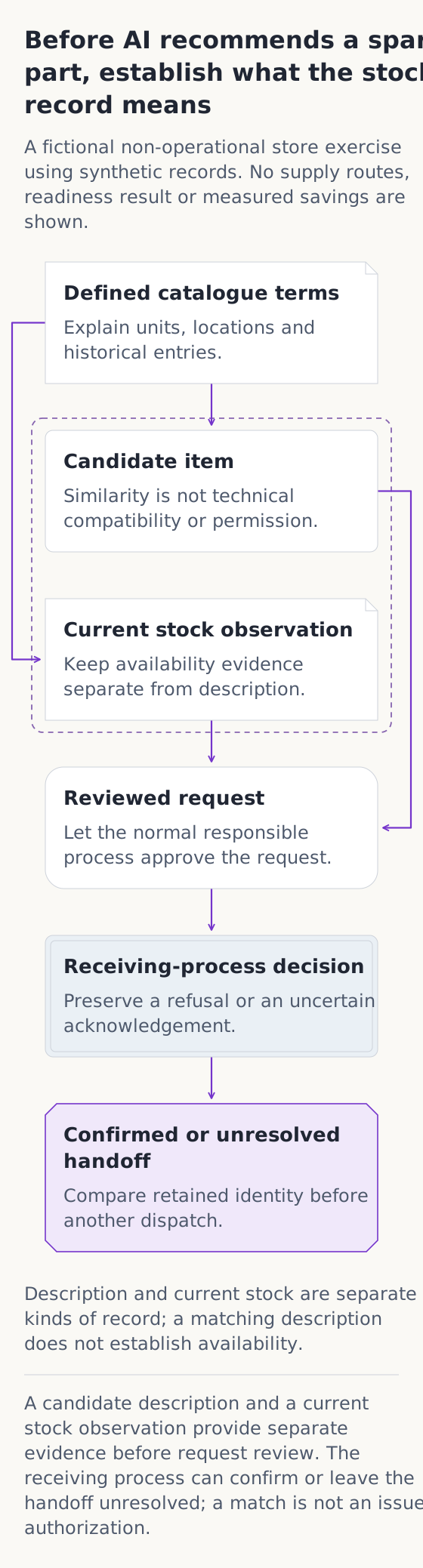
Original explanatory diagram: a fictional store keeps catalogue meaning, stock evidence, request review and acknowledgement distinct.
[Open the complete evidence diagram](/assets/defence-workflow-catalogue-logistics-20261015.svg)
Read the diagram
**Before AI recommends a spare part, establish what the stock record means**
A fictional non-operational store exercise using synthetic records. No supply routes, readiness result or measured savings are shown.
- **Defined catalogue terms** Explain units, locations and historical entries.
- **Candidate item** Similarity is not technical compatibility or permission.
- **Current stock observation** Keep availability evidence separate from description.
- **Reviewed request** Let the normal responsible process approve the request.
- **Receiving-process decision** Preserve a refusal or an uncertain acknowledgement.
- **Confirmed or unresolved handoff** Compare retained identity before another dispatch.
Description and current stock are separate kinds of record; a matching description does not establish availability.
How the connections work
- Defined catalogue terms provide context for the candidate item.
- Defined terms also clarify what the current stock observation means.
- The candidate item is considered in the reviewed request.
- The current stock observation supplies separate availability evidence for review.
- The reviewed request goes to the ordinary receiving process.
- The receiving decision leaves a confirmed or explicitly unresolved handoff.
Relationship key
A candidate description and a current stock observation provide separate evidence before request review. The receiving process can confirm or leave the handoff unresolved; a match is not an issue authorization.