Blockchain investigation agents must keep leads separate from findings
New TRM and Chainalysis agent announcements show how conversational graph tools can help investigation work while preserving attribution and uncertainty.
An investigation contains several kinds of statements that should not be flattened into one narrative. A recorded transfer, a supplier’s attribution, a suggested connection and an investigator’s conclusion have different support. New AI assistants promise to help people move among these layers using ordinary language. Their value depends on whether that convenience preserves the distinctions, rather than making a tentative lead sound like an established identity.
On 25 March 2026, TRM Labs announced Co-Case Agent inside TRM Forensics. The launch described natural-language graph operations, graph audits, suggestions and an interaction audit log, with availability beginning that day. This is a concrete first-party account of a tool and its intended use. Its speed, accuracy and statements about defensibility have not been independently tested here, and an audit log alone cannot guarantee acceptance of a report in a legal process. [TRM’s launch announcement](https://www.trmlabs.com/resources/blog/trm-labs-launches-co-case-agent-an-ai-assistant-for-every-crypto-investigation).
Chainalysis’s 31 March announcement described another agent approach: deterministic workflows for critical decisions, exploratory signals in other contexts, audit trails and human decisions about automation. It said rollout would begin over the summer. That prospective statement should not be silently rewritten as verified general availability by October. Nor do its early-development examples establish independently measured time savings. The distinction between a deterministic result and an exploratory suggestion is the part readers can usefully examine. [Chainalysis’s agent announcement](https://www.chainalysis.com/blog/introducing-first-blockchain-intelligence-agents-2026/).
An assistant is a layer over other evidence
A conversational interface can make complex software easier to approach. Instead of remembering every control, a learner can express a question and see a proposed operation. That is helpful only when the operation and its result remain inspectable. A request to explain a graph should not be confused with permission to change it, and a generated summary should not conceal where its underlying labels came from.
An August 2026 Penlink and Chainalysis announcement illustrates the joining problem. It describes bringing blockchain attribution and transaction context into an existing investigative environment, with links to other information and a route into Reactor. This is a first-party integration account, not a demonstration that a combined view identifies a particular person or proves wrongdoing. Different records becoming visible in one interface does not make them independent corroboration of each other. [The Penlink integration announcement](https://www.chainalysis.com/blog/penlink-integration-blockchain-intelligence-august-2026/).
Chainalysis’s 14 August methodology article offers a particularly useful qualification. The company says it does not use machine learning to identify wallet segments or construct address clusters, while using ML selectively for leads, anomalies, pattern recognition and scam detection. That is an attributed description of one supplier’s methods, not a universal rule about every analytics company or an independent legal finding. It shows why “AI-powered blockchain analysis” is too broad a label to explain a particular conclusion. [Chainalysis on ML’s stated role](https://www.chainalysis.com/blog/ml-role-in-blockchain-intelligence/).
The practical question is therefore which layer produced a statement. Was it a directly supplied record? A defined calculation? An attribution from a separate source? An inference offered for review? A fluent assistant can describe all four in similar language. A useful interface gives the reviewer enough context to tell them apart and to decline an unsupported connection without losing the rest of the work.
A fictional graph exercise
Imagine fictional adult learners at a Singapore financial-crime training session. They work with a deliberately invented graph of labelled boxes and synthetic transfers. There are no actual wallet addresses, personal identities or funds. One label is confirmed within the exercise, another is explicitly provisional, and a third has been withdrawn by the facilitator. The purpose is to practise explaining evidence, not conducting a real investigation.
The first task is simply to describe what the supplied graph shows. Learners distinguish the movement between boxes from the note about who might control a box. They record the source and edition of each note. When an assistant produces a narrative, they mark which sentences refer to supplied observations and which introduce additional interpretation.
The provisional label creates a useful test. An answer that says a fictional organisation definitely controlled a destination has moved beyond its support. Replacing the sentence with “the supplied note tentatively associates this box with that organisation” is not cosmetic caution. It preserves the type of evidence the next reader needs to evaluate.
The withdrawn label tests correction. Learners retain the earlier edition as part of the exercise history but use the corrected edition for the current account. They ask whether the assistant identifies which sentences depended on the withdrawn label. A tool that merely adds a general disclaimer at the end may leave the specific unsupported conclusion intact.
Another task compares two summaries of the same synthetic graph. One is concise but omits the uncertainty. The other is longer but identifies the unresolved attribution. Learners can discuss which is more useful for a particular handoff. This makes communication part of the evaluation, rather than treating factual support and readable prose as competing goals.
No learner sends an allegation, contacts a real person or tries to obtain private account data. The exercise ends with a limited explanation of the supplied materials and a list of questions those materials cannot answer. It is a proposed learning activity, not a claim that any of the named vendors uses this curriculum or that a real case would reach the same conclusion.
What helpful adoption would look like
The possible benefits are tangible: less effort navigating a large graph, clearer access to the provenance of a label and a more understandable account for a colleague. An assistant may also help a novice notice that a conclusion depends on information outside the graph. Those benefits require a task-level comparison, including correction time and the quality of the eventual explanation.
The failure modes deserve equally concrete treatment. An assistant might merge two labels with similar names, omit an important limitation or turn a suggested next question into a recommendation to act. A training evaluation should include those cases rather than rewarding only a smooth account of a clean graph. The result should describe what was actually observed, with no extrapolation to untested chains or categories of case.
Privacy and authority remain separate from analytical usefulness. Public visibility of a transaction does not by itself justify gathering unrelated personal information. A software capability does not settle who may use it, with what data or for which purpose. This article offers no legal advice and no method for bypassing access controls or identifying people from private records.
The 2026 launches and integration reports show a real move toward conversational investigative tools. The educational opportunity is to learn the layers beneath the conversation: observation, attribution, inference, review and correction. Keeping those layers visible is how a convenient assistant can support a careful finding without making every generated lead sound conclusive.
Evidence diagram and readable guide
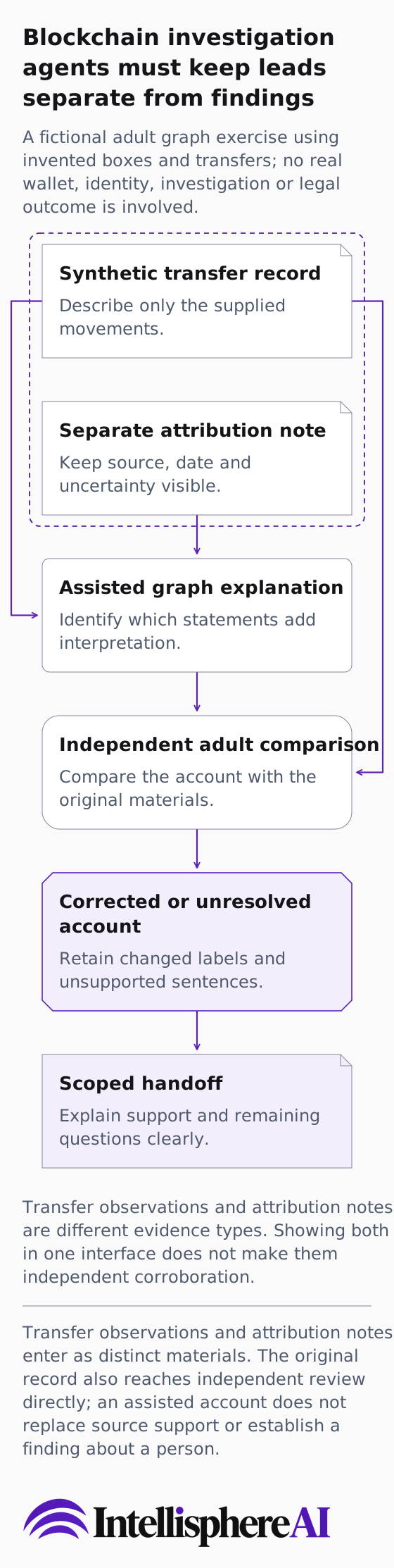
Original explanatory diagram: a fictional graph exercise retains observations, attribution notes, review and correction separately; no real wallet, identity or legal finding is shown.
[Open the complete evidence diagram](/assets/crypto-evidence-investigation-agents-20261016.svg)
Read the diagram
**Blockchain investigation agents must keep leads separate from findings**
A fictional adult graph exercise using invented boxes and transfers; no real wallet, identity, investigation or legal outcome is involved.
- **Synthetic transfer record** Describe only the supplied movements.
- **Separate attribution note** Keep source, date and uncertainty visible.
- **Assisted graph explanation** Identify which statements add interpretation.
- **Independent adult comparison** Compare the account with the original materials.
- **Corrected or unresolved account** Retain changed labels and unsupported sentences.
- **Scoped handoff** Explain support and remaining questions clearly.
Transfer observations and attribution notes are different evidence types. Showing both in one interface does not make them independent corroboration.
How the connections work
- The supplied transfer record provides movement context for an assisted explanation.
- An attribution note provides different context and retains its uncertainty.
- The original transfer record separately supports the adult's comparison.
- The assisted explanation enters review without replacing its underlying materials.
- The comparison identifies sentences requiring correction or retained uncertainty.
- The corrected account supports a scoped handoff, not a finding about a real person.
Relationship key
Transfer observations and attribution notes enter as distinct materials. The original record also reaches independent review directly; an assisted account does not replace source support or establish a finding about a person.