BPO quality careers need a contract that pays for judgment
A customer-support productivity result becomes a workforce decision only after clients and suppliers decide who will fund expertise, exceptions and learning.
An outsourcing contract can make an AI assistant look successful while making the service harder to sustain. If every faster conversation becomes a lower staffing allowance, workers have less time to investigate unfamiliar problems, coach colleagues and improve the knowledge base. The question for BPO employers is therefore how to pay for the judgment surrounding an answer. That question reaches beyond whether a chatbot can draft a polite reply. It concerns the jobs, contracts and learning arrangements that keep customer support reliable after routine drafting becomes cheaper.
The strongest relevant workplace evidence is specific. A [Quarterly Journal of Economics study published on 4 February 2025](https://academic.oup.com/qje/article/140/2/889/7990658) followed the staggered introduction of an assistant among 5,172 customer-support agents. Issues resolved per hour increased by 15% on average. Less experienced workers benefited more; the most skilled agents had small speed gains and small quality declines. The researchers studied one firm's setting and could not establish aggregate employment or wage effects. Those qualifications matter when a buyer turns an observed productivity result into a proposed staffing reduction.
The operational implication is an editorial inference: expertise can become less visible precisely when a system depends on it. A novice may receive a useful answer assembled from previous successful work. Experienced agents still notice that a policy changed, a customer is describing an unusual failure, or the available answer is inappropriate. A service that stops rewarding those contributions may improve its immediate handling metric while weakening the material from which future assistance is built. Employers should treat knowledge maintenance and exception handling as named work, with time and responsibility attached.
Consider an explicitly fictional outsourcing team serving a software business from Cebu and Bengaluru. Its assistant proposes account-recovery responses from an approved support library. During a supervised exercise, a senior agent notices that a suggested reply assumes a customer still controls an old email address. The agent refuses the suggestion, identifies the relevant exception and writes a safer escalation note. The example uses invented accounts and illustrates work design; it is not a reported deployment, security procedure or measured business outcome. Success means recognising the boundary, not issuing more recovery instructions.
That intervention belongs in the contract's quality definition. The buyer and supplier could separately record correctly resolved ordinary cases, justified escalations, repeated contact and corrected knowledge entries. They should also identify work that cannot be scored quickly, such as explaining why a convenient answer would be unsafe. A contract can reserve paid specialist capacity rather than assuming that every unhandled case is inefficiency. The proposed arrangement does not guarantee a particular staffing level; it makes the allocation decision visible enough to discuss before service quality deteriorates.
The unit of measurement needs similar care. An email or document improvement is not a completed support journey. [Microsoft Research's April 2025 workplace experiment](https://www.microsoft.com/en-us/research/publication/early-impacts-of-m365-copilot/) reported changes in email and document work across multiple firms. It provides evidence about particular activities, not a conversion factor for contact-centre staffing. A supplier should measure the time spent checking a generated summary, waiting for an authorised decision and repairing an incorrect handoff. Moving those minutes from the agent's screen to another team's queue does not remove them from the service.
Workers need a route into the specialist work, rather than a permanent instruction to accept suggestions faster. A useful learning session pairs a newer agent with an experienced reviewer on invented cases containing an outdated policy, an ambiguous request and a missing approval. The learner explains what evidence supports the answer and where responsibility passes to another role. The reviewer records the reasoning, not simply whether the final wording resembles a preferred script. These records can support coaching and a portfolio of demonstrated competence without becoming a covert ranking of employees.
Managers should distinguish learning from surveillance. A worker who flags a misleading suggestion should not automatically receive a lower adherence score. If people fear a penalty for disagreeing with the system, a dashboard showing high acceptance may conceal deteriorating judgment. An employer can make the escalation route explicit, protect time for disagreements and review whether quality sampling includes rejected suggestions. These are proposed controls, not findings that any particular employer has adopted them. They should be negotiated with worker representatives where those arrangements exist.
Global use data offers another reason to resist universal claims. [OpenAI's September 2025 consumer-usage study](https://openai.com/index/how-people-are-using-chatgpt/) describes how people use consumer ChatGPT, including information-seeking and writing. It does not measure an outsourcing workforce or reveal an employer's private deployment. Workers' familiarity with a public assistant can be useful background for training, but it cannot establish that they can handle regulated customer records, follow a client's permissions or recognise a product-specific exception. Those abilities require a task-specific demonstration within an approved environment.
Geography changes the practical design. The fictional team's two locations might differ in customer language, shift patterns, connectivity and access to specialist supervisors. A trial should therefore compare like-for-like case types and make coverage gaps visible. A result from one English-language support queue should not be described as a result for all Indian or Philippine BPO work. Nor should software-support evidence be transferred unchanged to debt collection, clinical administration or emergency assistance. The consequences of a wrong answer and the authority needed to resolve it differ.
Company leaders can begin with a contract review rather than a headcount announcement: identify which quality responsibilities remain, who owns each one and how the supplier is paid to perform them. Workers can ask for paid practice, a documented exception route and recognition for improvements to the support library. Together they can inspect whether the assistant reduces total service effort while preserving customer outcomes. The employment effect will depend on demand, pricing, management choices and wider conditions. A useful assistant creates an opportunity to redesign the work; it does not decide how the gains are shared.
Evidence diagram and readable guide
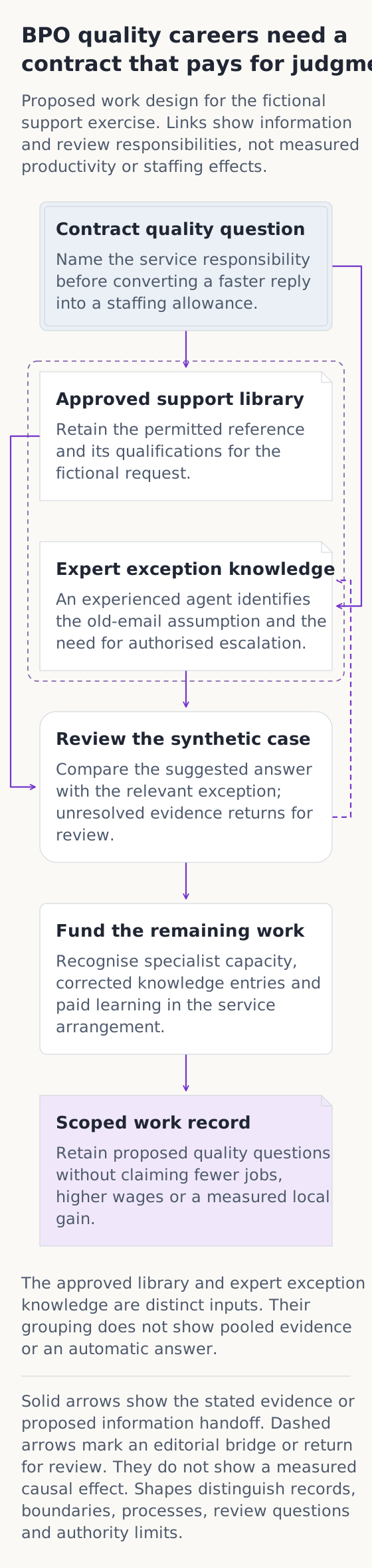
Original explanatory infographic: Proposed work design for the fictional support exercise. Links show information and review responsibilities, not measured productivity or staffing effects.
[Open the complete evidence diagram](/assets/future-work-workflow-bpo-quality-careers-20261016.svg)
Read the diagram
**BPO quality careers need a contract that pays for judgment**
Proposed work design for the fictional support exercise. Links show information and review responsibilities, not measured productivity or staffing effects.
- **Contract quality question** Name the service responsibility before converting a faster reply into a staffing allowance.
- **Approved support library** Retain the permitted reference and its qualifications for the fictional request.
- **Expert exception knowledge** An experienced agent identifies the old-email assumption and the need for authorised escalation.
- **Review the synthetic case** Compare the suggested answer with the relevant exception; unresolved evidence returns for review.
- **Fund the remaining work** Recognise specialist capacity, corrected knowledge entries and paid learning in the service arrangement.
- **Scoped work record** Retain proposed quality questions without claiming fewer jobs, higher wages or a measured local gain.
The approved library and expert exception knowledge are distinct inputs. Their grouping does not show pooled evidence or an automatic answer.
How the connections work
- The contract question defines which support reference is relevant.
- The same question also needs expert exception knowledge, not just a library response.
- The approved reference reaches the synthetic case review as one input.
- The expert exception reaches the review as a separate input.
- The proposed review informs which remaining responsibilities should be funded.
- The proposed responsibilities are recorded for a scoped work-design discussion.
- An unresolved exception returns to expert review; the dashed link does not authorise account recovery.
Relationship key
Solid arrows show the stated evidence or proposed information handoff. Dashed arrows mark an editorial bridge or return for review. They do not show a measured causal effect. Shapes distinguish records, boundaries, processes, review questions and authority limits.
Diagram references
- [Generative AI at Work](https://academic.oup.com/qje/article/140/2/889/7990658)
- [Early Impacts of M365 Copilot](https://www.microsoft.com/en-us/research/publication/early-impacts-of-m365-copilot/)
- [How people are using ChatGPT](https://openai.com/index/how-people-are-using-chatgpt/)