Buying public-sector AI means buying an explanation of its operation
A persuasive demonstration can hide the hardest parts of a public-service AI purchase. The software answers a prepared question quickly, but the buyer still needs to know how an affected person can challenge a mistake, what happens when the supplier changes a model and whether the service can contin
A persuasive demonstration can hide the hardest parts of a public-service AI purchase. The software answers a prepared question quickly, but the buyer still needs to know how an affected person can challenge a mistake, what happens when the supplier changes a model and whether the service can continue if the contract ends. Those questions should shape the purchase while the buyer still has choices. They are difficult to repair after a service has become dependent on one supplier’s undocumented behaviour.
Consider a fictional public-service team evaluating an assistant that routes enquiries about grants. All examples in its trial are synthetic; no real applicant is being assessed. The main task is to help staff find the right guidance, while the decision on eligibility remains elsewhere. A useful procurement brief describes that boundary, the information staff need to verify an answer and the situations where the assistant should stop and ask for human review. It does not begin by demanding an impressive model name.
Procurement policy has a specific audience
The UK’s Algorithmic Transparency Recording Standard scope policy, published on 17 December 2024, sets a mandatory central-government scope for qualifying tools. It covers significant influence on decisions with public effect or direct public interaction, and includes treatment of sensitive information. This is government policy with organisational and tool boundaries, not a rule making every business publish an ATRS record. [UK Government Digital Service](https://www.gov.uk/government/publications/algorithmic-transparency-recording-standard-mandatory-scope-and-exemptions-policy/algorithmic-transparency-recording-standard-atrs-mandatory-scope-and-exemptions-policy)
The UK’s AI procurement guidelines, published on 8 June 2020, organise considerations around planning, publication, selection and award, and ongoing contract management. They are best-practice guidance and assume that applicable procurement rules are addressed separately. A team cannot use the guide itself as a legal exemption or as proof that a particular purchasing route is available. [UK Office for Artificial Intelligence and partners](https://www.gov.uk/government/publications/guidelines-for-ai-procurement/guidelines-for-ai-procurement)
US OMB memorandum M-25-22 is dated 3 April 2025 despite the February date embedded in its download path. It provides federal-agency AI acquisition guidance and states that it rescinds and replaces M-24-18. The instrument is federal executive-branch policy; it should not be described as a general law for every private AI buyer. [US Office of Management and Budget](https://www.whitehouse.gov/wp-content/uploads/2025/02/M-25-22-Driving-Efficient-Acquisition-of-Artificial-Intelligence-in-Government.pdf)
The White House’s 7 April 2025 fact sheet describes M-25-21’s high-impact AI category and M-25-22’s emphasis on competition and avoiding vendor lock-in. That is an attributed contemporary explanation of the memoranda. It is not evidence that every agency’s later procurement terms are identical or that a supplier has met them. [The White House](https://www.whitehouse.gov/fact-sheets/2025/04/fact-sheet-eliminating-barriers-for-federal-artificial-intelligence-use-and-procurement/)
The fictional grants team should therefore keep a policy register alongside its requirements. It records the instrument being relied on, the body in scope, the date checked and the procurement professional responsible for interpreting current terms. Old guidance can still contain useful questions, but its publication date should not disappear when copied into a new tender. An acquisition record should make later changes and unresolved applicability questions easy to see.
Ask for evidence at the same level as the promised benefit
If the supplier promises faster routing, the buyer can request a trial that measures the whole routing task, including corrections and escalations. A model’s answer-generation speed is only one part of that task. If a staff member spends longer checking ambiguous answers, a faster response may not improve the service. A proposed evaluation should distinguish task completion, correctness, operator effort and the experiences of people who receive an incorrect route.
For this fictional trial, the buyer could prepare synthetic enquiries that resemble common and difficult cases. Some omit a key fact; others refer to an expired programme or contain two possible destinations. The supplier sees the trial protocol and the information it may use. Reviewers retain the answer, its evidence and the routing decision. These are proposed evaluation methods, not performance claims about a real product or a prescribed statutory testing standard.
The buyer should also ask what it will receive when the service changes. A hosted model can change independently of the public body’s own software release. The contract discussion can identify notice arrangements, version information, reevaluation responsibilities and a way to restrict a changed capability while it is reviewed. The precise contractual terms require the buyer’s commercial and legal process. The editorial point is that a dependency change should not be invisible to the people accountable for the public service.
Transparency needs an operational owner
A public explanation should say what the tool does in the actual service. “AI supports our work” leaves important questions unanswered. A better proposed explanation identifies whether the tool suggests a route, drafts a response or influences a decision, and tells a person where to seek help. The supplier may provide technical information, but the public body needs someone responsible for turning it into an accurate description of its own use.
That explanation need not disclose private records or security-sensitive implementation details. The review can maintain an internal evidence pack and a separate public description, recording the reason for any withheld detail through the appropriate process. Keeping the two linked matters: a public page that says staff always review an answer should not outlive a service change that removes that review. The link is an organisational responsibility, not a one-time communication exercise.
The grants team can test recovery as part of the purchase. It might interrupt the retrieval service while an operator has an unsent draft. The interface should explain that it cannot confirm the relevant guidance and preserve the safe draft. The trial records whether the operator can continue manually and whether retrying repeats a consequential action. A polished failure state is part of the service being bought, rather than an optional cosmetic improvement after the contract is signed.
Plan for leaving the supplier before entering the contract
An exit rehearsal can use a synthetic export containing the tool configuration, approved references, evaluation cases and review history. The team asks whether another authorised operator can understand the exported material without the supplier’s private dashboard. It also identifies material that cannot be transferred and why. Portability should be assessed at the level of useful service knowledge, rather than reduced to a promise that a spreadsheet download exists somewhere.
An adult student studying procurement can compare two fictional bids. One offers a strong demonstration and vague future documentation; the other supplies a clear evidence pack but has a narrower capability. The exercise is to identify what additional evidence would make the bids comparable, which uncertainties belong in contract negotiation and which proposed capabilities should remain outside the pilot. The student should not award a contract or declare either bid legally compliant from a short scenario.
As of 15 October 2026, these primary sources support the specific UK and US policy developments described here. They do not certify a purchase or establish current terms for every public body. The practical lesson is to make the explanation, evidence, update arrangements and exit path part of the main task being purchased. A supplier’s answer should remain inspectable when the demonstration is over and the public service has to work on an ordinary difficult day.
Evidence diagram and readable guide
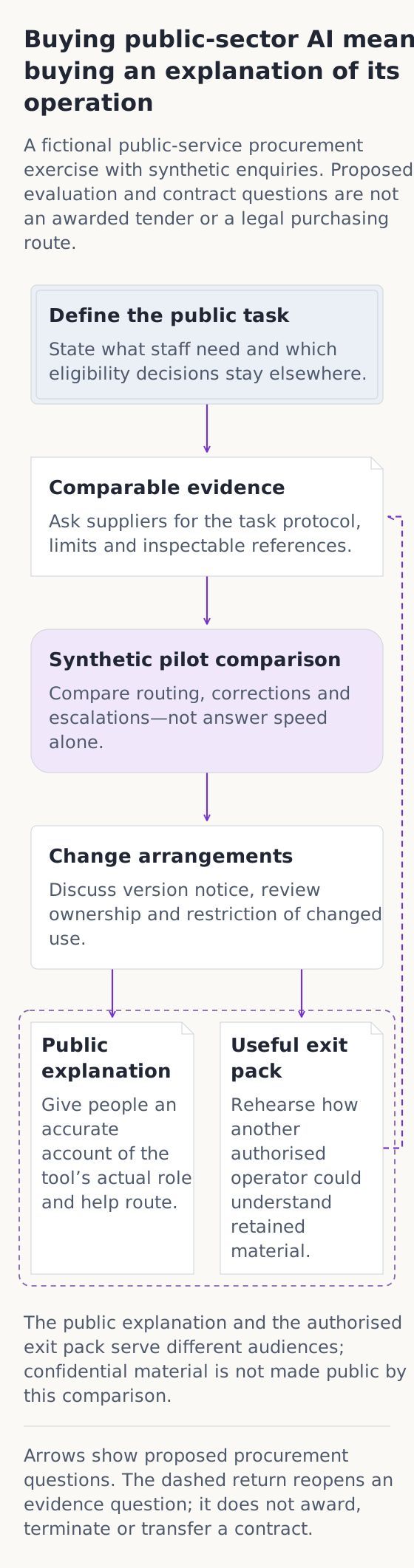
Original explanatory procurement workflow for a fictional grants-enquiry service; no real procurement, contract or performance result is represented.
[Open the complete evidence diagram](/assets/policy-workflow-public-procurement-20261016.svg)
Read the diagram
**Buying public-sector AI means buying an explanation of its operation**
A fictional public-service procurement exercise with synthetic enquiries. Proposed evaluation and contract questions are not an awarded tender or a legal purchasing route.
- **Define the public task** State what staff need and which eligibility decisions stay elsewhere.
- **Comparable evidence** Ask suppliers for the task protocol, limits and inspectable references.
- **Synthetic pilot comparison** Compare routing, corrections and escalations—not answer speed alone.
- **Change arrangements** Discuss version notice, review ownership and restriction of changed use.
- **Public explanation** Give people an accurate account of the tool’s actual role and help route.
- **Useful exit pack** Rehearse how another authorised operator could understand retained material.
The public explanation and the authorised exit pack serve different audiences; confidential material is not made public by this comparison.
How the connections work
- The defined service boundary determines what evidence makes competing proposals comparable.
- The buyer compares evidence through an agreed synthetic task, not an unqualified demonstration score.
- Pilot observations inform questions about updates and responsibilities; they do not prescribe a contract award.
- An accurate public explanation must remain linked to changes in the service.
- Change discussions also identify which service knowledge would be usable after the supplier relationship ends.
- An exit rehearsal can reveal missing evidence to ask about before a future purchase; it is not an automatic supplier switch.
Relationship key
Arrows show proposed procurement questions. The dashed return reopens an evidence question; it does not award, terminate or transfer a contract.