Civilian-protection information must keep its uncertainties visible
ICRC publications explain why AI-supported summaries must preserve the difference between observed facts, attributed accounts and unresolved civilian concerns.
A summary can become more confident as it travels. A report says that a public service may have been interrupted; a digest says that it was interrupted; a later briefing treats the digest as confirmation. AI can make that movement faster and less visible because it produces polished language even when the underlying information is incomplete. The civilian-protection question is therefore not simply whether the summary reads well. It is whether people can still see what the source established and what it did not.
This article discusses public, high-level information governance. It offers no method for identifying targets, selecting weapons or conducting operations. Its practical example is a fictional classroom review of synthetic reports. The purpose is to preserve uncertainty, provenance and human judgment when explaining civilian concerns, not to turn an administrative workflow into a guarantee of lawful conduct or reduced harm.
Distinguish the legal context from the tool
The ICRC’s [2026 FAQ on AI in the military domain](https://www.icrc.org/en/article/faq-artificial-intelligence-in-military-domain) describes applications extending beyond weapons, including logistics and decision support. In its discussion of warfare, it states that international humanitarian law applies to AI as it does to other means and methods. That is a statement about applicable obligations in armed conflict, not a conclusion that every military or administrative AI use falls under an identical legal regime. Actual applicability requires the relevant context and qualified legal assessment.
The ICRC’s [Decisions, Decisions, Decisions publication page](https://www.icrc.org/en/publication/decisions-decisions-decisions-computation-and-artificial-intelligence-military-decision), dated 13 May 2024, describes computerized decision-support tools as displaying, synthesizing or analysing information and proposing options. It emphasizes that tools can influence decisions even when they do not formally make them. That distinction matters when a generated digest is presented as merely a convenient intermediate document.
The organization’s [2025 submission to the UN Secretary-General on military AI](https://www.icrc.org/sites/default/files/2025-04/ICRC_Report_Submission_to_UNSG_on_AI_in_military_domain.pdf) includes preliminary recommendations on decision-support systems and stresses preserving human control and judgment where people face serious risks. These are the ICRC’s recommendations and analysis. They are not a new treaty, a product approval or evidence that an implemented workflow has prevented harm. The retained publication path identifies April 2025; an exact publication day was not established and remains unknown.
Its [working paper for the 2025 UN General Assembly First Committee](https://www.icrc.org/sites/default/files/media_file/2025-10/ICRC_First-Committee_Working_Paper_2025.pdf) places military AI within a wider humanitarian and disarmament discussion. A working paper contributes an institutional position to that discussion. It should not be relabelled as a negotiated rule or a completed international agreement. The paper’s session/year and its exact publication day are different metadata; the latter remains unconfirmed here.
A fictional classroom review
Imagine a fictional adult policy-training group in Geneva examining invented reports about disruption to a fictional public library’s electrical service. No real person, location, incident or conflict is represented. The documents are deliberately benign and synthetic. The exercise asks whether an AI-generated summary preserves the relationship between the reports and the claims made from them. It does not feed a real decision or operational system.
The first practice report states that a staff member could not access a catalogue terminal. A second describes planned maintenance during a different period. A third repeats a neighbour’s unverified account. The trainees should not compress these into “the library’s power supply failed.” That sentence removes differences in observation, time and source knowledge. It may sound clearer while carrying less faithful information.
The group can work with a small claim sheet. Each proposed statement names its supporting source, the period it describes and its uncertainty. If the source is second-hand, that remains visible. If two accounts concern different dates, the summary does not merge them. A missing fact stays missing rather than becoming a confident transition sentence. These are editorial review practices for the fictional exercise, not an operational assessment procedure.
Preserve disagreement through the handoff
The useful comparison is between the original synthetic material and what the next reader receives. A trainee who sees only the digest should be able to identify which claims are observations, attributed accounts or unresolved interpretations. If that distinction requires reopening an inaccessible technical log, the main document has not done enough to preserve meaning. The evidence record and the human explanation need to work together.
Suppose the generated summary omits the planned-maintenance document. A reviewer should be able to add a correction without deleting the earlier version or pretending the omission never happened. The retained record can explain what changed and why. This helps later readers understand that a conclusion was revised, rather than treating the latest confident wording as an uninterrupted chain of confirmation.
Disagreement should also have a place. Two reviewers may interpret a vague source differently. The exercise should preserve that uncertainty where the material cannot resolve it. Forcing a single answer can reward false precision. A well-written note can say that the available accounts do not establish the cause, while identifying the narrow facts on which the reviewers agree.
Do not confuse an interface with a safeguard
A checkbox labelled human review does not establish meaningful scrutiny. The adult reviewer needs time, relevant evidence and the ability to challenge or withhold an unsupported statement. The fictional exercise can examine whether a rushed reader notices the uncertainty label and whether the supporting material is easy to compare. It cannot infer a general safety result from one successful classroom discussion.
Privacy and access still matter. Real civilian information can concern vulnerable people and essential services. A public demonstration should not acquire realism by exposing their records. Synthetic material can test whether a summary retains uncertainty without creating that exposure. Decisions about real information require the responsible institution’s legal, humanitarian, privacy and security expertise; an AI workflow description does not replace it.
State the modest result
The possible benefit is a more faithful handoff of information: a reader can see what was observed, what was attributed and what remains unknown. No reduction in civilian harm, legal compliance rate or decision quality is measured here. Those claims would need evidence far beyond an illustration and a set of institutional recommendations.
The ICRC sources make a common concern visible: computer assistance can influence people without displacing their responsibility. Preserving uncertainty is one concrete way to respect that distinction in public explanation. The polished summary should make the limits of the information easier to understand, rather than making those limits disappear.
Evidence diagram and readable guide
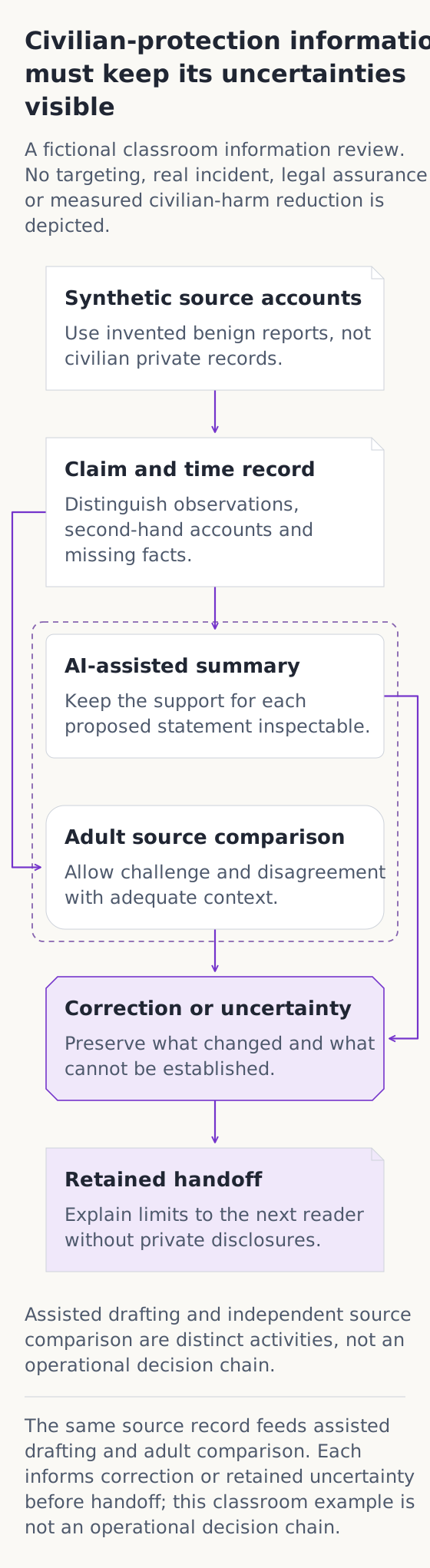
Original explanatory diagram: synthetic reports, assisted drafting and adult source comparison retain corrections and uncertainty in a classroom handoff.
[Open the complete evidence diagram](/assets/defence-workflow-civilian-information-20261015.svg)
Read the diagram
**Civilian-protection information must keep its uncertainties visible**
A fictional classroom information review. No targeting, real incident, legal assurance or measured civilian-harm reduction is depicted.
- **Synthetic source accounts** Use invented benign reports, not civilian private records.
- **Claim and time record** Distinguish observations, second-hand accounts and missing facts.
- **AI-assisted summary** Keep the support for each proposed statement inspectable.
- **Adult source comparison** Allow challenge and disagreement with adequate context.
- **Correction or uncertainty** Preserve what changed and what cannot be established.
- **Retained handoff** Explain limits to the next reader without private disclosures.
Assisted drafting and independent source comparison are distinct activities, not an operational decision chain.
How the connections work
- Synthetic source accounts support the claim and time record.
- The claim and time record constrains the assisted summary.
- The same source record is available for an adult comparison.
- The assisted summary is considered when making a correction or retaining uncertainty.
- The adult source comparison separately informs that correction or uncertainty.
- The correction and remaining uncertainty travel with the retained handoff.
Relationship key
The same source record feeds assisted drafting and adult comparison. Each informs correction or retained uncertainty before handoff; this classroom example is not an operational decision chain.