Clinical documentation savings depend on who checks the note
A randomised ambient-scribe trial shows why hospitals should evaluate complete record work and staff responsibilities before translating faster drafting into staffing promises.
An ambient scribe can move clinical work rather than simply remove it. Listening and typing may decrease, while checking a draft, correcting an omission and explaining the recording process become more prominent. For healthcare employers, the workforce question is how to allocate that changed responsibility. For clinicians and administrative colleagues, it is whether the new arrangement leaves enough time and authority to maintain an accurate record. A documentation tool's usefulness should not be confused with permission to diagnose, prescribe or reduce professional oversight.
A [UCLA-affiliated randomised trial, published online on 26 November 2025](https://pubmed.ncbi.nlm.nih.gov/41497288/), assigned 238 outpatient physicians across 14 specialties to DAX Copilot, Nabla or usual care. Nabla reduced time-in-note by 9.5% relative to control; DAX did not show a statistically significant reduction on that primary measure. The trial ran from November 2024 to January 2025. The EHR time-in-note measure excluded editing within the scribe platforms. Its abstract also reports occasional inaccuracies and cautions that secondary wellbeing findings need confirmation. Different results within one trial undermine the idea of a universal scribe-to-staffing conversion rate.
The relevant work unit is a completed, checked encounter record. A draft produced quickly may still require the clinician to reconstruct what was actually said. Conversely, a useful draft may reduce evening documentation without increasing appointments. Neither outcome is visible in a count of generated notes. Employers should distinguish active drafting time, correction time, record completion, interruptions and work outside scheduled hours. They should also record which colleagues receive new reconciliation tasks, because shifting an unfinished problem to a coding or referral team does not eliminate it.
Consider an explicitly fictional outpatient service in Pune testing an approved tool with simulated consultations and adult staff. A generated note incorrectly converts an uncertain symptom history into a definite statement. The clinician corrects it; a documentation specialist checks whether the correction also reaches a proposed referral summary. The exercise uses invented records and is not clinical advice or a claim that a named system made that mistake. It exposes a workforce dependency: one correction may have to travel through several documents before the administrative work is genuinely complete.
The team could assign three distinct responsibilities. The clinician owns the clinical content of the signed record. A designated operational lead owns access, retention and the recording explanation. Documentation colleagues review permitted administrative consistency without being expected to make clinical judgments. In a pilot, the team should specify what happens when a draft is absent, incomplete or disputed. A worker must be able to return to the established recording method. The proposed division is a design example, not a statement of legal duties in every jurisdiction.
Training should make the verification task concrete. Staff can compare a simulated consultation, an initial draft and the approved final note, identifying unsupported certainty, missing qualifications and misattributed speakers. A useful assessment asks the reviewer to explain the correction and identify any downstream document affected by it. It should not reward a short editing time when the participant failed to notice an important discrepancy. Nor should proficiency be inferred from enthusiasm for the interface. Familiarity with a tool and reliable review are different abilities.
The [World Health Organization's guidance on large multi-modal models](https://www.who.int/publications/i/item/9789240084759) addresses governance questions around a broad class of generative systems; its current publication page displays 25 March 2025. It is guidance, not evidence that a particular clinical workflow improves patient outcomes. A local employer should therefore ask separate questions about information governance, technical reliability, accessibility and the impact on staff. An attractive note interface cannot answer those questions on its own, and a successful documentation pilot cannot establish the safety of an unrelated diagnostic use.
Workers should have a voice in the measures used to assess the pilot. If management records only the time at which a note is signed, people may feel pressure to approve text before reviewing it properly. A better discussion includes corrections, delayed completion, duplicate documentation and the ability to explain the final record. Time released from typing could support patient communication, breaks or existing backlogs. Converting it immediately into additional visits is a separate management choice that needs its own evaluation of workload and service capacity.
The boundary between professional and consumer use also deserves attention. [OpenAI's September 2025 analysis](https://openai.com/index/how-people-are-using-chatgpt/) studies consumer ChatGPT conversations, not authorised clinical record systems. Public familiarity with generative tools cannot establish permission to enter identifiable health information. A hospital's procurement decision must specify the actual product, data arrangements and approved activities. A worker's personal subscription is not a substitute for that decision. This is an operational distinction, not a claim that every use of a consumer assistant has the same risk.
The international implications depend on working conditions. A well-supported outpatient trial in one US health system cannot establish the effect in a crowded multilingual service with different equipment, staffing or referral processes. A local assessment should include the languages actually used, the experience of staff who correct records and the accessibility of the recording explanation. These are proposed questions, not results for India or any other country. Evidence about documentation time should remain distinct from evidence about patient outcomes, diagnostic accuracy or the number of clinicians a community requires.
Healthcare leaders can begin by mapping the record's complete route and funding the review work around it. Clinicians and documentation staff can ask who may reject a draft, how corrections propagate and whether the old method remains usable. A staged evaluation should keep real patient information outside unapproved experiments and avoid premature staffing promises. The practical opportunity is to relieve a burdensome activity while improving the organisation of remaining work. Whether that happens depends on the product, setting and implementation; the professional responsibility does not disappear when the first draft arrives automatically.
Evidence diagram and readable guide
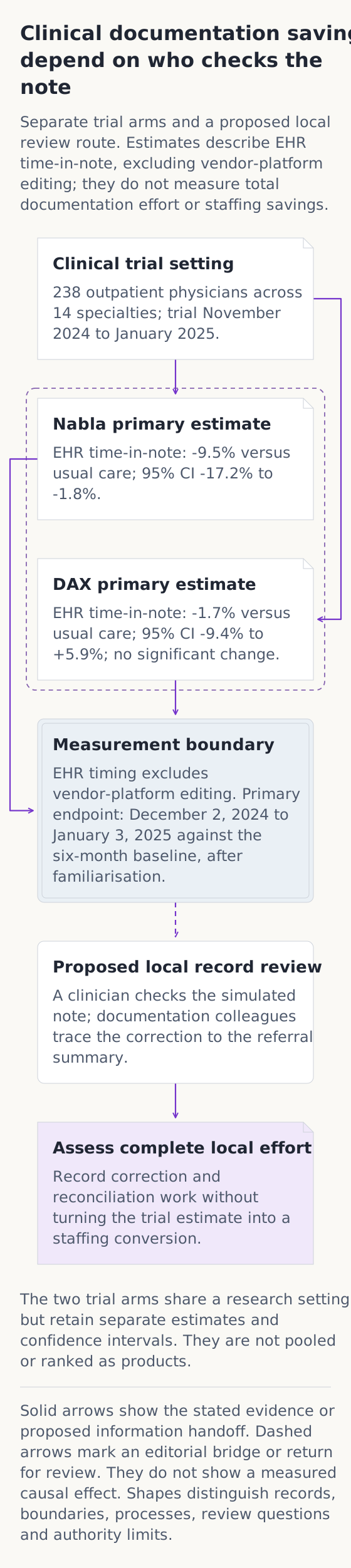
Original explanatory infographic: Separate trial arms and a proposed local review route. Estimates describe EHR time-in-note, excluding vendor-platform editing; they do not measure total documentation effort or staffing savings.
[Open the complete evidence diagram](/assets/future-work-workflow-healthcare-documentation-review-20261016.svg)
Read the diagram
**Clinical documentation savings depend on who checks the note**
Separate trial arms and a proposed local review route. Estimates describe EHR time-in-note, excluding vendor-platform editing; they do not measure total documentation effort or staffing savings.
- **Clinical trial setting** 238 outpatient physicians across 14 specialties; trial November 2024 to January 2025.
- **Nabla primary estimate** EHR time-in-note: -9.5% versus usual care; 95% CI -17.2% to -1.8%.
- **DAX primary estimate** EHR time-in-note: -1.7% versus usual care; 95% CI -9.4% to +5.9%; no significant change.
- **Measurement boundary** EHR timing excludes vendor-platform editing. Primary endpoint: December 2, 2024 to January 3, 2025 against the six-month baseline, after familiarisation.
- **Proposed local record review** A clinician checks the simulated note; documentation colleagues trace the correction to the referral summary.
- **Assess complete local effort** Record correction and reconciliation work without turning the trial estimate into a staffing conversion.
The two trial arms share a research setting but retain separate estimates and confidence intervals. They are not pooled or ranked as products.
How the connections work
- The shared trial setting provides context for the separately reported Nabla estimate.
- The same trial setting also provides context for the separate DAX estimate.
- The Nabla estimate is interpreted within the EHR timing boundary, not as total effort.
- The DAX estimate retains its uncertainty within the same timing definition.
- The measurement boundary informs a proposed local exercise; this is not an observed effect on that exercise.
- The proposed review asks the local team to account for remaining correction and reconciliation work.
Relationship key
Solid arrows show the stated evidence or proposed information handoff. Dashed arrows mark an editorial bridge or return for review. They do not show a measured causal effect. Shapes distinguish records, boundaries, processes, review questions and authority limits.
Diagram references
- [Ambient AI Scribes in Clinical Practice: A Randomized Trial](https://pubmed.ncbi.nlm.nih.gov/41497288/)
- [Ethics and governance of artificial intelligence for health: Guidance on large multi-modal models](https://www.who.int/publications/i/item/9789240084759)
- [How people are using ChatGPT](https://openai.com/index/how-people-are-using-chatgpt/)
- [Independent review clinical measurement context: NLM author manuscript Methods](https://pmc.ncbi.nlm.nih.gov/articles/PMC12768499/)