Farmer data agreements are part of an agricultural AI service
Current FAO discussions, India’s official AgriStack account and European testing services put practical questions around data recipients, purpose and service behaviour.
A farmer can understand a tool’s purpose and still reasonably ask where their records will go. A photograph collected for an advisory question, a plot description used for a demonstration and a dataset used to improve a model are different arrangements. A useful agricultural AI service should make those differences understandable before data begin to move, rather than treating permission as a final formality.
The policy conversation is current. In June 2026, the CFS High Level Panel of Experts on Food Security and Nutrition announced a background note examining AI’s evidence, data governance and conditions for responsible adoption. The announcement establishes the questions being discussed, not a binding global rule or a certificate that a service is trustworthy. The linked full note is not reproduced here. [The HLPE-FSN announcement](https://www.fao.org/cfs/cfs-hlpe/insights/news-insights/news-detail/new-note--harnessing-ai--digitalization-and-data-governance-for-fsn/en).
Adoption involves institutions as well as software
FAO’s June 2026 account of a Near East and North Africa dialogue records concerns about digital literacy, connectivity, language, affordability, trust and data governance. These are reported discussion themes, not a representative causal study of every farmer in the region. They do explain why an effective service proposal needs more than an attractive model demonstration. [FAO’s regional dialogue account](https://www.fao.org/neareast/news/details/fao-convenes-regional-dialogue-on-barriers-to-ai-adoption-in-agrifood-systems/en).
In an August 2026 parliamentary reply, India’s agriculture ministry described AgriStack’s federated registries and consent-based sharing with authorized entities for specific purposes. This article attributes that description to the ministry. It does not independently certify the system’s privacy, security or legal compliance, or infer that a particular farmer has authorized a particular use. [The official AgriStack account](https://www.pib.gov.in/PressReleasePage.aspx?PRID=2296209&lang=1®=48).
European testing infrastructure provides another institutional example. Munster Technological University’s AgriTech Ireland page describes its agrifoodTEF node and tailored field, system and usability testing. Access to such testing is different from evidence that a named product has passed it. A service listing is a way to ask for relevant evaluation, not a transferable approval badge. [MTU’s agrifoodTEF description](https://agritechireland.ie/agrifoodtef/).
Make a small data map before a large promise
Imagine a fictional adult horticultural cooperative near Cairo considering an AI-assisted way to organize advisory questions. The meeting uses synthetic member names, invented plot descriptions and staged greenhouse photographs. No real member data are uploaded and no service is commissioned. The group begins with a simple question: what information is needed for this task, and what would happen to each item?
One column describes the item in ordinary language. Another identifies the proposed purpose, the organization receiving it and who can answer questions about its use. The group marks whether the item is genuinely necessary. If a demonstration can work with an invented location, there is no reason to demand a member’s precise field coordinates merely to make the screen look complete.
The group then draws the proposed handoffs. An adviser reading a question is one recipient. A hosting organization is another. A model-development team using retained examples would be a further purpose that needs its own examination. Describing all of these as improving the service hides meaningful differences. The map should make it possible for a member to ask about one use without having to reject or accept everything at once.
Explain permission in the language of the task
For the fictional exercise, the cooperative writes separate example choices for answering a question, retaining a service record and considering material for later development. These are discussion aids, not a legal template or a claim about which permissions are sufficient in any jurisdiction. An actual organization needs the applicable legal, contractual and institutional review before adopting a process.
The human explanation should say what the person can expect and where uncertainty remains. It should identify a contact, describe the relevant retention arrangement and explain how to request a correction. A member should not need to understand a model-training pipeline to ask whether an image will be reused. Equally, an organization should not promise deletion from every derived artifact unless it has established how that promise can be fulfilled.
Accessibility is part of this conversation. Ask a consenting adult participant to explain the proposed arrangement in their own words, including which use they could decline. Record misunderstandings and revise the explanation. A signature or a clicked box shows an interaction; it does not by itself demonstrate comprehension. The exercise should allow questions without treating them as obstacles to technology adoption.
Compare the agreement with the service behaviour
The cooperative’s synthetic demonstration can test whether a correction remains attached to a record, whether a withdrawn optional use is visibly recorded, and whether the service distinguishes an unsent draft from a received question. These proposed cases concern workflow clarity. They do not establish that an actual platform enforces access restrictions or honours every deletion request.
For a later commissioned evaluation, the responsible team would need evidence that the system behaves as the agreement describes. That includes the data recipients, access boundaries, retained versions and recovery process after an uncertain submission. An attractive privacy paragraph cannot substitute for that inspection. The test plan should name which claims are examined and which require a separate security or legal assessment.
An example involving shared devices can reveal practical gaps without using anyone’s private account. Does a synthetic draft remain visible when another fictional member begins? Can an adult recognize which member’s record is open? The aim is to understand the service context and improve the design before real records are involved, not to probe an existing system without authorization.
Leave an exit that can be understood
Before a pilot begins, define what the cooperative expects to retain if it changes providers or stops the service. The answer might include its original records, a readable account of corrections and a list of unresolved requests. It should also identify what the organization cannot promise to transfer. Export availability alone does not establish that another service will interpret the records correctly.
A sound data arrangement gives farmers a clearer basis for deciding whether the proposed service fits their needs. It also gives technical teams a more concrete set of behaviours to build and evaluate. This article offers educational questions through a fictional adult cooperative, not legal advice, regulatory certification, an AgriStack audit or an endorsement of a provider. No real identities, farm records or private images were collected, and no agricultural or financial benefit is claimed from the exercise.
Evidence diagram and readable guide
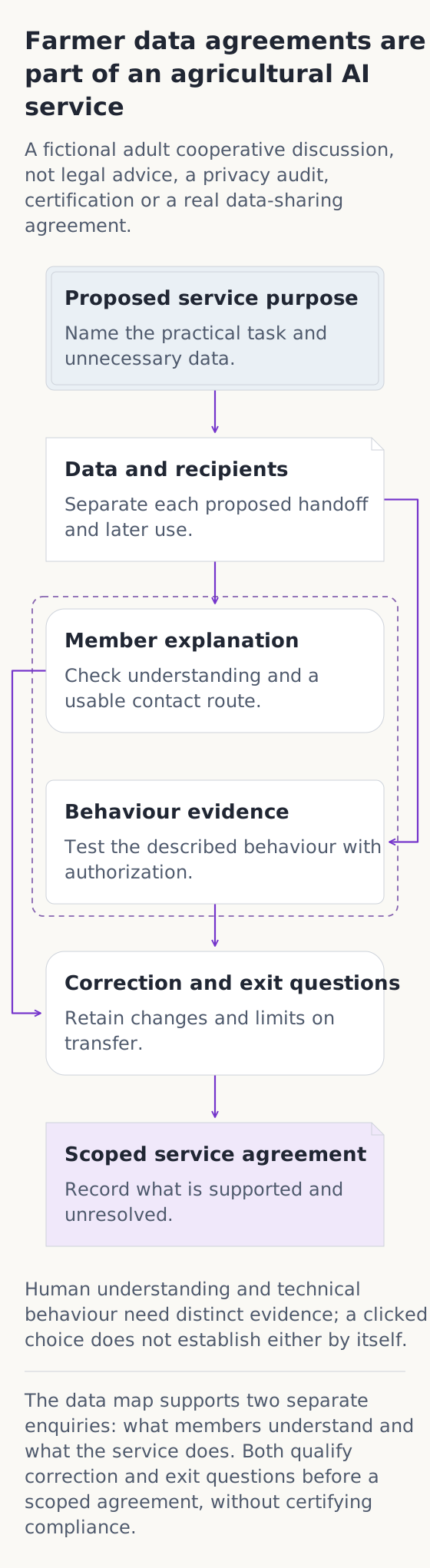
Original explanatory diagram: fictional adult cooperative members distinguish a data-purpose map, understanding, behaviour and unresolved lifecycle questions; this is not a legal agreement or privacy certification.
[Open the complete evidence diagram](/assets/agriculture-workflow-farmer-data-governance-20261015.svg)
Read the diagram
**Farmer data agreements are part of an agricultural AI service**
A fictional adult cooperative discussion, not legal advice, a privacy audit, certification or a real data-sharing agreement.
- **Proposed service purpose** Name the practical task and unnecessary data.
- **Data and recipients** Separate each proposed handoff and later use.
- **Member explanation** Check understanding and a usable contact route.
- **Behaviour evidence** Test the described behaviour with authorization.
- **Correction and exit questions** Retain changes and limits on transfer.
- **Scoped service agreement** Record what is supported and unresolved.
Human understanding and technical behaviour need distinct evidence; a clicked choice does not establish either by itself.
How the connections work
- The proposed purpose determines which data items and recipients need examination.
- The data map supplies concrete content for the member explanation.
- The data map separately identifies behaviours that an authorized evaluation must inspect.
- The member explanation raises understandable questions about correction and exit.
- Technical behaviour evidence supplies separate answers to lifecycle questions.
- Those lifecycle questions qualify a scoped agreement without certifying legal or technical compliance.
Relationship key
The data map supports two separate enquiries: what members understand and what the service does. Both qualify correction and exit questions before a scoped agreement, without certifying compliance.