Financial AI sandboxes turn broad promises into tasks people can examine
Current FCA and Hong Kong sandbox records, alongside the Bank/FCA adoption survey, help separate useful experiments from approval or proven deployment.
An AI demonstration can answer a question that nobody intended to ask. A team may arrive wanting to understand whether an assistant can help explain a payment exception and leave discussing the quality of its general conversation. A well-defined experiment makes that drift visible. Financial sandboxes are interesting because they can bring people, tools and a specific use case together without treating the first convincing demonstration as a finished service.
The FCA’s current Supercharged Sandbox page describes a controlled environment with AI tooling, data, compute and expert support. Its second cohort runs from July to December 2026, with a November showcase still in the future at this article’s 15 October check. The page explicitly says participation is not FCA approval, endorsement or authorisation. Its publication and update dates describe the page, not the beginning of every activity it recounts. [The FCA’s programme record](https://www.fca.org.uk/firms/innovation/supercharged-sandbox).
On 22 July 2026, the FCA announced support from Anthropic, including access to Claude, Claude Code and Claude Cowork. The described uses include agent-led payments, fraud detection, governance and compliance automation. These are named tools and intended experiments, not proof that a particular participant’s product achieved those goals. This article did not use those tools or observe the private projects. [The FCA’s support announcement](https://www.fca.org.uk/news/press-releases/anthropic-supercharged-sandbox).
Experiments, implementation and adoption are different evidence
Hong Kong provides a useful comparison with a distinct programme. HKMA’s October 2025 second-cohort announcement described AI checking AI-generated outputs and adversarial deepfake tests, with trials planned to begin in early 2026. That announcement establishes selected ideas and a schedule at the time. It is not a final outcome report, and the passage of the planned start date does not by itself prove that a trial began or succeeded. [HKMA’s cohort announcement](https://www.hkma.gov.hk/eng/news-and-media/press-releases/2025/10/20251015-4/).
A survey answers another question again. The Bank of England and FCA’s November 2024 report received 118 responses and reported that 75% of responding firms were using AI. It separately examined use cases, materiality and understanding of models. This is evidence of reported adoption among those respondents at that time, not a 2026 census of every financial firm or proof that three quarters of crypto platforms operate autonomous trading systems. [The Bank/FCA survey](https://www.bankofengland.co.uk/report/2024/artificial-intelligence-in-uk-financial-services-2024).
The distinctions matter for readers evaluating claims about the sector. Participation establishes that an organisation joined a programme under its terms. A demonstration can show an observed task under specified conditions. An adoption survey records what respondents report. A deployed service introduces questions about actual users, changing inputs and ongoing operation. None of these is useless; each needs to be described at the level it supports.
The same applies to learning. A person who completes an exercise may understand the example better immediately afterwards. That does not establish lasting retention or competent performance in a different job. A good training plan leaves room to check those later questions rather than counting attendance as the final benefit.
A fictional digital-finance learning lab
Imagine fictional adult learners in an Edinburgh training lab. Their materials are synthetic extracts from an imaginary payment service: a customer question, an operating explanation and a short exception record. No customer account, private dataset, API or payment system is connected. The task is to explain why the fictional request remains unresolved and identify what information the materials do not provide.
Before trying an assistant, the learners agree on the intended output. It should use plain language, point to the relevant synthetic passage and avoid claiming that a payment completed. They also decide what the exercise does not cover: real legal advice, a decision about a genuine customer or a test of the named programmes’ tools. This gives the group a task they can assess without pretending to reproduce a regulated environment.
The facilitator supplies two kinds of case. In one, all the information needed for an explanation is present but spread across several passages. In the other, a key fact is missing. The first examines whether assistance improves navigation and understanding. The second examines whether a learner can recognise a limit, even when a generated answer offers a tempting explanation.
Learners compare their initial answers with assisted ones. They mark which passages support each sentence and discuss any added assumption. If an assistant is correct but difficult to understand, they revise the wording without losing the evidence. If it is fluent but unsupported, they revise the conclusion rather than simply adding a reassuring disclaimer.
A separate reviewer then receives the explanation without the original conversation. Can that person find the cited passage? Can they distinguish an unresolved fact from an error? Can they explain the next question in their own words? This tests the handoff, which can be overlooked when a demonstration is judged only by the person who wrote its prompt.
The session ends with a brief account of what the group observed. It records which synthetic cases were considered and where people still disagreed. A later session could examine whether learners remember the distinction with different materials. Neither session would establish that a product is approved, that a model is suitable for live decisions or that customers have experienced better financial outcomes.
What makes a trial informative
An experiment needs enough realism to expose the difficulty it claims to study, while keeping its limits understandable. A document-explanation task may need ambiguous terminology and an outdated passage. A simulated fraud-review task may need both an obvious concern and a plausible innocent explanation. A payment-assistant task may need an acknowledgement that does not establish completion. Adding complexity is useful when it tests the intended question.
The result should include the work transferred to people. An assistant may produce a draft quickly while leaving reviewers to locate missing support or repair a misleading explanation. A useful account captures those corrections. It can identify a promising task for assistance without claiming an overall reduction in cost, time or staff requirements.
Tool access also does not settle data access. The presence of a familiar model name in a programme announcement does not authorise a participant to upload any record they hold. Synthetic materials should be labelled, and limitations in their resemblance to real cases should be retained. This educational discussion does not determine the legal or contractual terms of any named sandbox.
The FCA and HKMA programmes show active institutional experimentation, while the Bank/FCA survey provides an earlier snapshot of adoption. Together they offer a better vocabulary than the binary question of whether finance “uses AI.” People can ask what task was attempted, under what conditions, with which observations and what remains to be learned. That is how a sandbox can make a broad promise more concrete without turning participation into a seal of approval.
Evidence diagram and readable guide
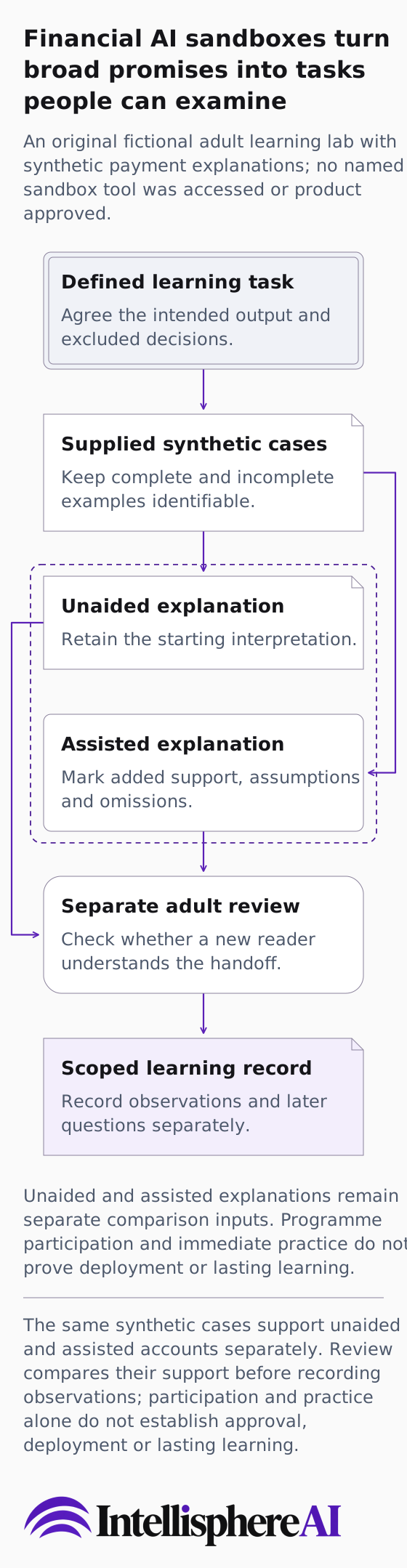
Original explanatory diagram: fictional adult learners compare unaided and assisted explanations of synthetic cases; no regulator approval, deployment or learning outcome is shown.
[Open the complete evidence diagram](/assets/crypto-evidence-supervised-experiments-20261016.svg)
Read the diagram
**Financial AI sandboxes turn broad promises into tasks people can examine**
An original fictional adult learning lab with synthetic payment explanations; no named sandbox tool was accessed or product approved.
- **Defined learning task** Agree the intended output and excluded decisions.
- **Supplied synthetic cases** Keep complete and incomplete examples identifiable.
- **Unaided explanation** Retain the starting interpretation.
- **Assisted explanation** Mark added support, assumptions and omissions.
- **Separate adult review** Check whether a new reader understands the handoff.
- **Scoped learning record** Record observations and later questions separately.
Unaided and assisted explanations remain separate comparison inputs. Programme participation and immediate practice do not prove deployment or lasting learning.
How the connections work
- The defined task determines which synthetic cases belong in the exercise.
- The supplied cases support an unaided explanation retained for comparison.
- The same cases also support a separately identified assisted explanation.
- The unaided explanation gives the reviewer a starting understanding to inspect.
- The assisted explanation supplies another input without establishing learning by itself.
- Separate review records scoped observations and leaves retention or transfer as later questions.
Relationship key
The same synthetic cases support unaided and assisted accounts separately. Review compares their support before recording observations; participation and practice alone do not establish approval, deployment or lasting learning.