Financial research assistants need both a search trail and a useful answer
Bloomberg's 2026 ASKB roadmap, AskResearchGPT and primary benchmarks show why financial research needs separate tests of retrieval, evidence and explanation.
A financial question often looks simpler than the work required to answer it. “How did this company describe its exposure?” might mean the latest annual report, a particular reporting period, an analyst’s interpretation or a change between two editions. An assistant can produce an elegant paragraph while choosing the wrong one. For people studying crypto businesses alongside listed companies and wider markets, the useful development is therefore more specific than a chatbot that speaks finance: tools are beginning to connect questions, document collections, calculations and explanations inside existing research work.
Bloomberg’s 16 April 2026 ASKB announcement illustrates that direction. It described a conversational interface in beta and a roadmap combining market information with firms’ proprietary research, portfolio tools and recurring workflows. The company also described attribution to original sources and underlying Bloomberg Query Language code. Those are first-party descriptions of availability and planned capabilities at that date, not this article’s test of the system or evidence that every roadmap item subsequently shipped. [Bloomberg’s ASKB roadmap](https://professional.content.cirrus.bloomberg.com/professional2023/insights/press-announcement/bloomberg-unveils-askb-roadmap-for-clients-to-augment-their-investment-process-with-agentic-ai/).
An earlier implementation shows a different part of the chain. In October 2024, Morgan Stanley announced AskResearchGPT for investment-banking, sales-and-trading and research staff. The launch described GPT-4 synthesising its research, with findings transferred into editable email drafts containing citation hyperlinks. This establishes a named staff-tool launch and its reported design; it does not establish investment returns, independent productivity gains or which model the firm uses today. Access to its proprietary material is not part of this educational account. [Morgan Stanley’s launch account](https://www.morganstanley.com/press-releases/morgan-stanley-research-announces-askresearchgpt).
Why finding and answering need different tests
A source trail has several jobs. It lets a reader open the relevant material, see the period it covers and compare the assistant’s wording with the passage. A calculation needs another trail: the input values, their units and the operation connecting them. A plausible explanation of a correct calculation can still answer the wrong question. Conversely, locating an appropriate report does not guarantee that a generated explanation represents it fairly.
The September 2025 FinSearchComp abstract makes this separation concrete. Its financial-search benchmark distinguishes time-sensitive data fetching, simple historical lookup and complex historical investigation, covering global and Greater China questions. These are different tasks with different evidence needs. The selected abstract describes a defined evaluation, not a current ranking of all available products, and its historical model results are not adopted here as a reason to select an investment or service. [FinSearchComp’s primary abstract](https://arxiv.org/abs/2509.13160).
FinanceBench provides an older, complementary reference. Its November 2023 abstract describes open-book questions about companies with corresponding answers and evidence strings, alongside a manually reviewed sample of model configurations. The useful lesson is the evaluation structure: an answer can be checked against stated evidence. The tested products and configurations belong to that historical study. Their scores cannot fairly be presented as the performance of a current assistant or of the entire question collection. [FinanceBench’s primary abstract](https://arxiv.org/abs/2311.11944).
These examples do not imply that every financial task should be automated. They identify work that a person can examine. A current-value question requires a defined observation time. A historical question requires the correct edition and period. A comparison requires consistent definitions across the sources. The interface should make those differences visible before a reader mistakes a convenient answer for a suitable basis for action.
A fictional research-room exercise
Consider fictional adult learners in a London research workshop. They receive a synthetic annual report for an imaginary digital-asset services company, a revised synthetic presentation and a deliberately incomplete news note. No account is connected and no asset is being recommended. Their question is limited: how did the company’s description of customer concentration change between the two documents?
The facilitator first asks each learner to write what would count as a satisfactory answer. They need the relevant dates, the definition of concentration and whether the documents discuss customers, revenue or transaction activity. This small preparation prevents a later disagreement about a model from concealing an earlier disagreement about the task. A concise answer is useful only when its scope is understood.
Next, the group separates document selection from composition. One learner identifies the passages and records the edition and page. Another drafts an explanation using those passages. A third checks the result without seeing the original prompt. If the explanation says “customers became more diversified” while the source only changes how customers are grouped, the reviewer can name the unsupported step. The correction concerns meaning, rather than whether the paragraph sounds professional.
The incomplete note supplies a harder case. It may contain a relevant phrase but omit the reporting period. A defensible exercise allows the answer to remain incomplete: the source cannot establish the requested comparison. That response should still help the learner understand what is missing. “Find the earlier definition” is more useful than an unexplained refusal, and more honest than silently filling the gap with background knowledge.
A calculation can be added using invented figures expressly labelled as such. Learners retain the formula and the two input labels, then ask whether the quantities are comparable. They do not turn the exercise into a price forecast or a simulated portfolio. The purpose is to discover whether the assistant can preserve the meaning of a financial question while helping someone inspect the evidence.
Benefits that deserve to be measured
The attraction of these tools is easy to understand. A person may spend less time navigating document collections and more time comparing the important passages. A novice may gain a clearer entry point into unfamiliar terminology. A team may share a useful query or repeat a well-defined research task. These are potential benefits to examine, not outcomes demonstrated by the fictional workshop or the announcements above.
A useful comparison would retain the whole task, including time spent checking and correcting the answer. It would distinguish a missing source from an incorrect interpretation and a changed document from a model error. A reviewer should be able to see when a question was answered correctly for the wrong reason. Otherwise, a polished first response can conceal substantial work transferred to someone else.
There are practical constraints beyond accuracy. Some research is proprietary, and a convenient interface does not confer permission to upload or redistribute it. A citation can point to material another reader cannot access. Different users may have different document entitlements. A shared explanation should therefore make its support understandable without claiming that every teammate can open the same underlying collection.
The learning opportunity is broader than prompt writing. People can practise defining a question, identifying the relevant reporting boundary, checking a citation and explaining a disagreement in plain language. The named developments show that these activities are moving into research interfaces. Their value will depend on whether the complete encounter becomes more useful and inspectable, rather than on the fluency of the final paragraph alone.
Evidence diagram and readable guide
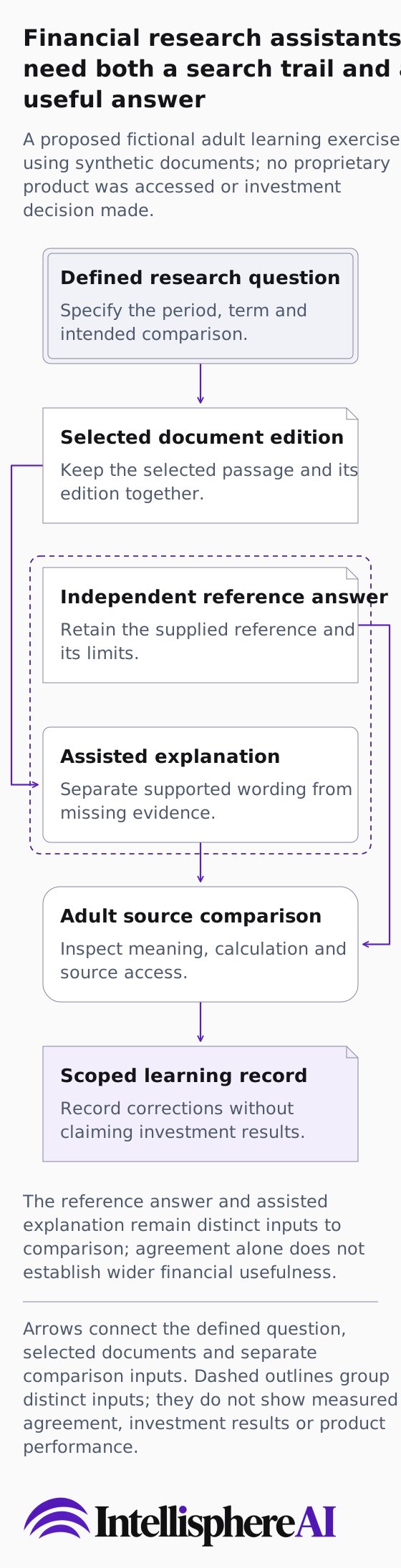
Original explanatory diagram: a fictional adult research exercise compares selected synthetic documents, a reference answer and an assisted explanation; no investment result is shown.
[Open the complete evidence diagram](/assets/crypto-evidence-research-assistants-20261016.svg)
Read the diagram
**Financial research assistants need both a search trail and a useful answer**
A proposed fictional adult learning exercise using synthetic documents; no proprietary product was accessed or investment decision made.
- **Defined research question** Specify the period, term and intended comparison.
- **Selected document edition** Keep the selected passage and its edition together.
- **Independent reference answer** Retain the supplied reference and its limits.
- **Assisted explanation** Separate supported wording from missing evidence.
- **Adult source comparison** Inspect meaning, calculation and source access.
- **Scoped learning record** Record corrections without claiming investment results.
The reference answer and assisted explanation remain distinct inputs to comparison; agreement alone does not establish wider financial usefulness.
How the connections work
- The research question determines which document edition needs selection.
- The selected document supports an explanation only within its actual content.
- The reference answer provides a separate input to adult comparison.
- The assisted explanation is compared with evidence rather than validating itself.
- The comparison records observed corrections, not a trading or productivity outcome.
Relationship key
Arrows connect the defined question, selected documents and separate comparison inputs. Dashed outlines group distinct inputs; they do not show measured agreement, investment results or product performance.