Following moving dust to infer the forces a plasma hides
Emory's trajectory-based force inference connects a carefully designed learning model to a laboratory measurement, with useful lessons about proxies and physical interpretation.
In a paper published online on 31 July 2025, Emory researchers used physics-tailored machine learning to infer effective forces from tracked dusty-plasma particles. They report dependencies missed by simpler descriptions. This is a specific experimental inference problem, not a discovery of unrestricted laws of nature. [PNAS paper](https://www.pnas.org/doi/10.1073/pnas.2505725122).
Which forces explain the trajectories? The model separates pair interactions, environmental effects and drag. Although particles are tracked in space, the force-inference construction concerns horizontal motion with dependence on height, rather than every force component. [Model scope](https://www.pnas.org/doi/10.1073/pnas.2505725122).
The institution's account places the work in a laboratory that studies interacting charged dust. It explains the combination of imaging, physical reasoning and learning, rather than a chatbot reading a physics textbook. Its suggestions about applications to other many-body systems are prospects. They are not additional experiments demonstrating the same performance in biological cells, industrial powders or every kind of plasma. [Emory research account](https://news.emory.edu/features/2025/07/ai-reveals-unexpected-new-physics-dusty-plasma).
The experiment begins before the neural network
An earlier paper by Yu and Burton describes laser-sheet tomography for tracking particles in a dusty plasma. The imaging method follows particles through a volume using a camera and a scanning sheet of light. That measurement work is a substantive part of the research lineage: a force model cannot recover information that was never resolved in the recorded motion. [Tracking method](https://arxiv.org/abs/2302.12975).
For someone learning the method, the first useful question is consequently about a track, not a network architecture. Does an identifier follow the same particle through time? Where does the track stop? Could an apparent sharp turn arise from an identification mistake? An analysis plan should preserve these questions rather than turn every irregularity into an exciting physical effect.
The paper's weak-form approach uses integrated motion relationships, reducing reliance on noisy numerical acceleration estimates. Physical symmetries structure the learned interactions. This designed model has assumptions and validation choices; it is not an unrestricted equation generator. [Inference construction](https://www.pnas.org/doi/10.1073/pnas.2505725122).
An accessible way to interpret that design is to compare a plausible explanation with a flexible fit. A plausible explanation should answer questions outside a single attractive trajectory. A flexible fit might merely trace what it has already seen. For a proposed replication, ask which new observations would distinguish those possibilities before deciding that the learned components deserve a physical interpretation.
The authors' public repository exposes the intended input structure and demonstration materials. Its README describes frame identifiers, particle identifiers and spatial coordinates; importantly, a column labelled mass is described there as camera brightness. A new user should not treat that label as an independently measured particle mass. Documentation is part of the measurement contract, even when a column name looks familiar. [Author software](https://github.com/wyu54/many-body-force-infer).
What the reported result means
The results identify nonreciprocal effective interactions and particle-size-dependent screening. A close acceleration fit is not the probability that an inferred law is correct. Effective interactions in this open plasma environment do not repeal Newtonian mechanics. [Results](https://www.pnas.org/doi/10.1073/pnas.2505725122).
That distinction is useful beyond plasma physics. When an analysis assigns separate learned components, ask how firmly each component is determined. If several combinations explain the same motion, an attractive decomposition may remain ambiguous. A careful proposed follow-up would identify an additional observation that separates those combinations, rather than simply training a larger network on the original recording.
The tracking paper's contribution is also a reminder that spatial reconstruction has its own conditions. Its imaging arrangement and particle-tracking assessment concern a particular laboratory method. They should not be interpreted as evidence that an ordinary phone video supplies equivalent trajectories. A prospective reader can study the measurement design without attempting to operate plasma equipment or reproduce an experimental procedure. [Measurement context](https://arxiv.org/abs/2302.12975).
Practical preparation could instead use a documented teaching dataset on an ordinary computer, subject to its licence and dependencies. First preserve the original files, units and readme. Then write down which quantities are measurements, proxies or model outputs. This is a proposed learning workflow; this publication has not installed the research code or rerun the force inference.
An unperformed exercise about a misleading column
Consider an invented classroom table containing time, a fictional particle identifier, position and brightness. Students are told explicitly that brightness is a camera-derived proxy, not a weighing result. The table is synthetic and has no connection to the Emory recordings. The exercise begins by asking students to rename their working variables so that the distinction remains visible.
One group then proposes a model in which all particles share an interaction; another allows interactions to vary with a recorded proxy. Before comparing them, both groups must specify a held-out set of complete tracks. They should not scatter neighbouring points from the same track casually across the comparison and then describe those points as wholly independent experimental confirmations.
Next, the instructor supplies a fictional track with a deliberate identity swap. Students inspect whether their model would interpret the discontinuity as a large force. They record the suspected measurement problem rather than deleting it quietly. An acceptable outcome is that the example cannot support a physical conclusion until the identity uncertainty is resolved.
Finally, the groups receive a second synthetic recording described as having different observation conditions. The worked conclusion is that brighter does not mean heavier without a justified measurement relationship. They must say whether their original representation can accept the new recording. This is an unperformed exercise in separating the camera, data preparation and proposed physical account, not a benchmark result.
A useful starting point for scientific software work
The repository makes the model inspectable, but availability is separate from reproducibility. Its demonstration dependencies and data descriptions need their own review before reuse. The sensible deliverable for a first study session is a small provenance note identifying the files and assumptions examined, not a claim to have confirmed the paper simply because a notebook opens. [Software materials](https://github.com/wyu54/many-body-force-infer).
The Emory account describes broader opportunities for learning interactions in complex systems. Such possibilities are worth investigating, but each transfer requires a fresh measurement and modelling argument. A system with different observables, hidden influences or observation times cannot inherit the plasma experiment's validation merely because both problems involve many moving objects. [Institutional outlook](https://news.emory.edu/features/2025/07/ai-reveals-unexpected-new-physics-dusty-plasma).
For students and research engineers, the practical skill here is connecting a physical question to an inspectable data representation. Tracking, proxy interpretation and model comparison are substantive work. They should appear in a project plan alongside learning algorithms, so that the eventual explanation can be challenged by someone who understands the measurement but did not write the software.
The dusty-plasma result is interesting because the learning system was constrained enough to ask a physical question and connected to an experiment capable of informing it. Its value lies in that combination. Reusing the method responsibly means preserving both halves, while leaving unsupported generalisations and unperformed replications out of the result.
Conceptual diagram and reading companion
Original conceptual illustration and unperformed classroom exercise; no measured data, authentic research interface or reproduced result is shown.
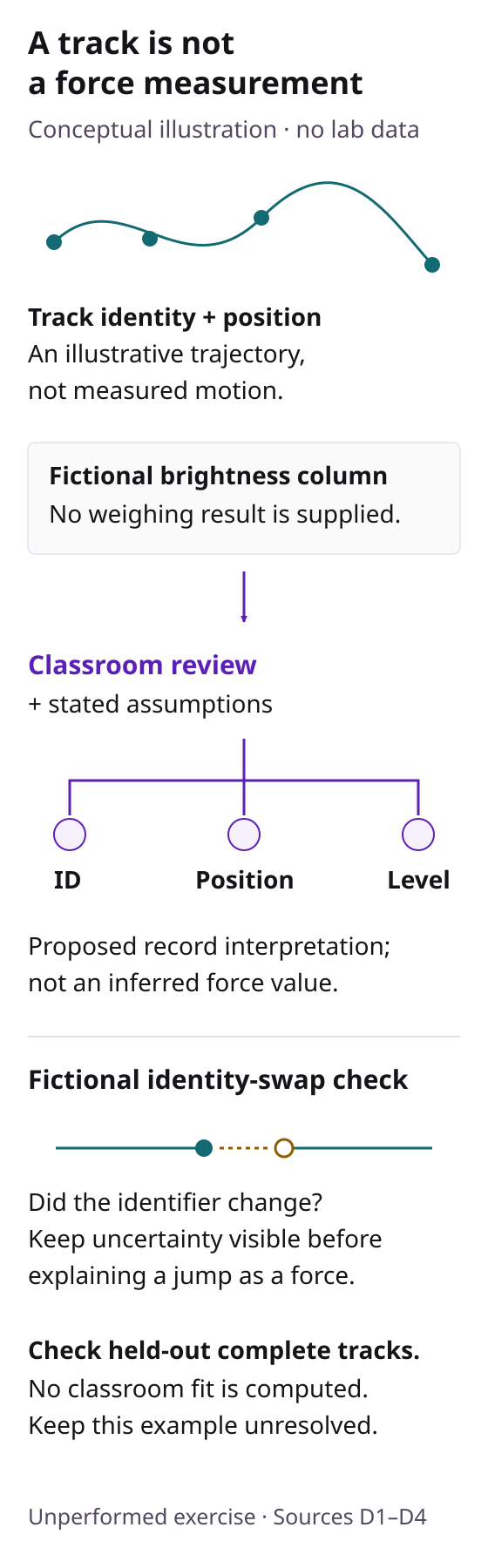
Original conceptual illustration supporting this article. Shapes and teaching examples are explanatory, not measured data, an authentic laboratory interface or an independent reproduction. Read the accompanying source-linked guide.
[Open the complete diagram](/assets/science-dusty-plasma-inference-concept-20261016.svg)
A track is not a force measurement
An unperformed classroom identity-swap example. Lines, dots and branches have no measured trajectory or force scale.
Review the invented track before explaining its jump
Treat the lower broken track as a fictional worksheet. Ask whether its identifier still refers to the same invented object before assigning meaning to the jump. Keep the suspected swap visible in the notes. The two token styles do not identify two measured masses.
For a proposed comparison, put a complete fictional track aside before developing a rule. Record which track was held out and what question the comparison would answer. A second worksheet with a changed recording condition needs a new explanation of the input; this companion supplies no model score or successful physical inference.
Read the upper labels as separate information roles rather than gauges. The three branches review the invented identifier, position and brightness-level fields; they are not the reported force components. Branch widths and line lengths have no magnitude scale. The unchanged article contains the actual paper/software context. No plasma, laser, apparatus or code was operated for this guide.
Readable figure labels
- A track is not - a force measurement - Conceptual illustration · no lab data - Track identity + position - An illustrative trajectory, - not measured motion. - Fictional brightness column - No weighing result is supplied. - Classroom review - + stated assumptions - ID - Position - Level - Proposed record interpretation; - not an inferred force value. - Fictional identity-swap check - Did the identifier change? - Keep uncertainty visible before - explaining a jump as a force. - Check held-out complete tracks. - No classroom fit is computed. - Keep this example unresolved. - Unperformed exercise · Sources D1–D4
Source context
For the reported facts, dates and access limitations, read the unchanged article above. These are the same underlying references, not additional experiments. The fictional exercise and diagram do not establish a measured result.
- [D1](https://www.pnas.org/doi/10.1073/pnas.2505725122) - [D2](https://github.com/wyu54/many-body-force-infer) - [D3](https://arxiv.org/abs/2302.12975) - [D4](https://news.emory.edu/features/2025/07/ai-reveals-unexpected-new-physics-dusty-plasma)