Greenhouse AI needs a clear boundary between prediction and control
WUR’s current and historical greenhouse research offers a practical way to separate sensing, modelling, shadow proposals and authority to control equipment.
A greenhouse can contain several kinds of intelligence at once: an experienced grower, a model of crop development, cameras describing plants, and software proposing changes to the climate. Calling the whole arrangement autonomous can conceal the most useful questions. Which observations are trusted? Which decisions may the software make? What happens when the expected reading does not arrive?
Wageningen University & Research’s AGROS II page gives those questions a current research setting. Its stated project period runs from January 2026 through December 2027. The page describes crop, substrate and climate measurements and two approaches to control: a digital twin and an AI algorithm. These are research aims and methods, not a declaration that every greenhouse can operate without intervention. [WUR’s AGROS II description](https://www.wur.nl/en/research/plant/agros-ii-next-steps-towards-autonomous-greenhouse).
Read the experiment before borrowing its result
A WUR research-portal record published in July 2023 describes a cucumber validation trial with digital-twin control, reinforcement-learning control and expert grower practice. That abstract establishes the comparison’s structure. It does not, on its own, supply a transferable performance figure or demonstrate the reliability of a commercial installation. The linked video was not used as evidence for this article. [The AGROS trial record](https://research.wur.nl/en/publications/autonomous-greenhouses-agros-validation-trial-2023/).
WUR’s January 2025 Dutch account of the fourth Autonomous Greenhouse Challenge reports dwarf-tomato cultivation and explains its competition scoring, including harvest timing and resource costs. A competition result belongs to its crop, facilities and scoring rules. Its reported winner is not a promise that the same controller will be most profitable under another grower’s energy contract or production requirements. [The fourth challenge’s reported result](https://www.wur.nl/nl/nieuws/winnaar-vierde-editie-autonomous-greenhouse-challenge-bekend).
The living challenge page still describes a fifth edition planned for 2026. That wording is retained as a plan; it is not converted into a completed 2026 result because the calendar has advanced. Development announcements, historical trials and operating acceptance should keep their own dates and evidence. [WUR’s challenge overview](https://www.wur.nl/en/research/plant/autonomous-greenhouse-challenge).
Begin with a shadow comparison
Consider a fictional adult cucumber-growing cooperative near Bleiswijk evaluating an idea with synthetic records. No equipment is connected and no crop setting changes. The group wants to compare an assistant’s proposed explanation with its normal review practice. It gathers invented observations of light, temperature, substrate and crop development, including a missing camera reading and a deliberately stale sensor record.
In this exercise, the proposed controller is placed in a shadow role. It can suggest a next review and explain which records it used, but the ordinary grower process remains responsible for decisions. This arrangement allows the group to inspect recommendations without representing the demonstration as safe automatic control. Any later connection to equipment would need a separately reviewed engineering and operational process.
The group starts by defining the purpose in ordinary terms: maintain a coherent cultivation plan while observing agreed limits. It avoids optimizing a single score without asking what that score leaves out. A simulated increase in production could coincide with an unexamined resource demand or an unacceptable product characteristic. An evaluation record should preserve each relevant objective, rather than conceal trade-offs inside an unexplained total.
Give every measurement a meaning
A temperature value needs a unit, location, timestamp and known instrument context. A camera-derived trait needs a description of what was estimated and where it was observed. The cooperative’s synthetic log keeps these fields separate from the model’s interpretation. That makes it possible to ask whether a disagreement comes from a questionable measurement, a mistaken interpretation or a different cultivation objective.
The exercise includes an ordinary contradiction: one invented sensor record looks plausible, while another suggests the first may be old. The assistant should show the disagreement and explain what needs checking. It should not average the records into a seemingly precise condition simply to continue producing actions. A missing value should remain missing until there is a justified replacement.
An estimate can be helpful without being treated as a direct observation. If a model fills a gap for exploratory analysis, label the estimate and retain the original gap. Compare the resulting recommendation with one made from confirmed records only. This proposed comparison reveals how much the recommendation depends on assumptions, while avoiding a claim that any named system uses this method or would fail the example.
Put authority beside the proposed change
The cooperative’s review form records the suggested change, its intended duration, the supporting observations and the responsible reviewer. It also asks what information would cancel the proposal. This is a practical way to prevent an explanation from becoming an enduring instruction after its conditions have changed. A later version of a model should not silently inherit approval given to an earlier proposal.
Where systems eventually control equipment, the boundary must be more explicit than a friendly confirmation button. The responsible engineering team needs to establish permitted commands, independent limits, interruption behaviour and the applicable equipment procedures. This article does not supply control parameters or a replacement for that work. The source research motivates the question; it does not validate a reader’s installation.
For the synthetic demonstration, the facilitator can introduce a lost connection, a delayed acknowledgement and a changed proposal. Participants should distinguish a recommendation that was displayed from an action that was accepted and completed. If completion is uncertain, the next step is comparison with the receiving system’s actual state through its established procedure, rather than an automatic repeat.
Preserve the result the next grower needs
The final exercise record should say which crop representation, observations, model edition, objectives and failure cases were examined. It should include examples where the group rejected a suggestion, requested an inspection or found the explanation unhelpful. Those cases are useful evidence for improving the workflow, even when they do not produce an attractive demonstration.
A research competition can reveal promising approaches; a local comparison can reveal whether a proposed workflow is understandable. Neither alone establishes unrestricted autonomy. For growers and technology teams, a more useful outcome is an inspectable boundary between observation, prediction, proposal and authorized control. This is educational analysis with fictional adults and synthetic data, not a deployed greenhouse, a measured saving, an operating manual or an endorsement of a controller.
Evidence diagram and readable guide
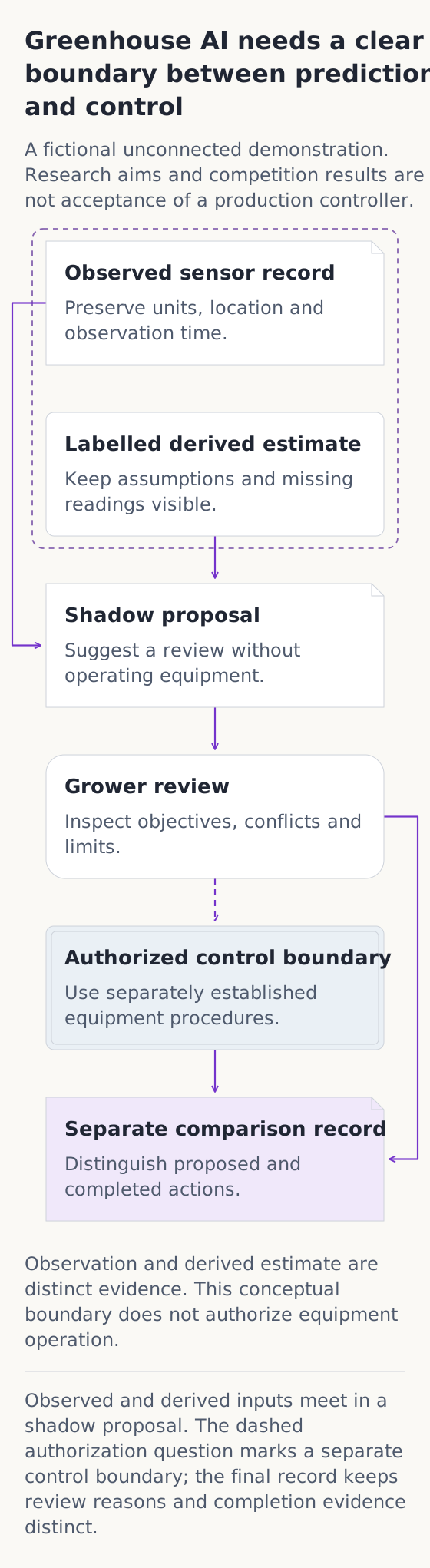
Original explanatory diagram: a fictional unconnected greenhouse exercise distinguishes observations, estimates, shadow proposals and a separate control boundary.
[Open the complete evidence diagram](/assets/agriculture-workflow-greenhouse-control-20261015.svg)
Read the diagram
**Greenhouse AI needs a clear boundary between prediction and control**
A fictional unconnected demonstration. Research aims and competition results are not acceptance of a production controller.
- **Observed sensor record** Preserve units, location and observation time.
- **Labelled derived estimate** Keep assumptions and missing readings visible.
- **Shadow proposal** Suggest a review without operating equipment.
- **Grower review** Inspect objectives, conflicts and limits.
- **Authorized control boundary** Use separately established equipment procedures.
- **Separate comparison record** Distinguish proposed and completed actions.
Observation and derived estimate are distinct evidence. This conceptual boundary does not authorize equipment operation.
How the connections work
- Confirmed observations inform the shadow proposal without becoming model estimates.
- A derived estimate can inform the same proposal while retaining its assumptions.
- The grower reviews the proposal and its competing objectives.
- Grower review raises the separate question of permitted control under equipment procedures.
- The receiving process needs a separate record before a proposed action is treated as completed.
- The grower review also supplies its reasons directly to the retained comparison record.
Relationship key
Observed and derived inputs meet in a shadow proposal. The dashed authorization question marks a separate control boundary; the final record keeps review reasons and completion evidence distinct.