India's court-translation record keeps the translator in the loop
A Supreme Court passage on SUVAS and a separate digital-assistance programme show why translation, review and access are different tasks.
A judgment can be publicly available without being understandable to the person whose life it affects. Language is one barrier; finding the document, obtaining a usable copy and understanding the next procedural step are others. Treating all of these as a single translation problem makes an ambitious technical demonstration look more complete than it is.
India's judicial records give a more concrete picture. They describe AI-assisted translation alongside human vetting and a separate network of assistance with digital court services. The combination suggests useful work for translators, legal-service teams and developers, while providing no basis for claiming that a translated document automatically delivers justice.
The Supreme Court described a tool and a review duty
In its [8 May 2025 proceedings in In Re: Policy Strategy for Grant of Bail](https://api.sci.gov.in/supremecourt/2021/26546/26546_2021_4_17_61634_Order_08-May-2025.pdf), the Supreme Court of India discussed delays involving records and translation. The order describes Supreme Court Vidhik Anuvaad Software, or SUVAS, as available to High Courts for translating judgments and potentially records. It says translators must vet translations to ensure accuracy.
That passage is specific judicial evidence about the translation workflow. It is not a published accuracy benchmark or proof that all historical records have been translated. The same document contains wider matters about criminal appeals; this article relies on its translation passage, not an interpretation of anyone's entitlement to bail.
The implementation account is a dated government report
A separate [9 August 2024 government reply published by PIB](https://www.pib.gov.in/PressReleaseIframePage.aspx?PRID=2043476) describes the Supreme Court's adoption of AI language technology for translation and other supporting work. It describes committees monitoring translation and the involvement of High Courts. This is an official implementation account from that date, not an independent evaluation of comprehension or case outcomes.
The dates matter. A statement that technology had been adopted in 2024 does not demonstrate every capability in October 2026. Equally, the 2025 order's requirement for vetting should not be silently converted into a claim that an unreviewed machine translation is an authoritative substitute for the original.
Digital assistance addresses a different part of access
The e-Committee's [public description of e-Sewa Kendras](https://ecommitteesci.gov.in/service/e-sewa-kendra/) lists help with case-status enquiries, copies, e-filing and routes to legal-service bodies. This is a separate service programme, not a speech or translation model. The undated overview describes intended facilities and pilot origins; it does not establish a current nationwide count of functioning centres.
Its relevance is practical. A person may need assistance obtaining or using a document before translation helps at all. A translation system and a digital-service assistance point address different handoffs, and neither public description supplies a measured estimate of their combined effect on access to justice.
Keep three documents distinguishable
| Material | What the user needs to know | What should remain visible | | --- | --- | --- | | Original judicial document | Which record is being consulted | Court, document identity and version | | Translation draft | That review is incomplete | Unresolved terms and source alignment | | Reviewed translation | Who reviewed which version | Link to the original and correction history | | Plain-language explanation | That this is a separate explanation | Scope, uncertainty and route to appropriate help |
This is an original illustrative table. It does not prescribe a court's official translation certification process. Its purpose is to prevent different kinds of material from becoming indistinguishable merely because each appears as readable text on a screen.
A fictional translator-training session
Imagine a fictional training centre in Bengaluru working with adult translators and legal-operations staff. The team uses an invented order about the return of a borrowed object, written specifically for the exercise. It includes a date, a negative statement and an ambiguous reference to a person. No actual litigant's record is uploaded.
Trainees inspect a mock Kannada translation beside the source. One version drops the negative statement; another keeps the words but changes who appears to have an obligation. The exercise asks participants to explain the difference and record an unresolved question. It does not test SUVAS or assert an error rate for Kannada translation.
Legal meaning can turn on a small difference
An overall similarity score may not reveal whether a consequential phrase survived. In the fictional exercise, the reviewer checks identity, dates, qualifications and the relationship between the document's parts. The purpose is to inspect meaning rather than reward fluent wording alone.
A plain-language explanation is then prepared as a separate task. It must not silently resolve the ambiguity the translators have left open. Explaining a document and determining what someone should do about it involve different responsibilities. The exercise deliberately stops before giving procedural or legal advice to a real person.
Reviewers retain both versions when they disagree. A later correction should not erase which draft another participant saw. These are proposed design choices for a training interface; the cited judicial records do not establish that every deployed system exposes this particular history or uses these evaluation categories.
Find the document before explaining it
A second part of the workshop simulates a person who knows that a document exists but cannot locate the right version. Trainees practise distinguishing a search problem, a missing copy and a translation problem. A service that answers the wrong question can appear helpful while leaving the original need unmet.
The fictional help desk uses invented reference numbers and a sample directory of assistance routes. It makes no representation that a real e-Sewa Kendra can handle every task at every location. Availability, procedural requirements and appropriate assistance must be checked through the relevant official service for an actual matter.
A failure should not become a legal event
If a mock translation request fails, the interface preserves the selected source and explains that processing did not finish. It should not mark the document reviewed, imply that a deadline changed or present an empty output as a completed translation. Technical status and legal status need separate explanations.
The same distinction applies to document transmission. Saving a draft, requesting a copy and confirming a submission are different events. A training system can make these differences visible using invented material. That is an interface proposal, not evidence that any cited court service has been independently tested for those recovery states.
What the evidence leaves open
The records establish an actual translation initiative, a judicial requirement for human vetting and described digital-assistance facilities. They do not measure whether a particular person understood a judgment, obtained representation, met a deadline or received a better outcome. Those would require carefully defined studies and appropriate access to evidence.
Useful work remains in terminology, review, version management and comprehensible service boundaries. For developers, making the original document, translation status and assistance route inspectable may be more consequential than promising universal language access. No universal legal rule, accuracy guarantee or staffing reduction follows. This is general educational reporting checked on 15 October 2026, not advice on a case or a claim of professional qualification.
Evidence diagram and readable guide
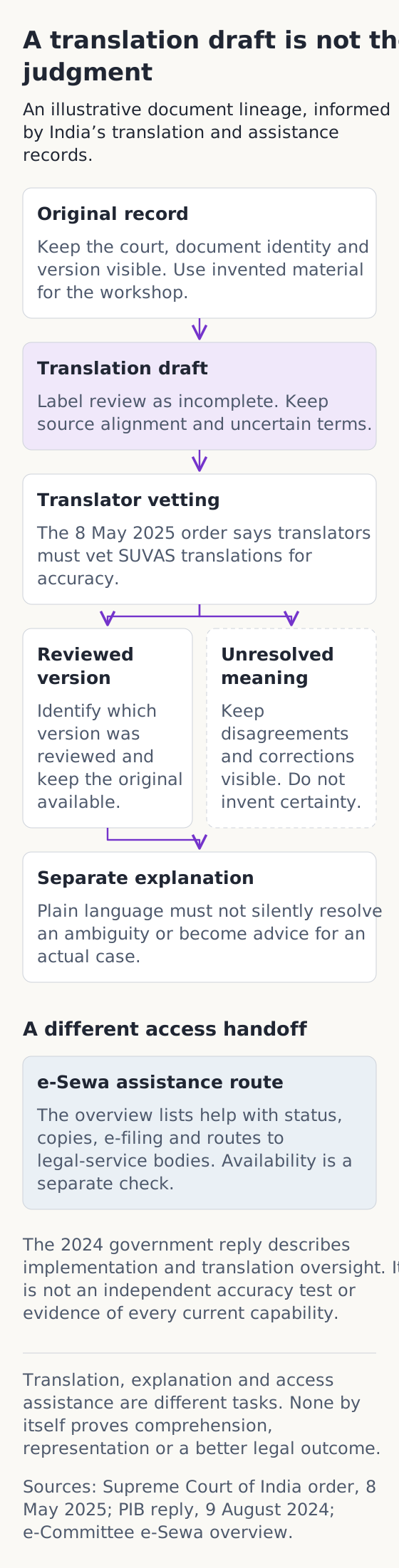
The document lineage separates original, draft, translator vetting, reviewed translation and explanation, with e-Sewa access assistance kept as a separate programme.
[Open the complete evidence diagram](/assets/legal-workflow-translation-access-20261015.svg)
Read the diagram
**A translation draft is not the judgment**
An illustrative document lineage, informed by India’s translation and assistance records.
- **Original record.** Keep the court, document identity and version visible. Use invented material for the workshop.
- **Translation draft.** Label review as incomplete. Keep source alignment and uncertain terms.
- **Translator vetting.** The 8 May 2025 order says translators must vet SUVAS translations for accuracy.
- **Reviewed version.** Identify which version was reviewed and keep the original available.
- **Unresolved meaning.** Keep disagreements and corrections visible. Do not invent certainty.
- **Separate explanation.** Plain language must not silently resolve an ambiguity or become advice for an actual case.
A different access handoff
- **e-Sewa assistance route.** The overview lists help with status, copies, e-filing and routes to legal-service bodies. Availability is a separate check.
The 2024 government reply describes implementation and translation oversight. It is not an independent accuracy test or evidence of every current capability.
**Reading the evidence.** Translation, explanation and access assistance are different tasks. None by itself proves comprehension, representation or a better legal outcome.
*Sources: Supreme Court of India order, 8 May 2025; PIB reply, 9 August 2024; e-Committee e-Sewa overview.*
**Keep the comparisons separate.** Possible review states; a readable draft is not automatically approved. Finding or obtaining a document and translating it address different needs; no combined outcome estimate.