Keep the scan when AI turns personal paperwork into searchable text
Keep original pages, uncertain OCR spans and reviewed corrections separate when building a searchable personal archive.
A household document becomes easier to search when software extracts its text. It also becomes easier to misunderstand when the extracted words look more authoritative than the page they came from. A missing character in a model designation, a merged table row or a note attached to the wrong paragraph can survive into a fluent answer. A useful personal archive therefore keeps a route back to the scan, including the parts the software could not read.
The Docling technical report, first submitted in August 2024, describes a document-conversion package using specialised models for page layout and table structure. Its subject is conversion into a usable representation. It does not establish the truth of a document's contents or guarantee that every difficult scan will be converted faithfully. No parser or research model was installed or run for this article. [Technical report](https://arxiv.org/abs/2408.09869).
The current project documentation describes OCR, structured document representation, exports and local-execution capabilities. These are useful ingredients for an archive in which extracted material retains its origin. They are documentation for available components, not evidence that any particular combination has been configured privately or that a conversational answer will automatically contain correct page citations. [Docling project](https://github.com/docling-project/docling).
Preserve the layers separately
Keep the original file as the source object. Add extracted text as a derivative, with its document and page identifiers. Corrections belong in a reviewed derivative or annotation, while the original remains available for comparison. If a later extraction improves a word, preserve enough history to show why the searchable version changed. Renaming a corrected file without retaining that relationship can make an old answer impossible to investigate.
The OCR engine's input conditions matter. Tesseract's documentation explains how skew can impair line segmentation and recognition, alongside other image-quality and layout considerations. That supports reviewing the scan before treating a strange word as a language-model error. It does not mean that straightening an image guarantees accurate recognition, or that this article processed a sample and measured an improvement. [OCR quality guidance](https://tesseract-ocr.github.io/tessdoc/ImproveQuality.html).
A practical archive note can distinguish visible text, uncertain transcription and a user's interpretation. For an unclear part designation, retain the uncertain span and link to its page. Resist filling the gap with a familiar product name. The most useful answer may be that the designation cannot be established from this copy and another source is needed. That is an archive finding rather than a failed attempt to sound helpful.
Decide what offline covers
LM Studio's offline documentation distinguishes locally running downloaded models and document processing from network-dependent discovery, downloads, runtime updates and application updates. Its statements concern those product functions. They do not certify every extension, synchronisation service, backup or other application on a person's computer. The proposed archive should have an explicit data boundary rather than inherit a privacy guarantee from a single word in a product description. [Offline operation](https://lmstudio.ai/docs/app/offline).
Before selecting a workflow, list which components read the document and which can contact an external service. Include the place where the extracted index and conversation history are stored. A local model can be useful without making the surrounding device private by default. Shared access and automatic folder synchronisation still need an intentional decision by the person responsible for the documents.
Begin any evaluation with public or synthetic material. Use a small collection whose answers can be checked manually. A larger archive can make retrieval appear impressive while making mistakes harder to notice. The first goal is to establish whether a proposed answer can be traced to the right edition and passage, not to maximise the number of files imported in an afternoon.
A fictional archive in Accra
Imagine an adult learner in a fictional Accra household organising appliance manuals and community-club equipment instructions. The material in this example is invented, and the exercise has not been run. The learner has an original scan and a derived text file. A designation includes an unclear character that could be a letter or a digit, while a table continues onto the following page.
The learner asks which manual passage lists the relevant replacement-part designation. A proposed assistant response should identify the document edition and the source span, including the uncertainty. It should not recommend buying a part or invent a plausible missing character. The worked conclusion is that the scan supports a partial transcription, while the complete designation remains unresolved.
Next, provide a second synthetic copy in which the continuation page belongs to a different edition. The learner compares the headers and page sequence before accepting a combined table. A smooth extracted table is insufficient if its rows came from incompatible versions. Retaining the originals makes this problem visible without turning the exercise into an unsupported judgement about a real manufacturer's instructions.
Finally, introduce a correction supplied by the fictional document owner. Keep the correction and its reason beside the original uncertain span. A later answer should distinguish the reviewed annotation from text visibly present in the scan. That distinction lets the household benefit from an improved archive without rewriting the evidence of what the software originally received.
Make citations useful to the person reading
A citation should help someone open the relevant source and inspect the claim. A document title alone can be inadequate when several editions have similar names. A page reference can also fail if it points to an extracted sequence rather than the original page numbering. Record how the archive identifies a page and show enough surrounding context to resolve the difference.
Review a sample of answers with the model's explanation hidden. Open the cited passage first and decide what it supports. Then compare the proposed answer. This proposed procedure reduces the temptation to search only for words that seem to confirm an attractive explanation. It is a reading method, not a measured claim that this workflow eliminates hallucinations or improves recall by a particular amount.
Deletion and correction deserve their own check. If an owner removes a document from the permitted collection, determine how its derivatives and index entries are handled before relying on an old chat. Likewise, a corrected scan does not necessarily update an earlier saved answer. The person using the archive should know whether a response describes today's collection or a preserved earlier snapshot.
The useful result is a searchable collection whose uncertainty remains inspectable. Conversion, retrieval and explanation can each help, provided their outputs stay connected to the original material. That gives a reader a concrete next action when a word is doubtful: open the scan, review the annotation or obtain a better source, with no need to pretend that fluency repaired the missing evidence.
Conceptual diagram and reading guide
The following original diagram explains the article's fictional exercise. It has not been run and adds no observed product result.
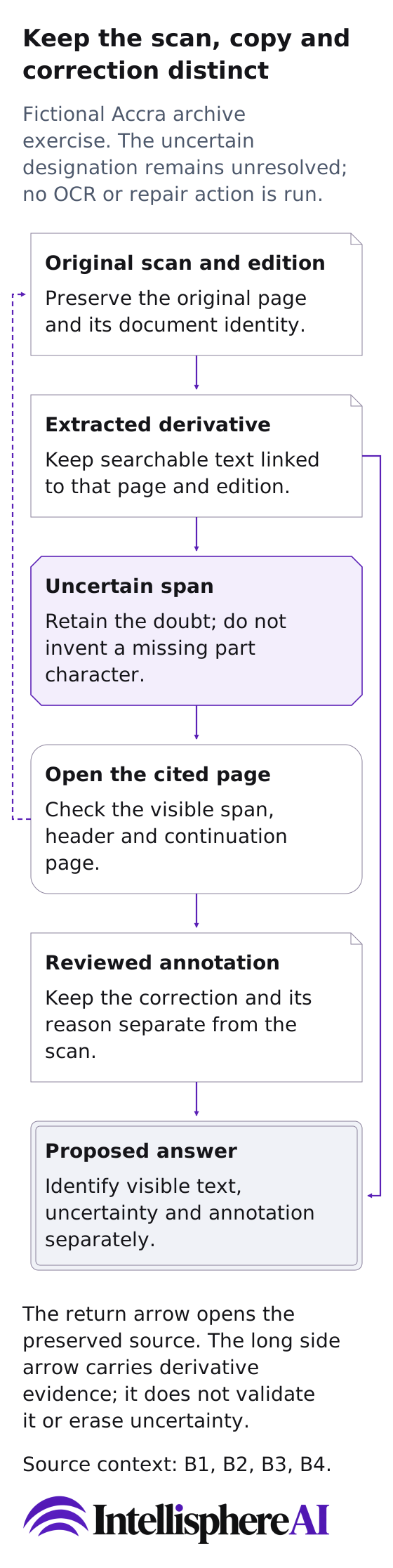
Original conceptual diagram of the fictional, unrun source-scan comparison exercise; no product action, measurement or approval is depicted.
[Open the complete diagram](/assets/personal-evidence-scan-layers-20261016.svg)
Keep the scan, copy and correction distinct
Fictional Accra archive exercise. The uncertain designation remains unresolved; no OCR or repair action is run.
Original scan and edition
Preserve the original page and its document identity.
Extracted derivative
Keep searchable text linked to that page and edition.
Uncertain span
Retain the doubt; do not invent a missing part character.
Open the cited page
Check the visible span, header and continuation page.
Reviewed annotation
Keep the correction and its reason separate from the scan.
Proposed answer
Identify visible text, uncertainty and annotation separately.
Original scan and edition to Extracted derivative: Extraction creates a derivative rather than replacing the original evidence.
Extracted derivative to Uncertain span: A doubtful character remains a doubtful span, not a guessed designation.
Uncertain span to Open the cited page: The reader returns to the actual source page before interpreting the span.
Open the cited page to Original scan and edition: Headers and page sequence are checked against the preserved edition.
Open the cited page to Reviewed annotation: A supplied correction is recorded with its reason, not written into the original.
Extracted derivative to Proposed answer: Extracted text can inform a draft answer only within its retained source limits.
Reviewed annotation to Proposed answer: Reviewed annotation is identified as annotation, not text visibly present in the scan.
The return arrow opens the preserved source. The long side arrow carries derivative evidence; it does not validate it or erase uncertainty.
A source-preserving design proposal; no OCR run, guaranteed recognition or whole-device privacy certification.
The second synthetic continuation page may belong to another edition. A smooth combined table cannot settle that mismatch.
Source context
These references ground the documented distinctions; the pictured routine is original editorial guidance, not a service observation.
- [B1: Docling Technical Report](https://arxiv.org/abs/2408.09869) - [B2: Docling project documentation](https://github.com/docling-project/docling) - [B3: Offline Operation](https://lmstudio.ai/docs/app/offline) - [B4: Improving the quality of the output](https://tesseract-ocr.github.io/tessdoc/ImproveQuality.html)