Manufacturing AI changes the handoff between an alert and a decision
Qualitative workplace evidence supports examining inspection, maintenance and quality responsibilities without converting task automation into an unsupported factory job-loss forecast.
A factory can automate an inspection step while making the handoff around it more important. Someone still has to decide what an alert means, whether the item needs another examination and who has authority to release it. If that work has no recognised owner, a quicker detector can create a queue of unresolved decisions. The workforce opportunity is therefore more specific than replacing an operator with AI. It is to organise inspection, maintenance and quality work so that useful assistance reaches a person who can act on it responsibly.
[OECD case-study research published on 27 March 2023](https://www.oecd.org/en/publications/the-impact-of-ai-on-the-workplace-evidence-from-oecd-case-studies-of-ai-implementation_2247ce58-en.html) examined nearly 100 cases in manufacturing and finance across eight countries. Its qualitative findings describe job reorganisation as more prevalent than displacement in the settings studied. Reported benefits included less tedious work and improved physical safety. These are selected implementation cases involving AI broadly, not a representative employment estimate or a trial of today's generative models. They support looking inside jobs before making a sector-wide headcount claim; they do not guarantee that any plant's transition will be benign.
That perspective helps separate several kinds of technology. A vision system may flag a surface feature; a predictive system may identify an unusual pattern; a language assistant may retrieve a maintenance record. Those are different tasks with different evidence requirements. A fluent explanation of an alert does not establish that a measurement is correct or that machinery can safely continue operating. Employers should define what the system observes, what it proposes and what remains an authorised human decision, using the actual equipment and approved local procedures.
Consider an explicitly fictional automotive-parts workshop near Pune. In a training session away from operating machinery, workers examine invented inspection images and mock maintenance records. An assistant retrieves a previous explanation for a similar mark on a part. The quality technician notices that the earlier record concerns another material and refuses to treat the explanation as a release decision. The exercise is a proposed learning scenario, not a real deployment, a safe operating instruction or evidence that a named tool detected a defect. Its useful output is a better handoff question.
The changed job may include checking whether a record concerns the right asset, material and operating context. That requires familiarity with the process as well as an ability to navigate the information system. A supervisor can make the responsibility explicit: an assistant prepares a reference trail, a competent person checks its relevance, and the established quality or maintenance authority decides the next step. The proposed arrangement should never be interpreted as permission to bypass equipment safeguards or alter a plant's approved procedures through a generated answer.
Training can preserve practical expertise rather than treating it as an obstacle to automation. Experienced workers can explain why two visually similar cases require different responses, while newer colleagues practise identifying the missing context. The employer should pay for this knowledge-sharing work and maintain a way to correct the reference library. A worker who spots a mismatch should receive recognition for the useful intervention. A performance measure based only on accepting alerts or closing tickets quickly would reward the opposite behaviour and make the resulting dataset less trustworthy.
The [OECD's separate 2023 worker-and-employer surveys](https://www.oecd.org/en/publications/the-impact-of-ai-on-the-workplace-main-findings-from-the-oecd-ai-surveys-of-employers-and-workers_ea0a0fe1-en.html) cover manufacturing and finance in seven countries. Their reported association between consultation, training and better worker outcomes is not proof of causation. For a factory, it provides a reason to ask operators and maintenance colleagues how the change affects actual work. Staff may identify a new administrative burden, an inaccessible interface or an alert pattern that a technical demonstration missed. Those observations should enter the pilot's evaluation, not remain informal complaints.
A useful measurement plan follows the issue through resolution. It can record the time from an alert to a qualified review, repeat inspections, false alarms, missed handoffs and work left waiting at a shift change. It should also distinguish reduced repetitive activity from increased pressure to process more exceptions. These are proposed local measures, not numbers established by the OECD studies. Management should review them alongside product quality and worker experience, because a lower inspection time can coexist with more rework or a larger unresolved backlog.
Employment exposure estimates answer another question. The [ILO's 20 May 2025 refined index](https://www.ilo.org/publications/generative-ai-and-jobs-refined-global-index-occupational-exposure) estimates potential generative-AI exposure from tasks; it does not count jobs actually removed. In manufacturing, office documentation and physical production duties should not be collapsed into a single label. A role can contain tasks that a language model assists and tasks that depend on equipment, physical context or local authority. The proposed analysis should list those differences before translating a technical demonstration into a workforce plan.
The international limits are substantial. A large manufacturer with a mature records system may have options unavailable to a small supplier working with incomplete archives or intermittent connectivity. A result from an OECD case cannot determine the employment outcome at the fictional Indian workshop. Company leaders should identify the data preparation, equipment integration and staff support their own site requires. Worker representatives can ask whether the business case budgets for those activities or assumes that employees will absorb them without additional time, training or recognition.
Career development can follow the changed responsibilities. An operator might build competence in identifying information gaps; a maintenance colleague might become more effective at tracing an explanation to a relevant record; a quality specialist might improve how uncertain cases are documented. These are possible development paths, not forecasts of newly created occupations or guaranteed promotions. Employers should connect any promised progression to actual responsibilities, assessment and pay arrangements. Otherwise, a new title may merely disguise the expectation that one person performs several jobs more quickly.
A sensible first step is to choose one handoff that already causes avoidable delay and examine it with the people who perform it. Keep the task bounded, use approved information and compare the complete route before and after assistance. Workers should be able to reject irrelevant material and continue through the established process when the system is unavailable. Manufacturing gains depend on reliable coordination between information and physical work. A useful AI output improves that coordination; it does not replace the need to know who is responsible for the next decision.
Evidence diagram and readable guide
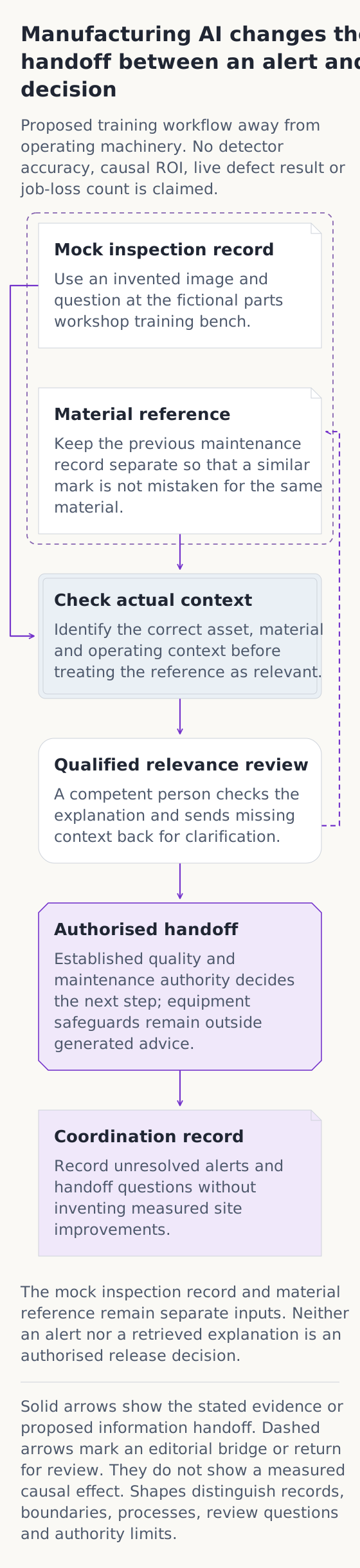
Original explanatory infographic: Proposed training workflow away from operating machinery. No detector accuracy, causal ROI, live defect result or job-loss count is claimed.
[Open the complete evidence diagram](/assets/future-work-workflow-manufacturing-quality-handoffs-20261016.svg)
Read the diagram
**Manufacturing AI changes the handoff between an alert and a decision**
Proposed training workflow away from operating machinery. No detector accuracy, causal ROI, live defect result or job-loss count is claimed.
- **Mock inspection record** Use an invented image and question at the fictional parts workshop training bench.
- **Material reference** Keep the previous maintenance record separate so that a similar mark is not mistaken for the same material.
- **Check actual context** Identify the correct asset, material and operating context before treating the reference as relevant.
- **Qualified relevance review** A competent person checks the explanation and sends missing context back for clarification.
- **Authorised handoff** Established quality and maintenance authority decides the next step; equipment safeguards remain outside generated advice.
- **Coordination record** Record unresolved alerts and handoff questions without inventing measured site improvements.
The mock inspection record and material reference remain separate inputs. Neither an alert nor a retrieved explanation is an authorised release decision.
How the connections work
- The invented inspection record supplies one input to the context check.
- The material reference supplies a distinct input to the context check.
- The identified context is considered in qualified relevance review.
- A relevant explanation goes to the established authorised handoff, not an automatic equipment action.
- The proposed coordination record retains what remains unresolved.
- Missing reference context returns for clarification without bypassing established procedures.
Relationship key
Solid arrows show the stated evidence or proposed information handoff. Dashed arrows mark an editorial bridge or return for review. They do not show a measured causal effect. Shapes distinguish records, boundaries, processes, review questions and authority limits.
Diagram references
- [The impact of AI on the workplace: Evidence from OECD case studies of AI implementation](https://www.oecd.org/en/publications/the-impact-of-ai-on-the-workplace-evidence-from-oecd-case-studies-of-ai-implementation_2247ce58-en.html)
- [The impact of AI on the workplace: Main findings from the OECD AI surveys of employers and workers](https://www.oecd.org/en/publications/the-impact-of-ai-on-the-workplace-main-findings-from-the-oecd-ai-surveys-of-employers-and-workers_ea0a0fe1-en.html)
- [Generative AI and Jobs: A Refined Global Index of Occupational Exposure](https://www.ilo.org/publications/generative-ai-and-jobs-refined-global-index-occupational-exposure)