More data is not automatically fairer insurance: review the field and the correction route
US model material, a Dutch attitudes study and South African survey context show why prediction, acceptability and permitted use need different evidence.
More information can make an insurance model more detailed without making the insurance process more understandable or acceptable to the person being assessed. Data-intensive underwriting raises a question that accuracy alone cannot settle: which information is appropriate to use, how it affects a customer and whether the customer has a meaningful opportunity to understand and correct it.
This article examines that question through US supervisory material, Dutch survey research and a South African regulator release. All were checked on 15 October 2026. The practical workflow is fictional; it does not recommend an insurance product, establish a premium or determine that a particular data practice is lawful.
A model bulletin is not automatically every state's law
The [NAIC model bulletin adopted on 4 December 2023](https://content.naic.org/sites/default/files/cmte-h-big-data-artificial-intelligence-wg-ai-model-bulletin.pdf.pdf) describes expectations around an insurer's AI programme, controls and consumer outcomes. It is a model document with jurisdiction placeholders. A reader must separately establish the actual state's adoption and applicable instrument rather than call the model universal US law.
The [NAIC working-group page checked in October 2026](https://content.naic.org/committees/h/big-data-artificial-intelligence-wg) records ongoing work on an AI Risk Evaluation Supplement. Its version 5.0 exposure description has a September 2026 comment deadline. Discussion and exposure do not prove a final requirement. The two NAIC sources concern the same organisation's work, not independent outcome studies.
The [Dutch insurance-fairness study](https://arxiv.org/abs/2501.12897) was first submitted in January 2025 and revised in August. Its [paper](https://arxiv.org/pdf/2501.12897) reports 999 survey respondents and explicitly says the sample is not fully representative. Reported attitudes are not observed purchase behaviour or worldwide opinion. The [South African release](https://www.resbank.co.za/content/dam/sarb/publications/media-releases/2025/sarbfsca-ai-report/Artificial%20Intelligence%20in%20the%20South%20African%20Financial%20Sector%20Final.pdf) dates November 2025 and draws on a 2024 financial-sector survey, not current claim outcomes.
Prediction, acceptability and authority are different questions
A statistical association can help predict an outcome without explaining why a person should bear a particular consequence. Separately, a customer may regard a practice as unfair even when the model's prediction is technically accurate. Legal applicability is another question again. These dimensions should be examined together without assuming that one resolves the others.
The Dutch research is useful because it studies reactions to described practices, including whether people can influence the information used. It does not provide a universal formula for fair underwriting. Its limitations invite further investigation in other populations and settings. A product team should not use one survey as a licence to copy a practice that respondents preferred.
An insurer also needs to distinguish actual information from proxies and inferred characteristics. A field might be collected for one administrative purpose and later proposed for another. Before adding it to a model, the organisation should establish the permitted purpose, data quality and relevant customer effects. A vendor's ability to derive a variable does not settle whether it belongs in the process.
The fictional case: reviewing an additional data field
Imagine a fictional insurer in Johannesburg evaluating whether an additional external data field belongs in a non-production underwriting experiment. The team initially uses synthetic customer profiles. It wants to examine the information's quality and consequences, not deploy a new price or deny anyone cover.
Start with a field register. Record the source, intended purpose, update interval, missingness and correction route. Explain what the field actually measures. If the field is inferred, say so. A tidy numerical value may conceal uncertainty about which individual it describes or whether the underlying record is current.
Then define the comparison before building the demonstration. Compare an existing synthetic baseline with a version using the proposed field. Investigate which profiles change and why. A small overall improvement may coexist with additional mistakes for a particular kind of incomplete record. The team needs to see those changes rather than accept a single favourable aggregate score.
A decision record for proposed data use
| Question | Evidence in the fictional experiment | What remains unresolved | | --- | --- | --- | | What does the field measure? | Source definition and quality assessment | Whether the definition fits the intended task | | Which profiles change? | Controlled synthetic comparison | Actual customer performance | | Can the value be corrected? | Proposed correction workflow | Whether it works in operation | | Is the use appropriate? | Documented review of purpose and consequences | Applicable legal and supervisory assessment |
The table is an original evaluation aid. It is not a NAIC form, a fairness certification or a statement of South African requirements. It helps prevent a technical demonstration from becoming an unexamined decision about real customers.
Examine the burdens created by missing and wrong data
A customer may have little control over an external record. If correcting it requires several organisations to act, a formal correction button may not provide a practical remedy. Map the steps, who can perform them and how long the customer's case remains unresolved. An automated decision process should not hide that burden.
Missing information also needs careful treatment. Absence can mean the data source does not cover the person, not that the person has an adverse characteristic. In the experiment, include synthetic profiles with absent, outdated and conflicting values. Check whether the system distinguishes them and whether staff can use a permitted alternative route.
Do not describe a model score as a complete explanation. A useful review record identifies the information used and the accepted reasoning appropriate to the actual process. Some technical explanations reveal associations without answering the customer's substantive question. People need an explanation they can use to identify a possible mistake, not a decorative confidence percentage.
Keep evaluation separate from deployment
The experiment should have no connection to live pricing or eligibility decisions. Store the synthetic cases and expected results separately from customer systems. A successful demonstration can justify more investigation, but it does not establish permission to introduce a new field into production. That requires separate review of the institution, purpose and applicable obligations.
If the project proceeds to a permitted operational evaluation, document the new boundary and who accepted it. Reassess the quality of the actual source and the correction process. Do not assume synthetic performance transfers unchanged to real records. The first useful report may be a description of why the proposed field was rejected or restricted.
Avoid choosing only favourable cases for an executive presentation. Preserve unresolved examples and the reasons for intervention. A review that records only accuracy improvements loses the information needed to understand customer harm, operational burden and the team's decision to pause a use case.
Skills for actuaries, operations teams and students
Actuarial and data expertise remain important, while provenance, customer communication and correction design become more visible. A specialist can explain what an association does and does not establish. An operations worker can identify where a correction request gets stuck. Engineers can ensure those observations change the application rather than remain an appendix.
A student can create two small synthetic datasets with deliberately missing and outdated values. Compare a model's outputs and write a short review explaining which differences require investigation. Include a proposed correction journey and its limitations. Do not claim the exercise measures a real population or proves an underwriting practice fair.
The workplace impact depends on the adopted process. More automation may reduce some repetitive comparisons while increasing the need to handle disputed records and explain decisions. Training should cover those tasks, and managers should measure the work before asserting job elimination. None of these sources supports a universal forecast of insurance employment loss.
What to follow next
Watch for final instruments, jurisdiction-specific implementation, studies in different populations and evidence about correction outcomes. Retain the dated research when new results arrive instead of relabelling it as today's opinion. This is educational analysis of insurance data use, without promoting an insurer, recommending purchases, setting premiums or offering a complete legal interpretation.
Workflow diagram and readable guide
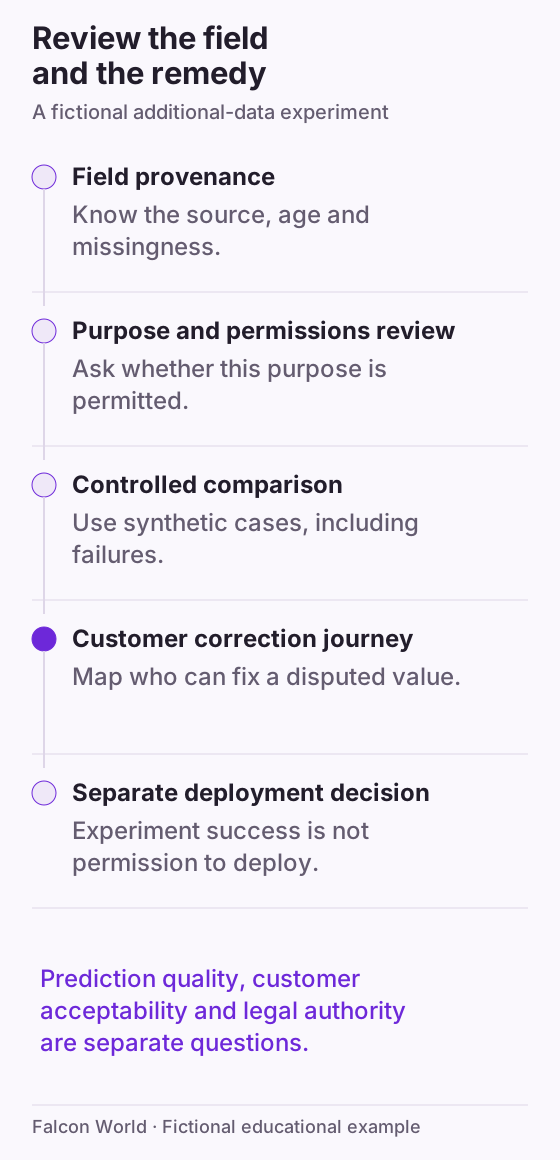
Original diagram of a fictional worked example; not a regulator-issued checklist, compliance certification or actual deployment.
[Open the complete workflow diagram](/assets/financial-workflow-insurance-data-fairness-20261015.svg)
Read the diagram
**Review the field and the remedy**
A fictional additional-data experiment
1. **Field provenance.** Know the source, age and missingness.
2. **Purpose and permissions review.** Ask whether this purpose is permitted.
3. **Controlled comparison.** Use synthetic cases, including failures.
4. **Customer correction journey.** Map who can fix a disputed value.
5. **Separate deployment decision.** Experiment success is not permission to deploy.
**Boundary to retain.** Prediction quality, customer acceptability and legal authority are separate questions.
*Falcon World · Fictional educational example*