NatWest’s Cora shows why a banking chatbot needs a useful human exit
NatWest reports wider generative support in Cora. Conversation counts and human-intervention rates leave important customer-service questions open.
A customer can leave a chat for opposite reasons: the answer solved the problem, or the conversation became too frustrating to continue. A bank therefore has to look beyond how many queries a digital assistant contains. NatWest's expansion of Cora offers a concrete case for examining that difference, because the bank now reports both a large volume of conversations and a growing set of generative-AI-supported customer journeys.
In its [2025 annual report](https://investors.natwestgroup.com/~/media/Files/R/RBS-IR-V2/annual-report-2025/2025-annual-report-and-accounts.pdf), NatWest says Cora handled 12.9 million retail banking conversations during the year and that half required no human intervention. It also reports 21 customer journeys supported by generative AI at year end. These are the bank's published operational figures, checked on 16 October 2026. They are not an independently established count of problems solved to every customer's satisfaction.
A broader conversation is not automatically a better service
The figures concern different things. Conversation volume describes activity. Human intervention describes one route through the service. The number of generative journeys describes product coverage. None is, by itself, a measure of whether a person understood an answer, completed an intended task or could reach the bank when the digital route was unsuitable. Reading them separately is essential to interpreting the actual development.
NatWest's [innovation and digitalisation page](https://www.natwestgroup.com/sustainability/society/innovation-and-digitisation.html) reports an approximately 20-percentage-point uplift in queries needing no human intervention for comparable generative-AI journeys against non-generative ones. That is a company-reported comparison of particular journeys. It is not a 20% improvement in all banking service, a satisfaction score or evidence that every conversation should avoid a colleague. The public page does not provide a randomised experiment from which this article can infer universal causation.
The operational attraction is still understandable. If a straightforward query can be answered clearly at the point of need, a customer may avoid waiting and staff may focus on complicated cases. The qualification matters: a complicated case should not be kept in a digital channel merely because escalation looks expensive. A helpful assistant needs a route out of its own conversation, together with enough context that the customer does not have to start again.
Imagine someone asking about a transaction while also explaining that they cannot access their usual device. A response that correctly explains a payment category may miss the immediate access problem. A system should distinguish the topic from the customer's ability to act on the answer. That is an analytical illustration, not a recorded Cora incident. It shows why a bank should assess the complete journey rather than the grammar of an isolated response.
From an announced partnership to reported operation
The chronology helps separate ambition from evidence. On 20 March 2025, [NatWest announced a collaboration with OpenAI](https://www.natwestgroup.com/news-and-insights/news-room/press-releases/ai-and-data/2025/mar/natwest-open-ai-collaborate-to-accelerate-cutting-edge-ai-transf.html). It described potential developments in customer digital assistants and tools for colleagues, including work around fraud and complaints. An announcement of intended development is different from a report that a particular capability is generally available or has improved outcomes. This article does not turn that roadmap into a completed customer service.
The annual report subsequently supplies a dated account of Cora's 2025 operation. It reports a narrower set of things than a general promise that AI will transform banking. This makes the case useful: readers can trace a particular service, its reported scale and the questions that remain. They need not choose between treating the announcement as proof of everything and dismissing the operational work altogether.
For the workforce, an important possibility is that the composition of incoming work changes. If routine requests are completed digitally, people reaching staff may have more unusual circumstances or greater need for explanation. That could increase the importance of judgement, accessibility skills and support resources. It does not establish fewer jobs, easier jobs or a particular staffing ratio. Those outcomes require workforce evidence that the sources used here do not supply.
The UK service obligation reaches the digital channel
The [FCA's explanation of the Consumer Duty](https://www.fca.org.uk/firms/consumer-duty/about) includes customer understanding and customer support among its four outcomes. That is relevant context for evaluating how a bank delivers a service through chat, rather than a special approval or prohibition of Cora. This article is not a legal assessment of NatWest's compliance or a substitute for advice about an individual complaint.
The [FCA's AI approach page](https://www.fca.org.uk/firms/innovation/ai-approach) also describes its own use of AI to help route consumers and support staff, while retaining people for judgement. This is a regulator's description of its operations, not validation of a bank's model. It does, however, show that the relationship between an automated first step and a capable human destination is an operational issue for regulators as well as firms.
Customers should not have to learn the architecture behind a chatbot. What they need is a service that explains what it can do, recognises when it cannot help and makes the next step usable. A contact option that appears only after repeated failures can undermine that experience. A handoff that sends an accurate, relevant summary can help, provided the person can correct any misunderstanding and sensitive information is handled appropriately.
A proposed learning exercise: follow the customer beyond the chat
The following is a proposed workshop for a fictional bank, not a test NatWest is reported to have run. Participants create synthetic conversations about an ordinary payment query, an access difficulty and a person who asks for a slower explanation. The objective is to design a handoff that continues the same service task, rather than to maximise the proportion of conversations kept away from staff.
One learner plays the customer, another operates a prototype assistant and a third acts as the receiving colleague. The colleague receives the assistant's proposed summary before reading the full synthetic conversation. They mark whether the summary preserves the original request, unresolved questions and any stated communication needs. They then compare it with the original. A concise summary that omits the reason the customer needs assistance should be treated as incomplete.
The group next changes the scenario. The customer asks to stop using chat, cannot complete a suggested action or disagrees with the assistant's account. Participants check whether the service respects that choice and gives a clear next step. A failed digital answer should not be recorded as a resolved case simply because the person left. Learners can document what additional evidence would be needed to distinguish completion from abandonment in a real deployment.
Finally, the workshop evaluates staff workload. A handoff may save repetition but create a new task in checking a machine-written summary. Teams should identify that work rather than assume it disappears. They can also review whether the most difficult cases reach colleagues with the relevant training. The exercise produces a proposed service map and evaluation questions, not a claim about time saved or a recommendation to remove a channel.
NatWest's reports show generative AI entering a substantial customer service operation. The useful question is what happens after a person asks for help. A banking assistant earns its place when it supports a clear answer or a competent continuation with a person. The absence of human intervention is one operational observation within that journey; it should never be mistaken for a complete account of customer experience.
Explanatory diagram and accessible reading guide
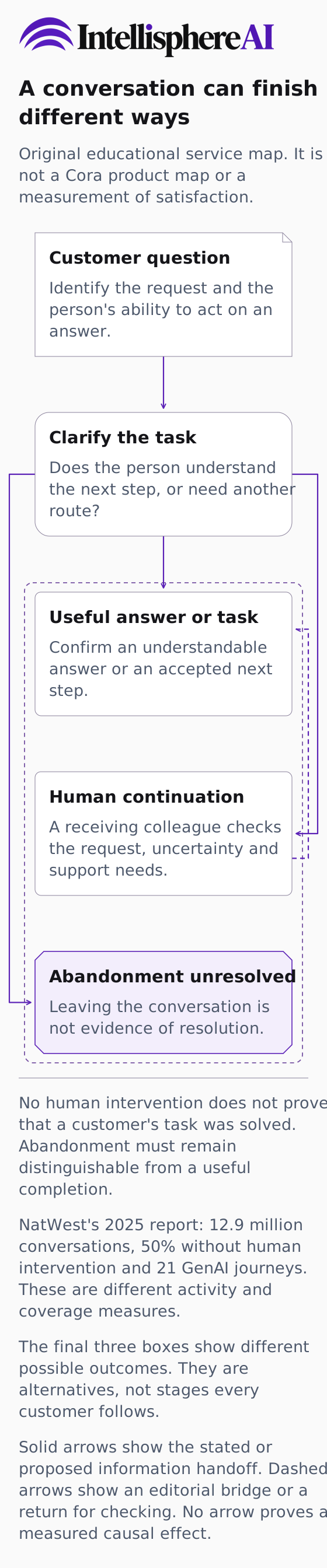
*Original educational infographic based on attributed reports and a fictional proposed exercise; not the named bank’s internal architecture, actual customer decision or measured result.*
[Open the full-size explanatory diagram](/assets/bank-uk-conversation-outcomes-20261016.svg)
This original diagram explains attributed source context and a fictional learning exercise. The exercise has not been run; the diagram is not an authentic product interface, internal bank architecture or measured operational result.
A conversation can finish in different ways
Original educational service map. It is not a Cora product map or a measurement of satisfaction.
Customer question
Identify the request and the person's ability to act on an answer.
Clarify the task
Does the person understand the next step, or need another route?
Useful answer or task
Confirm an understandable answer or an accepted next step.
Human continuation
A receiving colleague checks the request, uncertainty and support needs.
Abandonment unresolved
Leaving the conversation is not evidence of resolution.
No human intervention does not prove that a customer's task was solved. Abandonment must remain distinguishable from a useful completion.
NatWest's 2025 report: 12.9 million conversations, 50% without human intervention and 21 GenAI journeys. These are different activity and coverage measures.
The final three boxes show different possible outcomes. They are alternatives, not stages every customer follows.
Solid arrows show the stated or proposed information handoff. Dashed arrows show an editorial bridge or a return for checking. No arrow proves a measured causal effect.
The service clarifies the actual task before interpreting an answer.
A usable answer or confirmed task can support completion.
A need for another route is handed to a person with a checked summary.
Lost contact or departure remains unresolved until evidence says otherwise.
Human continuation still needs an outcome check; completion is not guaranteed.
Diagram source references
- [S06: NatWest Group Annual Report and Accounts2025](https://investors.natwestgroup.com/~/media/Files/R/RBS-IR-V2/annual-report-2025/2025-annual-report-and-accounts.pdf) — NatWest Group.
- [S19: About the Consumer Duty | FCA](https://www.fca.org.uk/firms/consumer-duty/about) — Financial Conduct Authority.
- [S20: AI and the FCA: our approach | FCA](https://www.fca.org.uk/firms/innovation/ai-approach) — Financial Conduct Authority.
- [S24: NatWest & OpenAI collaborate to accelerate cutting-edge AI transformation in support of bank-wide simplification and enhanced customer experience | NatWest Group](https://www.natwestgroup.com/news-and-insights/news-room/press-releases/ai-and-data/2025/mar/natwest-open-ai-collaborate-to-accelerate-cutting-edge-ai-transf.html) — NatWest Group.
- [S25: Innovation and digitalisation | NatWest Group](https://www.natwestgroup.com/sustainability/society/innovation-and-digitisation.html) — NatWest Group.