Pathology AI is learning the whole slide—and external tests are changing the story
TITAN’s rare-case retrieval and an independent multi-cohort benchmark explain why whole-slide representations need task-specific evidence before clinical claims.
A tissue slide contains more than a collection of interesting cells. The arrangement of structures across a large image can matter, and a rare case may resemble several different conditions in different regions. Teaching AI to represent that wider context is one of the central challenges in computational pathology.
TITAN, described in Nature Medicine in November 2025, connects whole-slide images with language. Its case-retrieval experiments offer a concrete view of what that might enable. An independent benchmarking programme supplies an equally useful counterweight: the model that performs well depends on the task, data and evaluation design. A foundation model is a starting representation, not a finished cancer service.
TITAN connects images, captions and reports
The [TITAN study](https://www.nature.com/articles/s41591-025-03982-3) describes pretraining with 335,645 whole-slide images, 182,862 reports and 423,122 synthetic region captions. The programme includes researchers at Mass General Brigham and Harvard Medical School. Its language alignment connects visual representations with descriptions at different scales.
One application is finding archived slides resembling a difficult case. The researchers included an external rare-cancer retrieval set of 39 slides covering 12 rare ovarian and soft-tissue cancer types from Kanagawa Cancer Center Hospital in Japan. That is a specific external test, not evidence of broad Japanese clinical deployment. Retrieval of a similarly labelled slide is also a different outcome from an improved patient diagnosis.
Whole-slide modelling has a separate research lineage
An earlier [Prov-GigaPath paper](https://www.nature.com/articles/s41586-024-07441-w), published on 22 May 2024, describes collaboration involving Microsoft, the University of Washington and Providence. Pretraining used 171,189 slides from more than 30,000 patients across the US Providence network. It addressed the challenge of connecting many small image tiles into a useful slide-level representation.
This historical record helps explain the architectural problem rather than establish an October 2026 winner. A slide encoder combines information across a large image; a tile encoder represents local regions. How a downstream task uses those representations can change the outcome. Comparing model names without that pipeline can conceal what was actually tested.
The independent benchmark asks a different question
The [Neidlinger and colleagues benchmark](https://www.nature.com/articles/s41551-025-01516-3) was published online on 1 October 2025, although it appears in a 2026 journal volume. It evaluated 19 foundation models using 13 cohorts, 6,818 patients and 9,528 slides across lung, colorectal, gastric and breast cancers. The work covered morphology, biomarkers and prognosis.
CONCH and Virchow2 performed strongly overall in that evaluation. The authors also found complementary information across models and limitations to using slide encoders within their particular multiple-instance learning setup. This is not a direct refutation of TITAN's later, different evaluation. It shows why a model's broad promise must be translated into a task-specific test.
Read the unit before reading the headline
| Evidence | Unit and task | Boundary | | --- | --- | --- | | TITAN development | Image, report and synthetic-caption pretraining | Training records are not independent patients | | TITAN Japan set | 39 slides; rare-cancer retrieval | Small, specific external challenge | | Independent benchmark | 6,818 patients; 31 downstream tasks | Retrospective model comparison | | Prov-GigaPath | Whole-slide representation research | Historical development, not current clinical acceptance |
These distinctions prevent a common numerical illusion. Hundreds of thousands of training images can sound like hundreds of thousands of independently evaluated diagnoses. One patient can contribute several slides, and several slides can contribute many tiles. The patient, slide and tile denominators answer different questions.
A fictional rare-case teaching library
Consider a fictional pathology teaching department in Cape Town building a retrieval exercise from a properly licensed, de-identified educational archive. This is an illustrative example, not a reported South African TITAN installation. A trainee views an assigned slide and asks the system for comparison cases. The interface shows candidate cases and the reason for inspecting them, without presenting the nearest neighbour as a diagnosis.
The supervising pathologist includes misleading similarities, poorly prepared slides and cases absent from the library. An absent category matters: a search tool always returning something can create false reassurance. The educational objective is recognising when similarity helps and when the archive cannot answer the question.
Keep search assistance separate from the signed report
In the fictional library, retrieved material remains a reference view beside the original slide. The trainee can inspect differences in tissue preparation, stain and morphology. A generated paragraph cannot enter a patient report through a convenient copy button without an appropriate clinical process. The exercise does not use active patient material.
The department records whether retrieval found useful teaching comparisons, how often it suggested misleading ones and how much supervision was needed. These are proposed learning measures. They do not measure cancer detection or treatment outcomes. A future clinical evaluation would require different permissions, reference standards and endpoints.
The scanner can become an unintended clue
TITAN's authors acknowledge that pathology representations may encode non-biological characteristics such as scanners and tissue-processing sites. That is a concrete scientific limitation. If a training archive associates one institution with one cancer category, a model might learn part of the institutional signature rather than the intended biology.
For an evaluator, the practical question is whether the system remains useful on a different preparation process and a different patient population. Splitting tiles randomly while related slides appear on both sides does not necessarily provide that answer. The comparison should preserve the appropriate patient and institution boundaries and document known overlap with pretraining resources.
Developers can make uncertainty inspectable
Useful engineering includes reliable slide identifiers, readable image-quality warnings, source-linked comparison cases and a clear route back to the unmodified original image. If processing fails, preserve the case and explain that comparison results are unavailable. A blank panel must not resemble a negative finding.
Do not assume a synthetic caption has the authority of a pathologist's observation. Retain how each text element was produced. Similarly, an attractive heat map shows where a system assigned attention; it does not automatically establish a biological explanation. Interfaces should help a reviewer inspect the underlying region and recognise the limits of the visual cue.
What the research changes for pathology work
The opportunity extends beyond writing reports. Archivists and laboratory staff help establish which slides can be found and trusted. Pathologists define meaningful comparison tasks. Engineers manage large images and maintain the connection between local regions, whole-slide context and source records. Good evaluation depends on these people working together.
Students can practise with authorised teaching material and an explicit unknown-category exercise. They should learn to explain why a retrieved case is informative and why it might mislead. The papers do not establish that retrieval reduces staffing requirements, and automation that creates more difficult review may shift rather than remove work.
The next evidence should follow the decision
The field needs prospective studies showing what clinicians do with these representations and whether the assistance improves an important outcome under a specified workflow. Independent external testing remains essential, particularly for rare conditions where an impressive average can hide very sparse evidence.
This is educational, non-promotional research reporting, not advice about an individual's pathology result. Sources were checked on 15 October 2026. The useful story is both technical ambition and better measurement: richer representations become clinically meaningful only through the decisions and outcomes they can support.
Research pathway and readable guide
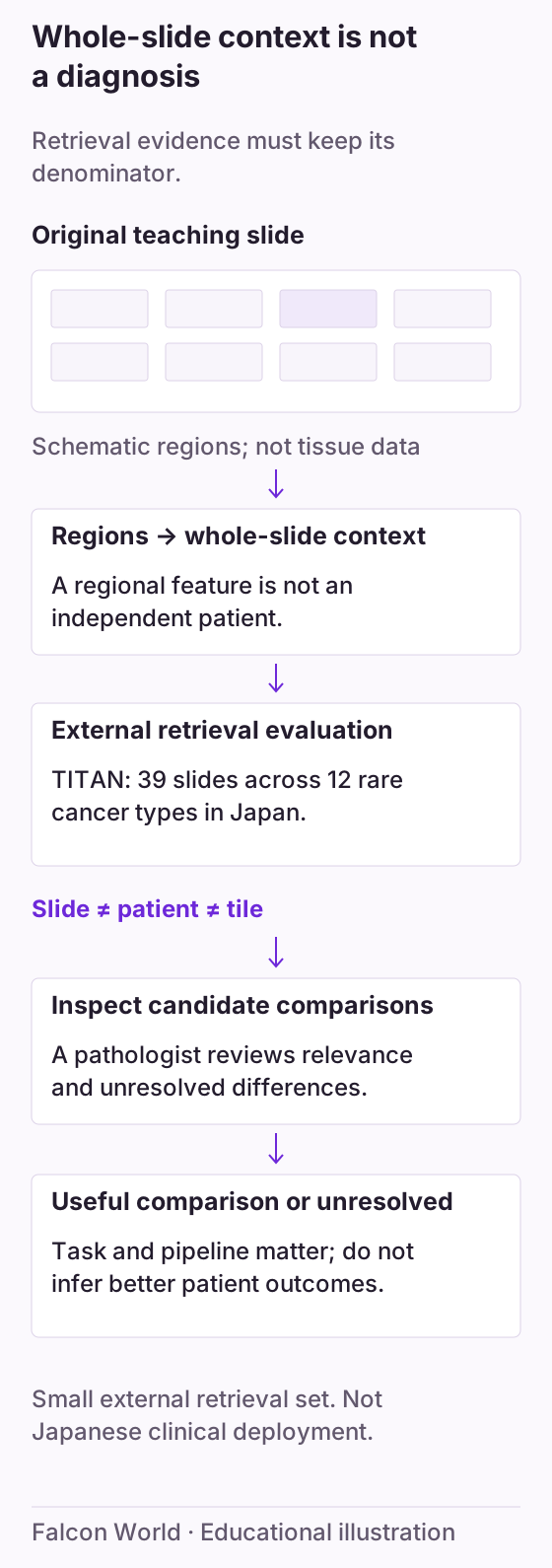
Original educational diagram of research boundaries and a fictional example. Not personal medical advice, a treatment instruction, regulatory approval or an actual clinical deployment.
[Open the complete research diagram](/assets/healthcare-workflow-pathology-20261015.svg)
Read the diagram
**Whole-slide context is not a diagnosis**
Retrieval evidence must keep its denominator.
- **Original teaching slide.** Schematic regions; not tissue data
- **Regions → whole-slide context.** A regional feature is not an independent patient.
- **External retrieval evaluation.** TITAN: 39 slides across 12 rare cancer types in Japan.
**Slide ≠ patient ≠ tile**
- **Inspect candidate comparisons.** A pathologist reviews relevance and unresolved differences.
- **Useful comparison or unresolved.** Task and pipeline matter; do not infer better patient outcomes. Small external retrieval set. Not Japanese clinical deployment.
*Falcon World · Educational illustration*
These pathways describe different research tasks and evidence boundaries. An arrow does not establish that one study caused another or that a research finding leads automatically to clinical benefit.