Recovery is a robot capability that the whole shift must understand
Toyota’s adaptation research and Japan’s AIST programme raise a separate operating question: who can establish that interrupted work is ready to continue?
A robot that adapts when an object moves can make a persuasive demonstration. A production team faces another question: when should adaptation end and a controlled recovery begin? A person may have changed the workpiece, the task order may be stale, or the equipment may have lost power. Continuing the intended motion is not always the same as continuing the intended work.
This distinction deserves its own place in discussions of industrial AI. Recovery includes physical condition, task state and authority to resume. A model can help describe an unexpected scene without acquiring permission to restart a machine. A site can require an explicit review for a particular workflow without asserting that every robot application everywhere must use the same restart procedure.
Research adaptation has a specific scope
Toyota’s [20 August 2025 joint research announcement](https://pressroom.toyota.com/ai-powered-robot-by-boston-dynamics-and-toyota-research-institute-takes-a-key-step-towards-general-purpose-humanoids/) describes a Large Behavior Model controlling Boston Dynamics’ Atlas through manipulation and locomotion tasks. In the reported demonstration, researchers introduced changes such as closing and moving a box. That is evidence of a described research demonstration of adaptation. It does not establish factory commissioning, an independent reliability rate or acceptance of any particular recovery procedure. Toyota Research Institute’s collaboration described here was announced from Boston, not from a Japanese production-line trial.
Japan’s AIST took a different institutional step in its [23 January 2025 announcement](https://www.aist.go.jp/aist_j/news/announce/pr20250123_2.html). It described starting robot-foundation-model research and seeking collaboration with users, manufacturers and system integrators, including testing task examples and integration across robots. This is a programme and collaboration account. It is not a published result showing that all proposed industrial tasks, or their interrupted states, have been solved.
The US [OSHA Technical Manual chapter on industrial robot systems](https://www.osha.gov/otm/section-4-safety-hazards/chapter-4) discusses application risk assessment, worker participation and hazards arising during programming, maintenance and other activities. It also distinguishes operating arrangements, including a safety-rated monitored stop where automatic resumption can be permitted under specified conditions. The chapter is guidance with references to particular standards editions, not a universal statement of current law or an approval of a model. This article does not reproduce or claim to replace paid standards or a competent site assessment.
A fictional recovery conversation
Imagine a fictional adult team in Nagoya assembling reusable test fixtures. A robot has placed a spacer but the task record has not confirmed whether the next clamp operation began. The line is paused. The example is invented, unrelated to Toyota or AIST equipment, and intentionally avoids instructions for defeating safeguards. The useful question is what the people need to establish before the responsible site process decides whether and how work can continue.
The operator needs a plain description: which task was active, what completion was last confirmed and which physical condition remains unknown. Maintenance needs the relevant equipment state. Quality needs to know whether the partly assembled fixture can remain in the ordinary flow. The supervisor needs the current order and the authorized recovery route. A single green “ready” indicator cannot carry all those meanings.
The team sketches distinct modes for its proposed interface: ordinary operation, paused with a known task state, unresolved interruption, inspection and authorized continuation. These are editorial design categories for the fictional task, not a robot standard or a claim about a product’s existing controls. Their purpose is to prevent one word, such as stopped, from implying both a physical condition and permission to resume.
Preserve the interrupted task
For a worked rehearsal, the team uses an isolated practice fixture and synthetic order. It interrupts the reporting path at a point where the receiver cannot confirm the final acknowledgement. The task remains unresolved. The interface keeps the original task identifier and proposed action visible instead of replacing them with an empty form that invites another dispatch. A person can then compare the retained record with the actual practice fixture.
The next decision is scoped. If the spacer is present but the clamp state is uncertain, the team does not infer completion from the model’s confident description of the scene. It follows the reviewed inspection route for the exercise. Where the available observations cannot settle the condition, the unresolved state remains unresolved. That may feel slower than generating another plan, but it preserves the distinction between an explanation and confirmed equipment evidence.
A second rehearsal changes the work order while a task is paused. The old plan may still be geometrically possible and semantically obsolete. The continuation process must establish that it belongs to the intended current work, rather than merely checking that the robot can move. This is a workflow-integrity problem as well as a motion problem. It is one reason recovery needs production and quality participation alongside robotics expertise.
Test the handover between adults
Shift changes reveal another weakness. The person receiving the task may not have watched the interruption. A useful handover preserves the last confirmed step, the observations made since, the unresolved questions and the identity of the responsible decision process. It should avoid suggesting that the next person is expected to guess or repeat an action simply because a previous message is missing.
Human messages can remain clear without discarding engineering evidence. “Completion has not been confirmed; review the fixture before continuing” conveys a different state from “the controller declined this request.” The technical record can retain version, task and controller details separately. Raw diagnostic text should not be the operator’s only explanation, particularly when several teams use different technical vocabularies.
Measure recovery separately from normal work
An evaluation should report ordinary task performance and recovery work separately. The fictional team could record whether the retained task matched the fixture, whether the next adult understood the unresolved condition and whether any duplicate dispatch occurred. It should preserve failures and interventions. A demonstration that adapts to a moving box cannot stand in for those observations, because it answers a different question.
The possible benefit is a clearer operating handoff when conditions change. No time saving, reduced incident rate, safety certification or production acceptance is measured here. The Toyota research account and AIST programme show serious work toward more adaptable robotics; OSHA guidance shows why the application and its surrounding work still matter. Industrial AI becomes easier to assess when adaptation and authorized recovery are described as related capabilities with different evidence requirements.
Evidence diagram and readable guide
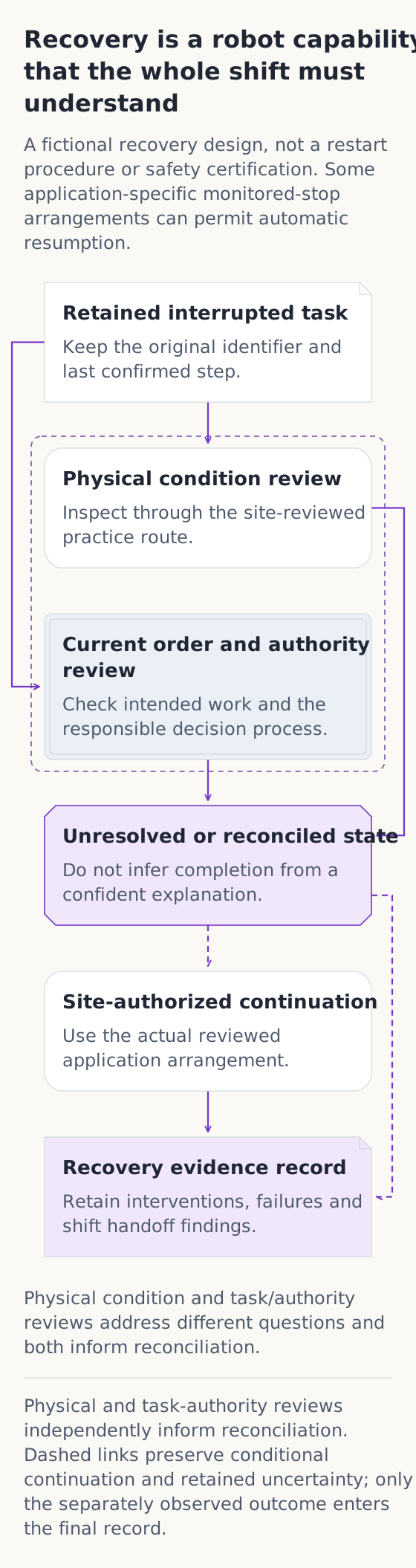
Original explanatory diagram: physical condition and task authority inform a recovery decision while unresolved evidence remains visible.
[Open the complete evidence diagram](/assets/manufacturing-workflow-recovery-operating-modes-20261015.svg)
Read the diagram
**Recovery is a robot capability that the whole shift must understand**
A fictional recovery design, not a restart procedure or safety certification. Some application-specific monitored-stop arrangements can permit automatic resumption.
- **Retained interrupted task.** Keep the original identifier and last confirmed step.
- **Physical condition review.** Inspect through the site-reviewed practice route.
- **Current order and authority review.** Check intended work and the responsible decision process.
- **Unresolved or reconciled state.** Do not infer completion from a confident explanation.
- **Site-authorized continuation.** Use the actual reviewed application arrangement.
- **Recovery evidence record.** Retain interventions, failures and shift handoff findings.
Physical condition and task/authority reviews address different questions and both inform reconciliation.
Physical and task-authority reviews independently inform reconciliation. Dashed links preserve conditional continuation and retained uncertainty; only the separately observed outcome enters the final record.
How the connections work
- Retained interrupted task to Physical condition review: physical review; solid directed link. Proposed conditional or evidence flow; no measured causal relationship.
- Retained interrupted task to Current order and authority review: workflow review; solid directed link. Proposed conditional or evidence flow; no measured causal relationship.
- Physical condition review to Unresolved or reconciled state: condition evidence; solid directed link. Proposed conditional or evidence flow; no measured causal relationship.
- Current order and authority review to Unresolved or reconciled state: authority evidence; solid directed link. Proposed conditional or evidence flow; no measured causal relationship.
- Unresolved or reconciled state to Site-authorized continuation: conditional continuation; dashed directed link. Proposed conditional or evidence flow; no measured causal relationship.
- Unresolved or reconciled state to Recovery evidence record: retained uncertainty; dashed directed link. Proposed conditional or evidence flow; no measured causal relationship.
- Site-authorized continuation to Recovery evidence record: observed outcome; solid directed link. Proposed conditional or evidence flow; no measured causal relationship.
Keep the paths separate
Physical condition and task/authority reviews address different questions and both inform reconciliation.