Robot demonstrations need a supply-chain record of their own
Robot datasets bring collection histories, action conventions and artifact-specific terms that a common file format cannot erase.
A robot-learning dataset may arrive as a tidy collection of episodes, yet each episode has a history. Someone chose the task, operated or supervised the equipment, recorded sensors and decided what counted as a useful attempt. Files can lose those distinctions when they are converted into a common format. For an industrial team, data provenance is therefore both an engineering question and a question about permitted use.
The tempting shortcut is to treat “available to download” as a complete answer. It is not. A visible repository may contain code, links to external data and separately distributed model artifacts. Their terms and origins may differ. Even when permission is clear, the recorded action may mean something different on the receiving robot. An accurate filename cannot settle a wrong coordinate frame, missing timing information or an episode that ends before the outcome is known.
Four primary records, different kinds of evidence
The official [AgiBot World repository](https://github.com/OpenDriveLab/Agibot-World) describes a robot-manipulation platform and identifies the data and code within that repository as CC BY-NC-SA 4.0. That noncommercial condition matters to an industrial team evaluating reuse. The statement should be checked against the exact artifact being considered; it is not a blanket account of every linked checkpoint, external collection or future version. This article downloads none of those materials and grants no reuse permission.
The [Open X-Embodiment project](https://robotics-transformer-x.github.io/) presents standardized robot datasets and cross-robot learning experiments, and asks users to cite contributed datasets as well as the joint work. Its action description uses a gripper-relative representation. Standardization makes comparisons possible, but it also makes conventions consequential. A receiving team should inspect each component’s documentation and terms instead of assuming that one project name describes a uniform origin or license.
The [DROID project account](https://droid-dataset.github.io/) explains the logistical, hardware and human-labour effort involved in gathering diverse manipulation data. That is a reminder that “in the wild” does not mean without a collection design. The primary page describes a research dataset; it does not establish that its environments, tasks or collected outcomes represent a particular manufacturing station. Its page-level publication date was not established here.
The living [LeRobotDataset v3 documentation](https://huggingface.co/docs/lerobot/en/lerobot-dataset-v3) describes tabular signals, video and metadata, with episode views reconstructed through metadata rather than separate files. That is a useful implementation detail for a provenance review: a storage shard is not necessarily an episode. The documentation was checked on 15 October 2026; this article does not assign that check date to the format’s original release or claim compatibility with an installed product.
A fictional demonstration intake
Imagine a fictional adult engineering cooperative in Suzhou considering data for handling reusable electronics trays. It has internal demonstrations and is evaluating whether any external collection is suitable for a research comparison. No real dataset contributor, company or participant is depicted. The first step is a manifest that separates candidate artifacts from approved inputs. Being listed in the manifest means “under review,” not “cleared for training.”
For each candidate, the cooperative records its publisher, exact version or file identity, source link, collection context and stated terms. It separately records who is responsible for deciding whether the intended use is permitted. A commercial objective should not disappear behind the word research. If the scope of a restriction is uncertain, the team holds the artifact and asks the appropriate rights specialist rather than converting it and hoping the conversion resolves the issue.
For internal recordings, the team describes the collection arrangement, including what people were told, which views were recorded and where sensitive material could enter the frame. It avoids using real customer labels in the practice area. A dataset that omits visible faces can still reveal a product design, a serial number or a worker’s pattern of activity. The appropriate review depends on the actual recording and jurisdiction; this is a planning example, not a universal legal checklist.
Preserve meaning through conversion
The next step is a small, inspectable conversion trial. The team chooses a few synthetic episodes and follows their timestamps, camera views, state measurements and requested actions through the conversion. It checks whether an action is an absolute pose, a relative movement, a velocity or another representation. It records units and reference frames explicitly. Merely obtaining an array of the expected shape is not enough to establish that it means the same thing.
Episode boundaries deserve equal attention. A pickup that stops because the operator intervened should not become an ordinary successful episode when files are combined. An interrupted recording should remain interrupted. The team preserves outcome labels, intervention reasons and missing-data indicators where they exist, and records when they do not. Inventing a success label from the final image would replace missing evidence with an assumption.
A worked review can compare the original episode description with a reconstructed view from the converted representation. The reviewer asks whether the same task, sequence and uncertainty are visible. Where compression or sampling removes detail, the conversion record explains the loss. This does not require publishing raw recordings or private content. A controlled internal inspection can establish the relationship while a public summary reports only the scope and limitations.
Separate diversity from independence
A large collection can still repeat the same demonstrations, rooms or operators across training and evaluation. The fictional cooperative therefore defines its held-out evaluation before tuning. It groups related recordings so that a near-duplicate does not quietly appear on both sides of the comparison. The grouping policy should reflect the question: testing a new object is different from testing a new camera arrangement or a different robot.
The evaluation record also distinguishes human demonstrations from autonomous attempts and corrected attempts. Mixing them may be a reasonable research choice, but it should be visible. Otherwise a model may appear to have learned an independent recovery behaviour when the relevant examples actually included extensive human guidance. The goal is not to condemn assistance; it is to describe accurately which assistance the evidence contains.
A reusable record, not a reuse guarantee
The potential benefit of this approach is a more intelligible data supply chain. When a model behaves unexpectedly, engineers can ask which collection, convention or transformation contributed to its training inputs. When a rights question arises, the team can identify the exact artifact and intended use. Those are practical capabilities, not measured savings or a promise that provenance alone makes a robot dependable.
The four primary records illustrate different parts of the problem: a repository’s stated license, a multi-contributor research effort, the work of collection and the mechanics of a common format. None removes the need to inspect the chosen data. A demonstration becomes a responsible industrial input only after its origin, meaning, permitted use and limitations survive the journey into the next system.
Evidence diagram and readable guide
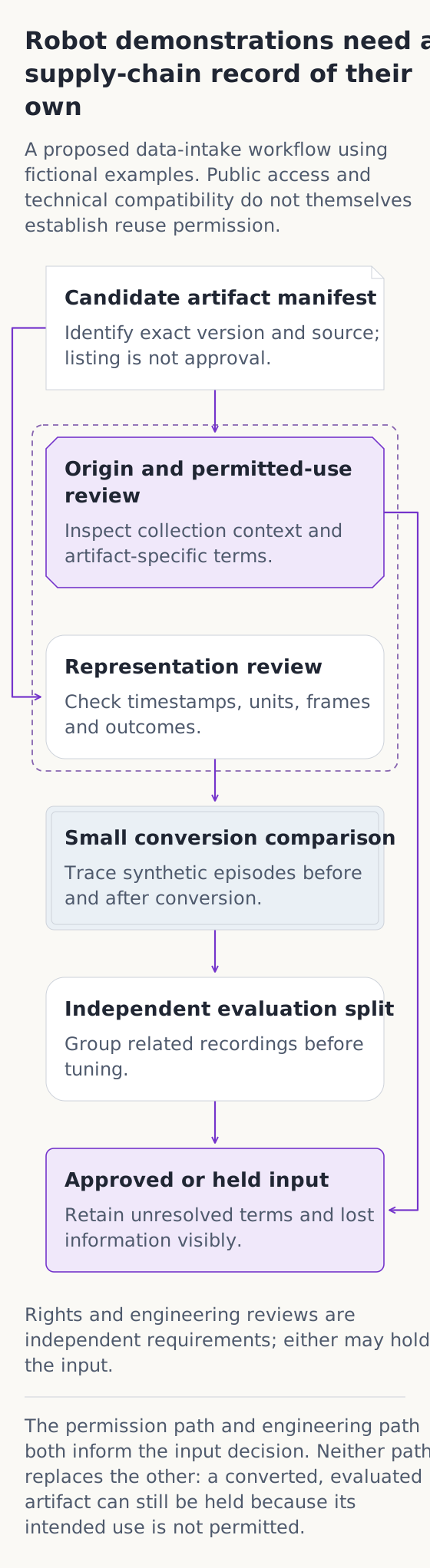
Original explanatory diagram: permission and engineering reviews both inform whether a demonstration input is approved or held.
[Open the complete evidence diagram](/assets/manufacturing-workflow-demonstration-provenance-20261015.svg)
Read the diagram
**Robot demonstrations need a supply-chain record of their own**
A proposed data-intake workflow using fictional examples. Public access and technical compatibility do not themselves establish reuse permission.
- **Candidate artifact manifest.** Identify exact version and source; listing is not approval.
- **Origin and permitted-use review.** Inspect collection context and artifact-specific terms.
- **Representation review.** Check timestamps, units, frames and outcomes.
- **Small conversion comparison.** Trace synthetic episodes before and after conversion.
- **Independent evaluation split.** Group related recordings before tuning.
- **Approved or held input.** Retain unresolved terms and lost information visibly.
Rights and engineering reviews are independent requirements; either may hold the input.
The permission path and engineering path both inform the input decision. Neither path replaces the other: a converted, evaluated artifact can still be held because its intended use is not permitted.
How the connections work
- Candidate artifact manifest to Origin and permitted-use review: rights review; solid directed link. Proposed conditional or evidence flow; no measured causal relationship.
- Candidate artifact manifest to Representation review: meaning review; solid directed link. Proposed conditional or evidence flow; no measured causal relationship.
- Origin and permitted-use review to Approved or held input: permission gate; solid directed link. Proposed conditional or evidence flow; no measured causal relationship.
- Representation review to Small conversion comparison: conversion check; solid directed link. Proposed conditional or evidence flow; no measured causal relationship.
- Small conversion comparison to Independent evaluation split: evaluation design; solid directed link. Proposed conditional or evidence flow; no measured causal relationship.
- Independent evaluation split to Approved or held input: engineering gate; solid directed link. Proposed conditional or evidence flow; no measured causal relationship.
Keep the paths separate
Rights and engineering reviews are independent requirements; either may hold the input.