Securing a private AI server starts with the routes around the model
vLLM, Triton and PyTorch documentation explains why local inference still requires route controls, reviewed loading and restricted operating privileges.
Moving inference into an organisation's own infrastructure changes who operates the service. It does not, by itself, settle who can reach it, what its processes can access or how much work an incoming request can create. The model may be local while its surrounding application still has an unexpectedly large security boundary.
The most useful starting document is a service map. Show the application, inference interface, administrative routes, storage, model-loading path and any communication between workers. Then ask which callers need each connection. This turns a general wish for private AI into a design that an operator can inspect and test.
Read the server's own security limits
The [vLLM security documentation checked on 15 October 2026](https://docs.vllm.ai/en/latest/usage/security/) warns that its built-in API-key protection covers specified path prefixes rather than every endpoint on the HTTP server. It recommends additional controls, including limiting exposed routes and using a reverse proxy. A configured key is therefore not evidence that the whole listening service has the same protection.
The same documentation says multi-node communication is insecure by default and needs an isolated network. Those statements concern the documented software and configuration, not a finding that a particular organisation is exposed. Operators should check the documentation and behaviour of their exact installed release; this article makes no claim about the newest release number.
A fictional service separates three callers
Consider a textile cooperative in Bengaluru preparing an internal assistant over invented equipment instructions. This is an illustrative design, not a real deployment. Staff use a simple application to ask questions. Maintainers update approved components. A separate process records service health.
These callers do not need identical access. An ordinary question should reach the accepted inference interface, subject to the application's access rules. It should not become a model-management command. A health collector needs the metrics selected for its job, not every diagnostic route. The maintainer needs a reviewed update path rather than permission embedded in every user's session.
The cooperative writes these distinctions into the service map before choosing where to place a proxy. It then plans negative tests for routes and operations the ordinary application must not reach. A successful answer to one permitted question is insufficient evidence for the other boundaries.
The network boundary has more than one side
An external access rule protects only the connection it actually governs. Worker communication, storage mounts and management interfaces need their own review. If the application can fetch an image or another remote resource, the destination also becomes part of the request's security analysis.
In the fictional design, users cannot turn the assistant into a general-purpose network fetcher. The team defines which inputs the feature actually needs and applies limits at the appropriate service boundary. It avoids exposing extra capabilities simply because a demonstration server provides them.
The review includes the service's outbound connections. A server inside a private network can still have access to other internal services or the public internet. Explain which connections are required for the accepted feature and how the operator will detect an unexpected attempt. A network diagram should describe observed or enforced relationships, not merely a desired arrangement.
Model repositories can carry executable behaviour
[NVIDIA's Triton secure-deployment guidance](https://docs.nvidia.com/deeplearning/triton-inference-server/user-guide/docs/customization_guide/deploy.html) warns that some backends execute code from a model repository and that Triton does not provide a security sandbox for arbitrary model or backend code. It also discusses deployment behind a secure gateway and running with least privilege.
This is a reason to give model updates their own controlled intake path. The fictional cooperative does not let a question upload an arbitrary replacement model. A package review identifies which components contain executable behaviour, who approved them and what permissions the serving process receives. Accepted weights are not a blanket endorsement of an unrelated custom backend.
The operating account should not inherit a maintainer's broad credentials just because that makes an early experiment convenient. Design the process so that its available files, credentials and service permissions match the job. Test that arrangement in an authorised environment before relying on it.
Safer formats leave other risks to manage
The [PyTorch security policy](https://github.com/pytorch/pytorch/security/policy) treats running untrusted models as running untrusted code and recommends isolation. It also warns that more secure serialization formats do not remove threats from unexpected downstream inputs. A format choice addresses one part of a system, not the whole request lifecycle.
For the cooperative, availability is part of acceptance. The team defines appropriate limits for input size, work per request, simultaneous jobs and waiting time. The values should come from its own permitted workload and measured capacity. Inventing a universal safe limit from a tutorial would conceal the decisions the operator actually needs to make.
Failures should be understandable to staff. A request that exceeds the agreed limit should receive a clear explanation and an appropriate next step, without exposing an internal exception. A timed-out request should not trigger an unlimited sequence of hidden retries that consumes the remaining capacity.
Logs and caches need explicit ownership
An internal question may still contain information the organisation needs to protect. Decide which content must be retained to operate the feature and which diagnostics can use identifiers instead. Restrict access to caches, traces and backups according to their contents rather than assuming that all operational data is harmless.
The cooperative tests a fictional staff member's departure as part of the review: the former account loses application access, while an authorised maintainer can still inspect the bounded service records needed for recovery. It also tests a service restart and an unsuccessful update. These exercises are proposed acceptance cases, not measurements performed for this article.
Make an upgrade a new reviewable event
Preserve the installed version, accepted configuration and test results. When an update changes routes, authentication behaviour or model-loading features, revisit the service map. A previous security review cannot automatically cover a materially different interface simply because the same project name remains on the package.
Self-hosting can give an organisation direct control over where inference runs and how the environment is operated. That control also creates operational responsibility. A private service becomes dependable through explicit access boundaries, reviewed artifacts, bounded requests and a recovery process that staff can actually use.
This is defensive educational reporting, not a deployment recipe or product endorsement. The cooperative is fictional. No server, model, network probe or exploit was run; the cited living documentation was checked on 15 October 2026, with unknown original publication dates retained as unknown.
Evidence diagram and readable guide
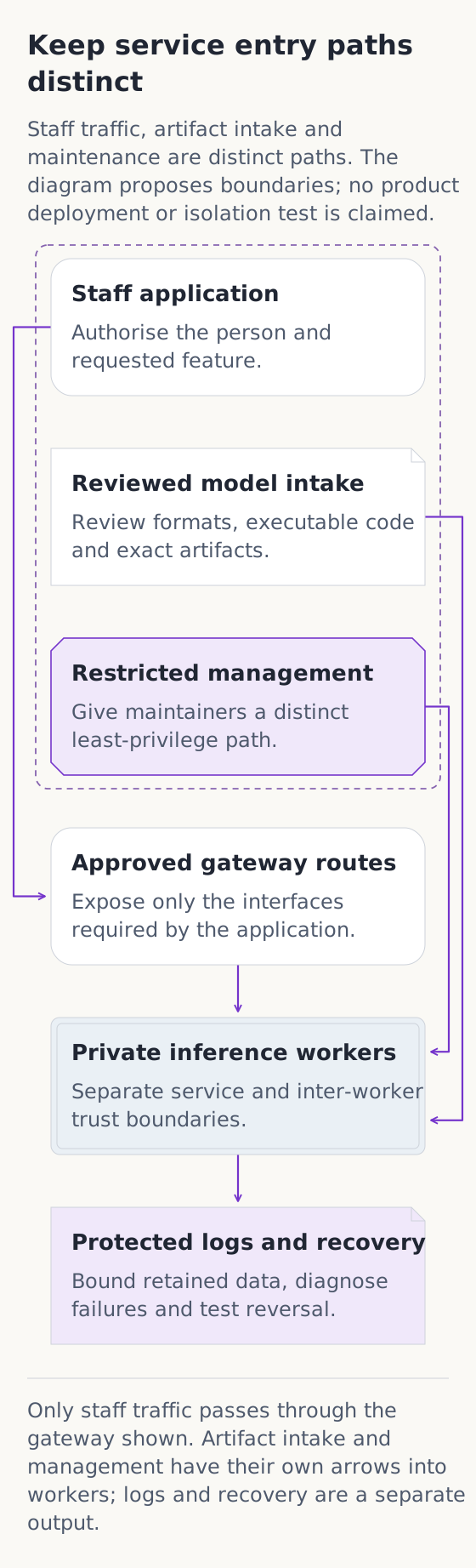
Original explanatory diagram: staff, artifact intake and maintenance reach the service through distinct paths with different authority.
[Open the complete evidence diagram](/assets/cyber-workflow-private-inference-service-20261015.svg)
Read the diagram
**Keep service entry paths distinct**
Staff traffic, artifact intake and maintenance are distinct paths. The diagram proposes boundaries; no product deployment or isolation test is claimed.
- **Staff application.** Authorise the person and requested feature.
- **Approved gateway routes.** Expose only the interfaces required by the application.
- **Private inference workers.** Separate service and inter-worker trust boundaries.
- **Reviewed model intake.** Review formats, executable code and exact artifacts.
- **Restricted management.** Give maintainers a distinct least-privilege path.
- **Protected logs and recovery.** Bound retained data, diagnose failures and test reversal.
Only staff traffic passes through the gateway shown. Artifact intake and management have their own arrows into workers; logs and recovery are a separate output.
How the connections work
- Staff application to Approved gateway routes: request; solid directed link. Proposed request relationship; no measured causal effect.
- Approved gateway routes to Private inference workers: inference; solid directed link. Proposed inference relationship; no measured causal effect.
- Reviewed model intake to Private inference workers: approved-artifact; solid directed link. Proposed approved-artifact relationship; no measured causal effect.
- Restricted management to Private inference workers: administration; solid directed link. Proposed administration relationship; no measured causal effect.
- Private inference workers to Protected logs and recovery: evidence; solid directed link. Proposed evidence relationship; no measured causal effect.
Keep the paths separate
Staff application, reviewed model intake and restricted management are independent entry paths, not a sequence.